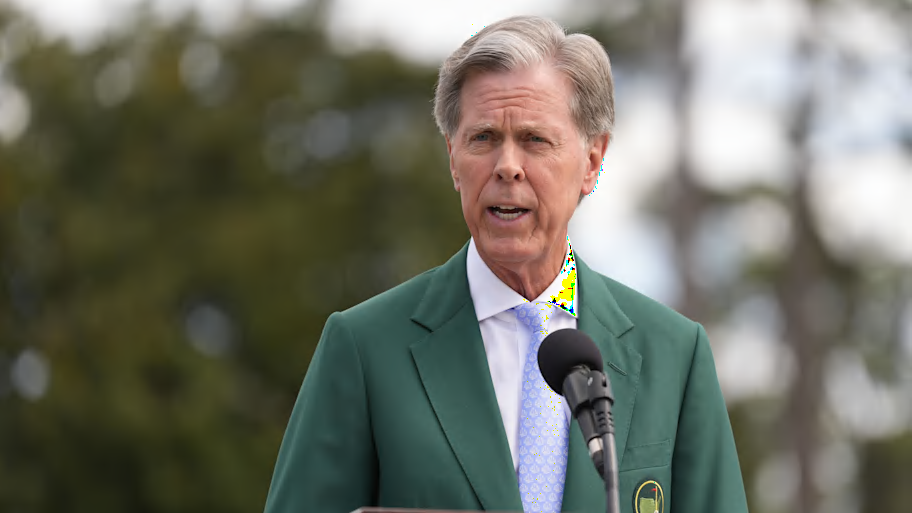
AUGUSTA — Fred Ridley made clear, in perhaps his most forceful manner to date, that he believes “failure is not an option” as it relates to a proposed golf ball rollback in the game.
As has been customary of the Augusta National and Masters chairman, along with his predecessors, Ridley said the Masters is in step with the game’s governing bodies—the United States Golf Association and the R&A—which have proposed a testing change that would see a rollback in distance for the game’s elite.
Why is this important?
Because both the PGA Tour and the PGA of America have expressed their doubts and have asked for a delay in the rollback to 2030 (it was supposed to be 2028 for elite players), thus setting up the possibility of different golf ball specifications at three of the four major championships.
“Regulation of the golf ball is not an attempt to turn back time or stifle progress,” Ridley said at his annual pre-Masters news conference at Augusta National Golf Club. “It is an effort to preserve the essence of what makes golf the great game that it is.”
The idea of scaling back the golf ball has been studied, discussed and debated for years. Called the Overall Distance Standard, the USGA and R&A announced a plan in 2023 that would see testing of golf balls at a higher speed of 125 mph, which would see a reduction in driving distance by 15 to 20 yards depending on the players at elite levels.
Such reductions would be minimal among average players because their swing speeds are not as fast.
PGA Tour players and equipment manufacturers have balked. Thus the ongoing debate.
“I’ve commented for the past several years on the subject of distance,” said Ridley, a former U.S. Amateur champion, USGA president and chairman at Augusta starting with the 2018 Masters. “We have been consistent in our support of the governing bodies in their effort to regulate the distance elite players are hitting the golf ball.
“I want to reemphasize that support and affirm our position as the USGA and R&A represent their collective obligation as custodians of the game.”
Ridley said his concerns are not just about Augusta National but golf overall.
“Until recent years golf has been a game of imagination, creativity, and variety,” Ridley said. “The game has become much more one-dimensional. As players drive the ball prodigious distances and routinely hit short irons into par-4s and even some par-5s, this issue goes beyond competitive impacts. Increased course lengths results in more time, more cost, and more environmental concerns.
“The data that has been shared with all stakeholders makes one thing clear: The impact to the recreational game will be immaterial. All of us in this room and millions of weekend golfers around the world will be hard-pressed to notice the effects of this change, and I do not believe our enjoyment of the game will be affected.
“As for professional golf, we hold firm in our belief that the greats of the game are defined not merely by how far they hit the ball, but their extraordinary skill in all aspects of the game. Their ability to shape shots, to take on risk and to execute under pressure is at the heart of championship golf and is best displayed through a full spectrum of shot-making opportunities.”
The original intent was to implement the rollback for elite players in 2028 with recreational players grandfathered in until 2030. Now it appears the governing bodies will wait to do so for all players in 2030.
Golf manufacturers have pushed back because they say average players do not want to see any decrease in how far they hit the ball, given the difficulty of the game.
And pro players, who have endorsement deals with those companies, as well as PGA of America officials, whose members sell equipment and balls, do not want to see growth stifled.
At the elite level, golf is unique because the various tours around the world typically do not make their own rules. They play be the rules set forth by the USGA and the R&A.
For example, there are different rules for football, whether it be the NFL or college. There are different rules in the NBA, compared to college basketball or the international game.
Golf has always been played by the same set of rules.
It is possible the governing bodies could implement a local rule—as it does in many instances—that would allow for tournaments to declare what type of ball they will use. But for players at the elite level, it could cause plenty of problems. If the majors are on board with a rolled-back ball but the PGA Tour is not, then players might be forced to get used to different types of golf balls.
PGA Tour CEO Brian Rolapp is still studying the issue
“I think this is clearly a complex issue,” PGA Tour CEO Brian Rolapp said last month at the Players Championship. “From what I can tell, it comes down to two questions: Is distance a problem, and should it be addressed, question number one. Question number two, does the current rule being proposed accomplish that.
“I’ve spoken with players; I’ve spoken with obviously the governing bodies; I’ve spoken with golf ball manufacturers; I’ve spoken to fans; I’ve spoken to everybody. What’s clear to me, everybody has an opinion, and those opinions are clearly not consistent on both those questions.
“As far as our players, I know they’re hitting prototypes. I hear all different things from them. Some are impacted, some that expected to be impacted are not impacted. So as far as the PGA Tour is concerned, we have not taken a position. We have not made our mind up of where this is, and when we get comfortable with the rule and the data, at that point we’ll make a decision.”
Ridley’s stance on this was firmer than in past years and it appeared he believes all sides need to work harder to come to an agreement.
“My feeling on this subject is failure's not an option,” Ridley said. “I think we need to continue to work together to come to some agreement.
“Tough issues like this require compromise, and I think there has been some compromise to date. There’s certainly commercial interests that are at play here, and we all know what those are, but at the same time, I think, if we can look at this from the standpoint ... it’s not the good old days. That’s not what we're trying to do.
“What we’re trying to do is to protect the integrity of what makes golf so great. I think I tried to articulate it in my comments, and that it's more than about just hitting prodigious drives.”
Ridley relayed a story about talking to Jackson Herrington, 19, who earned a spot in the Masters via a runner-up last year at the U.S. Amateur. Herrington plays college golf at Tennessee and noted that he was able to hit his tee shot past the fairway bunker on Augusta’s first hole as well as over the left fairway bunker on the fifth.
Those are carries of 325 yards. Ridley joked that “we can make changes, but there’s not much we can do to make changes on No. 1, unless we tear down the Eisenhower Cabin (located behind the 10th tee). And we’re not going to do that.
“We’ll make changes when we can, but I think it’s time to really address this issue. It’s been talked about for a long time.”
More Golf Coverage from Sports Illustrated
- Beginner’s Masters Betting Guide: How to Bet Rory McIlroy, Xander Schauffele and Min Woo Lee
- 2026 Masters Predictions: Our Picks to Win the Green Jacket
- Masters Weather Forecast Portends a Wildly Tough Version of Augusta National
- Keegan Bradley Was So Fired Up After Historic Hole-in-One at Masters Par 3 Contest
- 2026 Masters Hole in One Odds and History at Augusta National
This article was originally published on www.si.com as Masters Chairman Takes Strongest Stance Yet on Pro Golf’s Battle Over Distance.