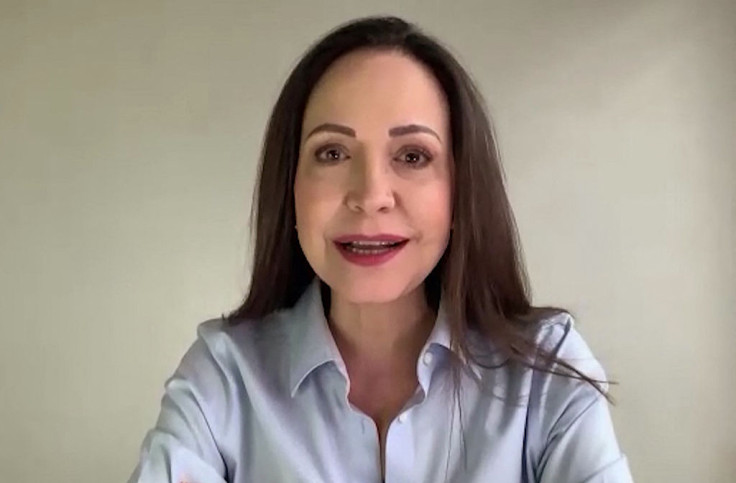
Venezuelan opposition leader María Corina Machado is preparing to return to her country, revive her political movement and press for a new presidential election, even as the Trump administration strengthens its support for interim President Delcy Rodríguez.
Machado outlined her plans during a rare interview with The Wall Street Journal from Panama City, where she has been living since leaving Venezuela in December 2025 to receive the Nobel Peace Prize in Norway.
"I cannot lead the process from abroad," Machado told the newspaper. "The moment to return has arrived."
The planned return would be Machado's most consequential political gamble since the disputed 2024 presidential election, when she was prohibited from running but mobilized a nationwide opposition network behind candidate Edmundo González Urrutia. The opposition said its collected tally sheets demonstrated that González defeated Nicolás Maduro, a result recognized by the United States and several other governments but rejected by Venezuelan authorities.
Machado has spent nine months outside Venezuela developing a strategy to reactivate that network and convert it into a national campaign for a democratic transition. Her return date remains uncertain, and she told the Journal that she is prepared to enter Venezuela by land, sea or air.
She previously attempted to return in June, following the earthquakes that devastated parts of Venezuela, but that effort was reportedly stopped while she was in transit. According to the Journal, some Trump administration officials opposed the trip because they feared her arrival could provoke unrest or disrupt Washington's arrangement with the interim government.
Machado's plan begins with a tour of Venezuela's 23 states, revisiting the cities and small communities that formed the backbone of the 2024 opposition campaign. She intends to meet with workers, mothers, farmers, business owners, students, teachers, doctors and other citizens to rebuild the grassroots organization that has weakened during her time abroad.
Her movement, Vente Venezuela, has already begun reactivating inside the country. Young activists associated with the organization held "Elecciones Ya," or "Elections Now," demonstrations in 16 states in June, according to the Journal. On Sunday, they posted an image that quickly became viral with the message "Set this date: July 24, 2027."
24 de julio 2027. pic.twitter.com/UZyhkWO2JZ
— Vente Venezuela (@VenteVenezuela) September 20, 2026
The first priority would be creating the conditions for a presidential election, including updating Venezuela's voter registry. Machado intends to run if an election is held.
Her team is also planning thousands of citizen assemblies across the country. Participants would submit ideas using QR codes and other digital tools, while artificial intelligence would help organize the proposals into priorities for a national transition plan.
Machado's advisers are simultaneously identifying potential officials capable of assuming responsibilities in education, healthcare, the judiciary, the military, and the economy if political power changes hands.
The opposition leader has also contacted foreign investors and encouraged them to consider opportunities in Venezuela. Executives have reportedly approached her team seeking assurances that agreements signed with the Rodríguez administration would remain valid under a future democratic government. Machado has not asked them to wait for a political transition before investing.
Her plans place her on a collision course with Rodríguez, the former Maduro vice president who became Venezuela's interim president after the U.S. military captured and removed Maduro in January.
President Donald Trump has increasingly embraced Rodríguez's administration. Washington and Caracas have reached a sweeping energy agreement giving the United States access to Venezuela's oil sector, while the Trump administration has shown little urgency in demanding immediate presidential elections.
Trump is also scheduled to meet Rodríguez in New York during the United Nations General Assembly. It will be their first in-person meeting since Maduro's removal and another demonstration of Washington's decision to treat Rodríguez as Venezuela's current head of state. Reuters reported that the encounter will take place during a reception hosted by Trump.
Machado told the Journal that her presence in Venezuela should be viewed as a contribution to the transition rather than an attempt to destabilize it. However, members of the Trump administration reportedly remain divided over whether she could successfully govern and maintain control of institutions still dominated by officials connected to the former Maduro system, particularly the armed forces.
Some U.S. officials believe Machado would be the favorite in a free election, especially if millions of Venezuelans abroad were permitted to vote. Others appear to prefer a gradual transition under Rodríguez, particularly if her administration reduces blackouts, improves salaries and attracts foreign investment.
Machado has been excluded from U.S.-backed negotiations between the interim administration and representatives of Venezuela's opposition-controlled 2015 National Assembly. Her prolonged absence has also generated concern among allies who fear that her movement could lose momentum while Rodríguez consolidates power.
Returning carries significant personal risk. Venezuela's security institutions remain largely hostile to Machado, and Rodríguez has warned that she will have to answer for supporting the U.S. operation that removed Maduro. Other government officials have publicly suggested that they have a "surprise" waiting for her.
Nevertheless, Machado says Venezuela's democratic cause cannot be directed indefinitely from a borrowed apartment in Panama. The central question is no longer whether she wants to return, but whether Washington and Caracas will permit her to enter, campaign, and challenge the political arrangement they are building without her.