Get all your news in one place.
100's of premium titles.
One app.
Start reading
Latin Times
Latin Times
Politics

Marco Rubio Went Before a Venezuelan Audience to Defend Delcy Rodríguez and Alejandro Betancourt But The Questions Got Uncomfortable

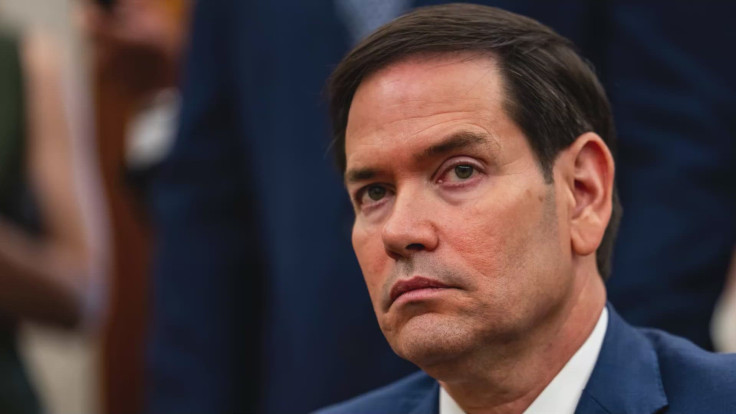
Secretary of State Marco Rubio turned to a respected familiar voice to Venezuelans this week as the Trump administration faced mounting criticism over its cooperation with interim Venezuelan leader Delcy Rodríguez and its decision to place controversial businessman Alejandro Betancourt at the center of a historic oil agreement.

In a rare, extended Spanish-language interview with Venezuelan journalist Sergio Novelli, Rubio attempted to reassure an audience that has long viewed him as one of Washington's most forceful opponents of chavismo. The conversation covered the deportations of Venezuelans, the oil deal, democratic elections, opposition leader María Corina Machado, and the selection of Betancourt's company as the United States' private partner.

But the timing and format were almost as significant as Rubio's answers.

Rather than granting the interview to a major American network, Rubio spoke directly to Novelli, a veteran Venezuelan broadcaster based in Miami whose independent digital platforms reach a large diaspora audience. Novelli spent years at RCTV and Globovisión before moving to South Florida, where he has continued producing Al Día con Sergio and other news programming.

The interview quickly attracted hundreds of thousands of views, reflecting the anxiety created by Washington's increasingly close working relationship with Rodríguez, who served as Nicolás Maduro's vice president before becoming interim leader following the U.S. operation that removed Maduro in January.

Rubio's central argument was that the oil agreement should not be interpreted as a political endorsement of Rodríguez.

"This really is not an agreement with the interim government," Rubio told Novelli. He characterized it instead as an agreement between the United States and North American Blue Energy Partners, or NABEP, the private company led by Betancourt.

That distinction is central to the administration's public defense. It is also more complicated than Rubio's formulation suggests.

The Venezuelan government granted NABEP rights to operate 17 oil fields, while the country's National Assembly approved the arrangement Tuesday. Under the reported structure, the fields contain approximately 65 billion barrels of proven reserves, representing about one-fifth of Venezuela's total. NABEP would receive concessions lasting as long as 100 years.

The U.S. government would hold a 35% interest in the venture through the Pentagon's Office of Strategic Capital. Washington would also have the right to purchase 20% of production at cost, while American citizens would control a majority of the company's board and the U.S. government would retain veto power over its members, according to details reported by the Associated Press.

In other words, the arrangement may involve a private company, but it depends on concessions authorized by the Rodríguez administration and includes direct U.S. government participation. That makes it an unusual public-private geopolitical partnership, not a conventional transaction between two independent businesses.

Rubio said most of the 17 fields had previously been controlled by Russian or Chinese interests and that many were underused. Washington's support, he argued, would allow NABEP to attract private investment, increase production, and create a more transparent revenue system.

The secretary of state also presented the agreement as one stage in a broader transition rather than a replacement for democratic change.

"There is much more to be done, including the issues of democracy and elections," Rubio said.

Rubio said Venezuela needs both a democratically elected government and a functioning economy capable of directing investment and tax revenue toward the public instead of politically connected individuals. He maintained that elections should occur as soon as the necessary conditions can be created.

He also told Novelli that María Corina Machado could return to Venezuela "whenever she wants" and should face no retaliation. The statement appeared intended to counter fears that Washington's dealings with Rodríguez have pushed Machado and Venezuela's democratic opposition to the margins.

The most delicate portion of the interview came when Novelli asked why the administration had selected Betancourt.

Rubio described NABEP as Venezuela's largest private producer after Chevron and said U.S. authorities had reviewed Betancourt's background.

"We have checked with all the authorities," Rubio said. "There was no investigation within our system against him."

That statement was carefully framed. Betancourt has not been criminally charged in the United States, Switzerland, Spain or Venezuela. However, the absence of a current U.S. investigation does not erase the scrutiny he has faced.

Betancourt became wealthy through Derwick Associates, a company that received power-generation contracts during Hugo Chávez's government. He and his associates became known in Venezuela as part of the "bolichicos," a group of young business figures accused by critics of profiting from opaque state contracts during the country's electricity crisis. Betancourt has denied wrongdoing.

A 2021 Reuters investigation reported that federal prosecutors in New York had examined whether Derwick laundered money or paid bribes connected to power contracts. Reuters also reported that Betancourt had been considered a target in a separate Florida investigation involving an alleged scheme to launder more than $1 billion connected to former Venezuelan officials.

Betancourt was never charged in either case.

More recently, The Washington Post reported that he had faced investigations in Switzerland, Spain and the United States over alleged money laundering. According to the newspaper, he was arrested twice in Britain in 2025 while authorities considered European extradition requests, but he was not ultimately charged.

Rubio offered another reason for viewing Betancourt as a useful partner: his past support for Juan Guaidó's opposition movement.

The secretary said Betancourt "helped a lot" during Guaidó's interim presidency in 2019 and suffered politically after Maduro learned of that support. Rubio presented that history as evidence that Betancourt had previously assisted forces aligned with U.S. policy.

That relationship also carries controversy. Reuters reported in 2020 that Betancourt told Rudy Giuliani, then Trump's personal attorney, that he had secretly financed Guaidó's efforts. Giuliani later urged Justice Department officials to show Betancourt leniency in the Florida investigation, according to people familiar with the matter. Betancourt's support for the opposition therefore became entangled with attempts to resolve his own legal exposure.

Here is the full interview

Sign up to read this article
Read news from 100's of titles, curated specifically for you.
Already a member? Sign in here
Related Stories
Top stories on inkl right now
One subscription that gives you access to news from hundreds of sites
Already a member? Sign in here
Our Picks
Fourteen days free
Download the app
One app. One membership.
100+ trusted global sources.