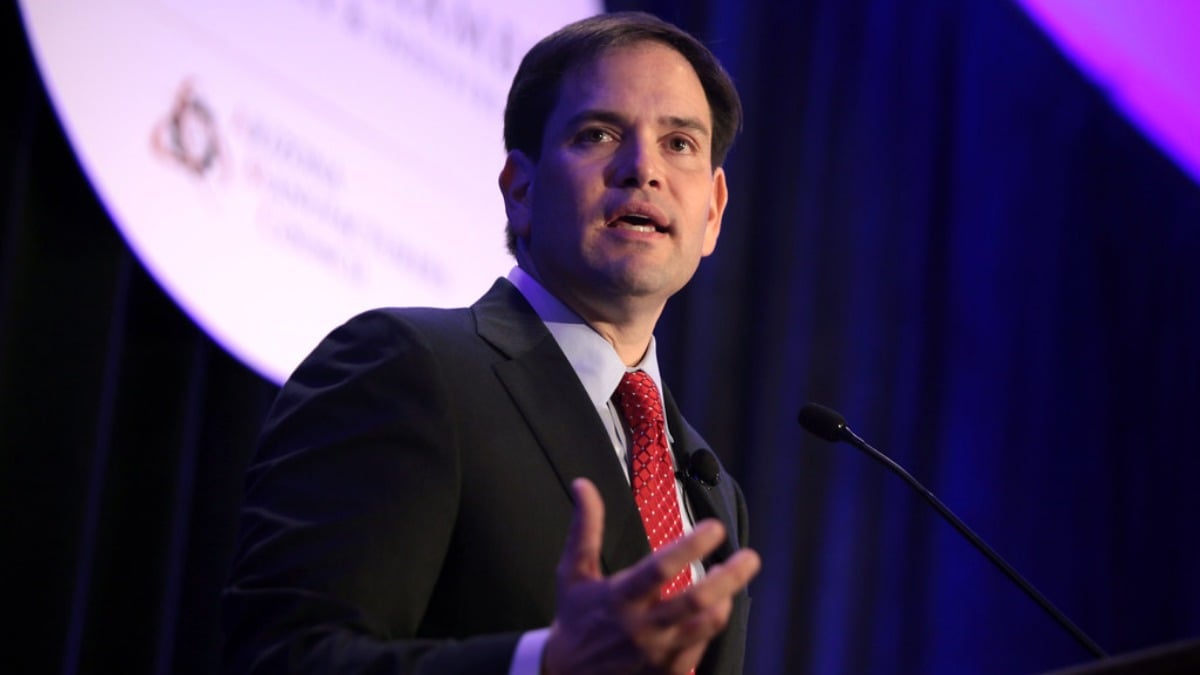
Secretary of State Marco Rubio has issued a warning that Iran’s threats to control the Strait of Hormuz “is not going to be allowed to happen,” promising a resolution in “weeks, not months.” In a clip shared on X by the Department of State, he emphasized that Iran’s threats about creating a “tolling system” to control the international waterway “will never be allowed to happen.”
Rubio made these comments during an interview on Good Morning America, where he discussed the current state of affairs with Iran. According to Rubio, the president has “a number of options available to him” to prevent Iran from seizing control of the crucial shipping lane.
The Hill reported that a few days before the GMA interview, Rubio had talked to foreign ministers of the Group of Seven nations in Cernay-la-Ville, France, about the same potential post-conflict challenge. That the primary challenge after the US met their operation objectives, the primary challenge was Iran’s threat to set up a tolling system in the Strait.
Trump clearly thought that he had a bigger advantage
Rubio stressed that this is “illegal, it’s unacceptable, it’s dangerous for the world.” He added that the U.S. is ready to be part of a plan to confront this but expects allies, especially those in Asia, to “contribute greatly to that effort.”
Rubio called the last regime “lunatics” and “insane religious zealots” who, in his view, “can never be allowed to possess a nuclear weapon because they have an apocalyptic vision of the future.” He directly linked the Iranian regime to every terrorist group in the region, including the Houthis and Hamas, stating that “all the destabilization in this region tracks directly back to the Iranian regime.”
SECRETARY RUBIO: Iran is making threats about controlling the Strait of Hormuz and creating a tolling system. That’s not going to be allowed to happen.
— Department of State (@StateDept) March 30, 2026
There is a way forward here to achieve our objectives in a matter of weeks, not months. pic.twitter.com/YG2BdBPHAc
Thus, Iran, with thousands more weapons, was an “unacceptable risk.” He noted that the core objectives of the military operation were being met on or ahead of schedule. These include the destruction of Iran’s air force and navy, a significant reduction in their missile launchers, and the wiping out of their capability to produce new missiles and drones. Now, Iran is “at its weakest point.”
Recently in a post on Truth Social, Trump warned that if ongoing discussions with a “new and more reasonable regime” in Iran don’t yield results, the United States is prepared to “blow up and completely obliterate” the purposely untouched, “electric generating plants, all their oil wells and Kharg Island and possibly all desalinization plants.”
Despite that threat, Rubio insisted that the president preferred diplomacy.He expressed hope that “new people now in charge” would have “have a more reasonable vision of the future.” He also cautioned that the U.S. must be prepared for the “probability that that is not the case.”
As the conflict progresses into its fifth week, the diplomatic landscape remains tense. Despite promises of no boots on the ground, the Pentagon has plans for ground operations. As a result of the war, current polls also show that the vast majority of people don’t approve of the war.