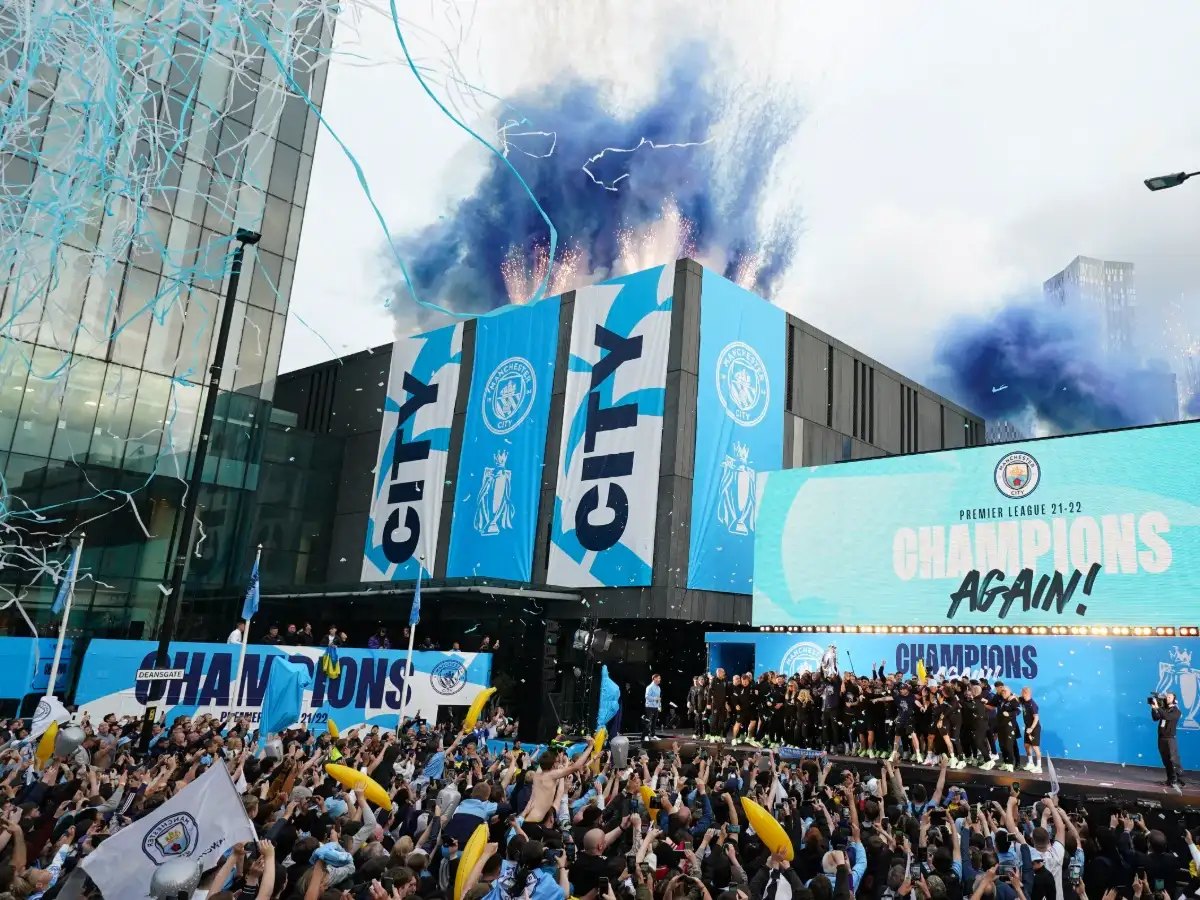
Manchester City has been found guilty of serious breaches of the Premier League's financial rules over a nine-season period, in a landmark verdict that could lead to severe sanctions against one of English football's most successful clubs.
The Premier League confirmed on Tuesday that an independent commission had found City guilty of all charges relating to serious breaches of its financial rules, as well as the majority of charges concerning the club's failure to cooperate with the league's investigation.

Also Read: Manchester City vow to prove their innocence after being found guilty of financial charges
The sanctions will be decided at a separate hearing by the independent commission and could potentially include a significant points deduction or even expulsion from the Premier League.
The case, one of the biggest financial scandals in English football, was initiated by the Premier League more than three years ago after allegations first emerged in 2018 following leaked club emails and documents.
Premier League chief executive Richard Masters said the commission's verdict "details how the club systematically broke Premier League rules for nearly a decade."
City, which currently leads the Premier League and has dominated English football over the past 15 years, said it was "disappointed and surprised" by the findings. The club maintained that it was "innocent of the accusations made by the Premier League" and said it would be "relentless" in pursuing avenues to appeal.
The club has until Friday to lodge an appeal.
What was Manchester City accused of?
The charges relate to alleged financial violations between 2009 and 2018, a period in which City transformed from a club operating in the shadow of Manchester United into one of the world's most powerful football teams.
The allegations included failing to provide accurate financial information, submitting inflated figures for sponsorship agreements involving Abu Dhabi-based partners and concealing payments that supplemented the salaries of managers and players.
The club was also accused of breaching financial regulations introduced by the Premier League and UEFA, European football's governing body, to ensure clubs remain financially sustainable and do not spend beyond their means.
City faced additional charges relating to its conduct during the Premier League's investigation between 2018 and 2023.
In its statement, the Premier League said City had "arranged sham' contracts (which misrepresented the true agreement between the parties) with a number of its commercial partners, as well as relying on sham' agreements with others, to artificially inflate the club's revenues and reduce its costs."
The league also said the club "filed misstated accounts and concealed the true state of its finances from its auditors and football regulators."
According to the Premier League, the schemes were designed to "artificially inflate the club's revenues, and reduce its costs, by more than £900 million ($1.19 billion) during the affected period, to appear to comply with financial rules."
The findings could have significant implications for City's remarkable rise under Abu Dhabi ownership, which has funded a succession of expensive, star-studded squads and helped the club win multiple Premier League titles and the Champions League.
City vows to fight verdict
City has consistently denied wrongdoing throughout the case.
When the Premier League brought the charges in 2023, the club said there was a "comprehensive body of irrefutable evidence that exists in support of its position."
Even before Tuesday's verdict, City chairman Khaldoon Al Mubarak said there remained a "confidence and intent in proving the club's innocence."
The club's appeal could potentially reach the High Court in London if City argues that the process was unfair or lacked impartiality.
The verdict is also likely to have wider consequences for English football. Rival clubs could pursue legal action seeking compensation if they believe they suffered financial or sporting losses because of City's alleged conduct.
There are also questions about the future of the club's star players, including Erling Haaland and Rayan Cherki, should severe sporting sanctions eventually be imposed.
The verdict could also put renewed focus on the future of Sheikh Mansour bin Zayed Al Nahyan, the Abu Dhabi royal family member and UAE deputy prime minister who bought City in 2008. Under his ownership, City has developed into the centrepiece of the City Football Group, which also owns clubs including New York City FC and Melbourne City.
For now, however, the most immediate issue is the sanctions hearing. The Premier League said those penalties will be determined separately by the independent commission, while City's appeal process could determine whether Tuesday's findings ultimately stand.