
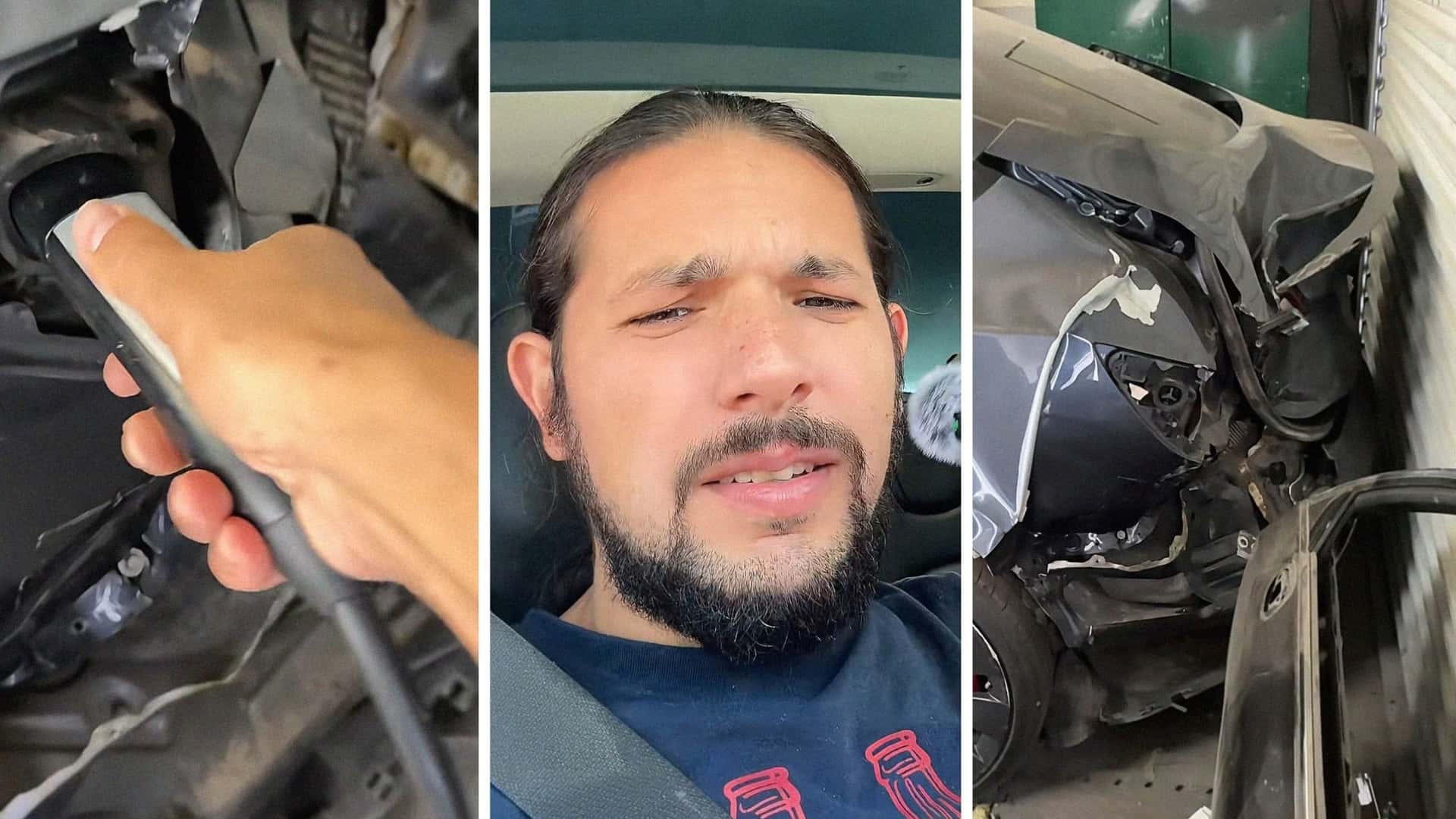
A man attempted to charge a Tesla Model 3 after it was involved in a grisly crash. But is that a good idea?
Dr. Auto (@itsmedrauto) describes himself as an “advocate” for Tesla on social media. His post about the all-but-demolished Model 3 had some folks concerned. Primarily because he decided to charge the car.
“On today’s episode: will it take a charge?” Dr. Auto asks, grabbing a Tesla charger cable. The EV’s exposed charger port exterior cover was nearly destroyed in the wreckage. Yet when h*He lifts the cover, remarkably, a light blinks, indicating the Tesla is ready charge.
Then Dr. Auto plugs the NACS cable into the destroyed Tesla. It makes a noise that indicates the cable is properly plugged in and charging. The infotainment display reads "starting to charge" and shows how long it will take to charge.
“And it’s charging,” he says.
It appears as though the accident didn’t impede the Tesla’s ability to juice up its massive power pack.
What Will Happen To The Wrecked Tesla?
While the Tesla does appear to be charging, that doesn't mean it's road-worthy. The infotainment center has multiple warning lights: a low tire-pressure icon, a message indicating the Model 3’s left front turn signal is malfunctioning.
The image of the car on the screen shows the Tesla’s frunk is open. That's an understatement. Dr. Auto shows in his video that the frunk cover is no longer connected to the vehicle.
Dr. Auto explains that the Model 3 will ultimately “be parted out.”
Gallery: 2024 Tesla Model 3 (Highland)
Should You Charge A Tesla After A Crash?
Just because you can plug a Tesla in after an accident doesn't mean you should. In fact, it can be dangerous.
One commenter suggested as much. “I wouldn’t do that considering the state of the car,” they wrote. While several expressed confidence in Dr. Auto’s capabilities, there is reason for concern.
There have been cases of electric cars catching fire during or after accidents, sometimes days later. EV.com reports that these batteries “can reignite after a crash” due to a “chain reaction … called thermal runaway." Collisions can cause short circuits in battery packs, meaning that a cell “can continue heating until it affects a neighboring cell," EV.com adds.
The New Hampshire Union Leader states that “electric car batteries can catch fire days after an accident.” In a 2019 article, it noted that a firefighters struggled to put out a Model S after a crash; the cells inside of its battery kept catching fire time and again.
The National Highway Traffic Safety Administration has specific guidelines and best practices for dealing with electric vehicles after a collision. NHTSA warns against storing crashed EVs and adds that “post-incident” vehicles with lithium-ion power packs must be kept away from other cars.
“Do not store a severely damaged vehicle with a lithium-ion battery inside a structure or within 50 feet of any structure or vehicle," it states.
Motor1 has reached out to Dr. Auto via TikTok direct message for further comment. We'll update this if he responds.