Get all your news in one place.
100's of premium titles.
One app.
Start reading
The Conversation
The Conversation
Niranjan Shivaram, Assistant Professor of Physics and Astronomy, Purdue University

Making 'movies' at the attosecond scale helps researchers better understand electrons − and could one day lead to super-fast electronics

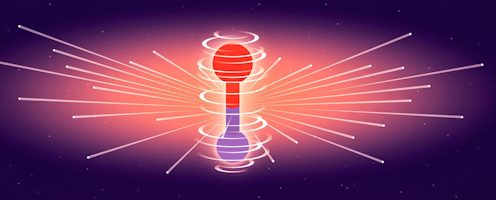
Attosecond light pulses help researchers understand the movement of electrons. Greg Stewart/SLAC National Accelerator Laboratory, CC BY-SA

Electrons moving around in a molecule might not seem like the plot of an interesting movie. But a group of scientists will receive the 2023 Nobel Prize in physics for research that essentially follows the movement of electrons using ultrafast laser pulses, like capturing frames in a video camera.

However, electrons, which partly make up atoms and form the glue that bonds atoms in molecules together, don’t move around on the same time scale people do. They’re much faster. So, the tools that physicists like me use to capture their motion have to be really fast – attosecond-scale fast.

Sign up to read this article
Read news from 100's of titles, curated specifically for you.
Already a member? Sign in here
Related Stories
Top stories on inkl right now
One subscription that gives you access to news from hundreds of sites
Already a member? Sign in here
Our Picks
Fourteen days free
Download the app
One app. One membership.
100+ trusted global sources.