Get all your news in one place.
100's of premium titles.
One app.
Start reading
Radio France Internationale
World
RFI

Macron urges world to resist ‘law of the jungle’ in final UN address

French President Emmanuel Macron addresses the 81st United Nations General Assembly in New York on 22 September 2026.
French President Emmanuel Macron addresses the 81st United Nations General Assembly in New York on 22 September 2026. REUTERS - Brendan McDermid

French President Emmanuel Macron urged countries to resist a return to the “law of the jungle” in his final UN General Assembly address as France's leader – defending international rules as he called for action on Gaza and Ukraine, climate change, artificial intelligence and the effects of social media on children.

“The question put to us, in very simple terms, is whether we want to live in this state of nature, with a kind of return to the law of the jungle, or in a civilised international society,” Macron told the assembly on Tuesday.
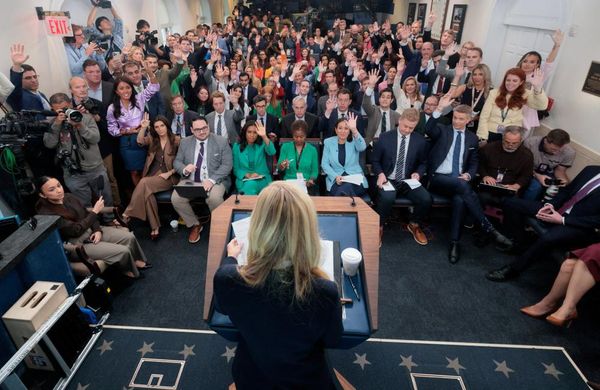
His appeal came at the opening of the UN’s annual gathering in New York, where wars in the Middle East and Ukraine are dominating discussions alongside growing concerns over climate change and AI.

For Macron, those crises also exposed what he described as double standards that divided countries and undermined the international order.

“My message is to stand firm. Do not yield to the situation which is developing ... The rhetoric of defeat that is giving way to abuse of power by empires, threatening the sovereignty of some nations,” he said.

Wars and sovereignty

Ukraine was one of the most immediate tests. Macron, a long-standing supporter of Kyiv, had raised the country’s case during a meeting with US President Donald Trump on Monday.

At the UN, he proposed a moratorium on Russian and Ukrainian strikes against civilian and energy infrastructure.

“We’ve seen the destruction of civilian infrastructure, human rights violations. It’s a new era of barbaric acts,” he said.

A separate moratorium on attacks on commercial shipping in the Black Sea would help free up grain exports and protect food security.

Gaza brought an even sharper criticism of the international response.

“What is our credibility worth if we remain inactive on Gaza? Some claim that peace has been achieved, but this has not opened up humanitarian deliveries. It is a spectacle that shames us all,” Macron said.

His criticism extended to Israeli actions in the West Bank, where he said violations were taking place every day and argued that “Hamas has never struck in the West Bank”.

That claim drew a sharp rebuke from Israel.

“The grotesque absurdity of Emmanuel Macron’s statement is staggering,” the office of Israeli Prime Minister Benjamin Netanyahu said.

Netanyahu’s office said Hamas carried out attacks against Israelis in the West Bank, pointing to the fatal shooting of Israeli-French citizen Netanel Shukrun there on Sunday.

Macron also called for sovereignty for Palestinians, Lebanon and Syria.

Those who claimed Israel’s security depended on violating the sovereignty of its neighbours were making a “disastrous mistake” that weakened that security, he said.

Turning to the UN itself, Macron backed a Franco-Mexican initiative to restrict the use of the Security Council veto in cases of mass atrocities. The proposal has the support of 128 member states, he said.

“Our duty is not to yield,” he said. “There is no peace without justice.”

Africa was another part of that push, with France seeking a stronger peace and security role for the African Union and regional organisations.

Climate, AI and children

The defence of collective action went beyond war. On climate and biodiversity, Macron urged countries not to give in to fatalism or challenges to science.

“We must defend science,” he said.

Artificial intelligence provided a direct contrast with Trump, who had rejected global AI regulation in his own address hours earlier. Macron instead proposed an open-source advanced AI model that would leave countries less dependent on China or the United States.

“We should not depend on somebody else,” he said.

Social media was another concern, with Macron citing declining learning ability, mental health problems and obesity among young people.

“We have waited too long to protect our children and adolescents from social media. Everywhere in our societies, we see the consequences,” he said.

The issue will return at the Paris Peace Forum on 10 and 11 November, when governments, organisations and other participants are due to discuss stronger protections for children.

(with newswires)

Sign up to read this article
Read news from 100's of titles, curated specifically for you.
Already a member? Sign in here
Related Stories
Top stories on inkl right now
One subscription that gives you access to news from hundreds of sites
Already a member? Sign in here
Our Picks
Fourteen days free
Download the app
One app. One membership.
100+ trusted global sources.