Get all your news in one place.
100's of premium titles.
One app.
Start reading
The Conversation
The Conversation
Grant Duncan, Research Associate, Public Policy Institute, University of Auckland, Waipapa Taumata Rau

Luxon’s leadership on the line – again. Neither National nor Labour stand to benefit

Hagen Hopkins/Getty Images

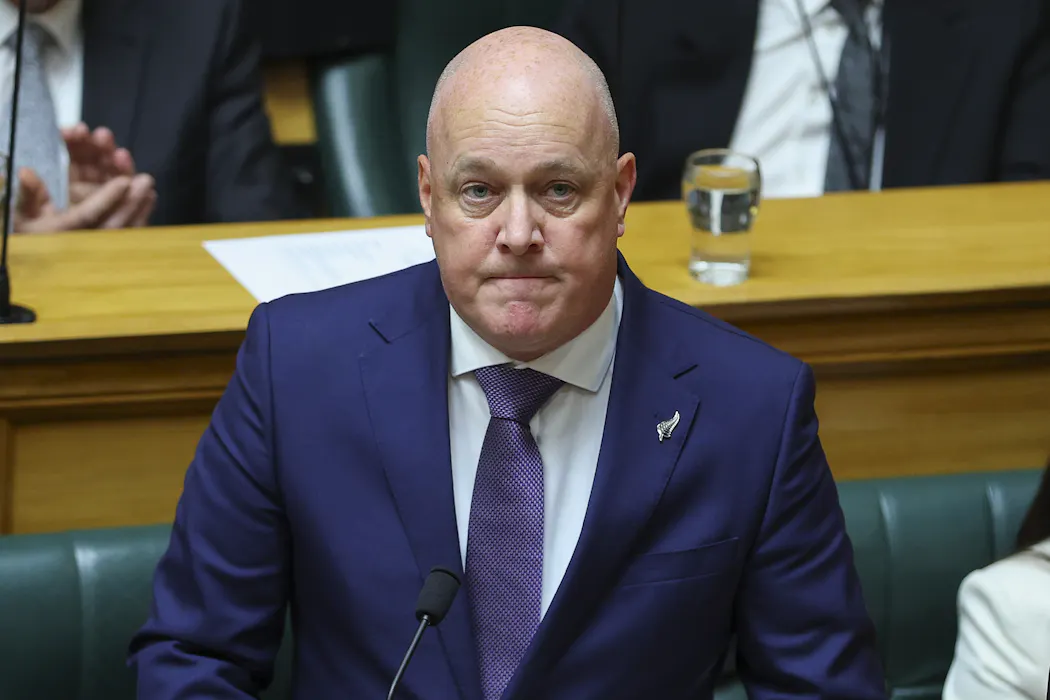
Whatever happens at tomorrow morning’s urgent caucus meeting to address speculation about his leadership, Prime Minister Christopher Luxon has had a very bad few days already.

It began with the National Party leader apologising for chastising a business gathering about dependency on government. He then took his caucus colleagues by surprise with an impromptu “promise” to hold a referendum on the electoral system.

His mishaps have earned comparisons with the fictional David Brent of The Office, and media speculation about a leadership spill ramped up yet again.

Luxon had already put his own leadership to a caucus vote in April. The problem – then and now – is that the party has no stellar alternative leader waiting in the wings, unlike Labour in 2017 when it elevated deputy Jacinda Ardern to the top spot within seven weeks of polling day.

Strategically, it can make more sense for an up-and-coming politician to let their leader take the fall at an election, then make their move to become party leader. That way they get to enjoy a spell in opposition to consolidate and differentiate themselves from an incumbent prime minister.

Ardern’s rise in 2017 was a stunning last-minute gamble that paid off. But haste didn’t serve her career well in the long run. Ideally, contenders within the National caucus such as Chris Bishop and Erica Stanford would be timing a run more carefully, given the Ardern example.

A change of leader at this late stage is a desperate measure – and the consequences hard to predict. What worked for Labour in 2017 may not work again for either major party.

Culture war casualties

Labour should be benefiting from National’s blunders, but is not faring much better. Leader Chris Hipkins is doing about as poorly as Luxon in preferred-prime-minister polls.

Worst of all for Labour, two recent polls have placed the party below 28% of the party vote, lagging behind National.

When National went below 30%, Luxon’s leadership was on the line. Hipkins has deflected criticism, speaking of a “rogue poll” produced by a “right-wing lobby group”.

The problem is, Hipkins has not “built new stocks of leadership capital” since my previous assessment of the two leaders in March 2025. Moreover, there’s an underlying controversy that may sink Hipkins’ bid to return as prime minister.

In other countries, the big issue eroding support for traditional centre-left (and centre-right) parties is immigration. That’s becoming a bigger concern in New Zealand too, fuelled mainly by the NZ First party. But New Zealand is better able to control immigration because of its geographic isolation.

The really divisive culture war issue in domestic politics is Indigenous rights, Māori sovereignty and te Tiriti of Waitangi. On this, Hipkins and Luxon are both nervous.

Coalition vulnerabilities

In the United Kingdom, one of the main reasons given by those defecting from Labour to the right has been “immigration”. In New Zealand, one has to look at “Treaty-based co-governance” as a reason for Labour to lose supporters.

Hipkins knows this and was silent on the issue during his recent speech to the Labour Party faithful.

He can’t risk angering his pro-Treaty base by walking back from policies of the former Labour majority government. And he can’t risk alienating potential Labour voters who support Treaty settlements but aren’t comfortable with wider co-governance policies.

There is nowhere to hide, however, as these matters are bound to come up in election debates. And both leaders are vulnerable because of their likely coalition partners.

Luxon’s leadership was compromised, for example, by the ACT Party insisting on introducing a socially divisive (and ultimately doomed) Treaty Principles Bill in 2024. More recently, he was sideswiped by NZ First leader Winston Peters telling a Chinese-born Green MP to “go back to your own country”.

For his part, Hipkins will face pressure from the Greens and Te Pati Māori – if they form a coalition government – to reintroduce a co-governance agenda or push even further towards tino rangatiratanga (self-determination) without first building majority public support.

Febrile speculation

Neither Luxon nor Hipkins has been highly popular as a leader of their country. In both cases, it looks like their leadership capital peaked too early.

For Luxon, that came while still in opposition in early 2022, after he’d been elected to lead his caucus in late 2021. For Hipkins, it was after he took over from Ardern as prime minister in January 2023, and then responded to a major weather disaster.

Voters know both leaders well enough now. They saw them compete once before in head-to-head debates before the 2023 election, and they’ve had plenty of time to “price in” their unimpressive leadership skills.

A change of leader in either of the major parties is unlikely to pull a rabbit out of the hat at this late stage. Neither has an obvious alternative contender for prime minister.

Still, the political media (and plenty of citizens) enjoy a bit of febrile speculation. Backbench MPs whose careers are at stake if their party polls badly will be inclined to grumble. Journalists will listen. But voters needn’t (and probably won’t) be moved by it.

This article was originally published on The Conversation. Read the original article.

Sign up to read this article
Read news from 100's of titles, curated specifically for you.
Already a member? Sign in here
Related Stories
Top stories on inkl right now
One subscription that gives you access to news from hundreds of sites
Already a member? Sign in here
Our Picks
Fourteen days free
Download the app
One app. One membership.
100+ trusted global sources.