Get all your news in one place.
100's of premium titles.
One app.
Start reading
The Economic Times
The Economic Times
Trending Desk

Lunar eclipse August 2026: When will Blood Moon be visible, timings, how to watch

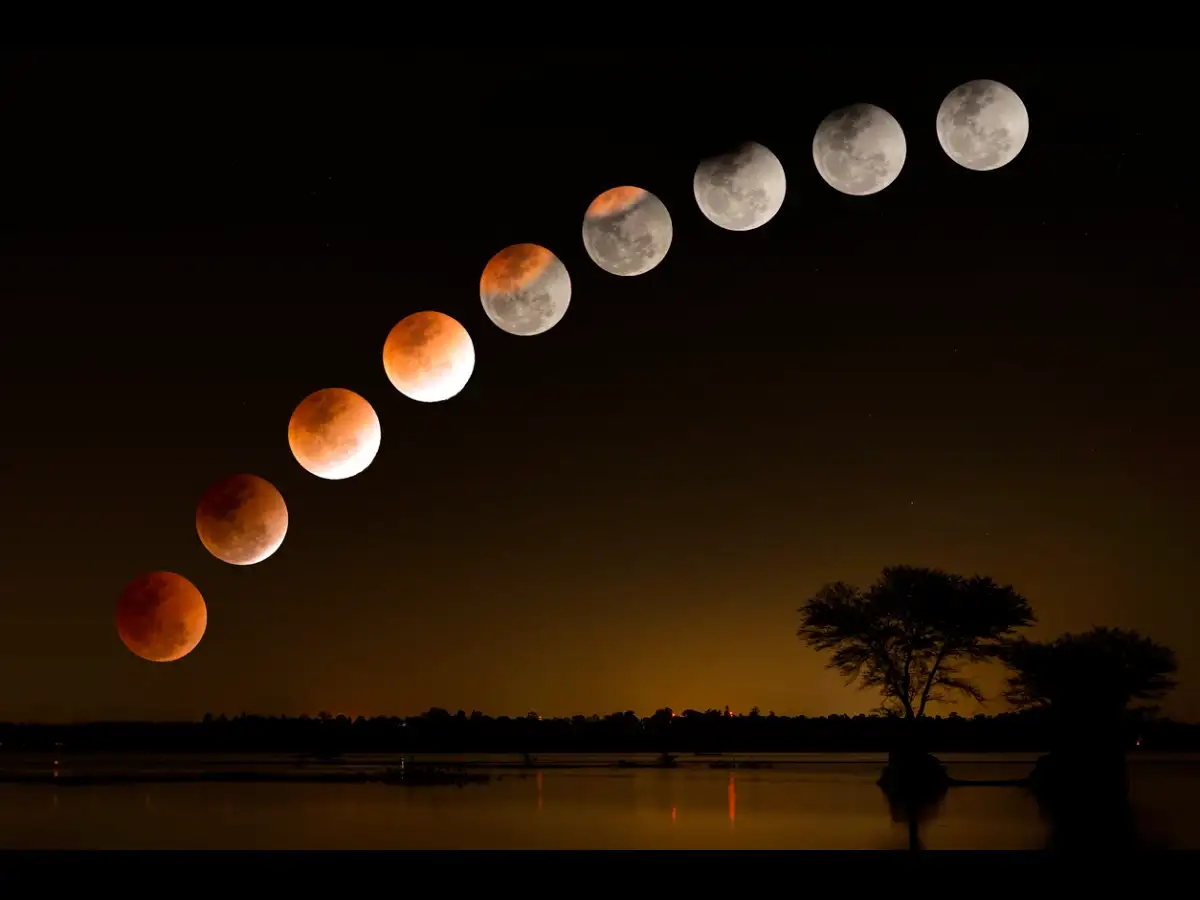
A partial lunar eclipse is set to take place on August 27-28, with observers across North America, South America, Africa and Europe expected to see much of the Moon darkened by Earth’s shadow. During the event, about 96% of the visible lunar surface will move into the planet’s darkest shadow, while a thin section will remain exposed to direct sunlight.

The eclipse will occur when Earth moves between the Sun and Moon during the full Moon phase, creating an alignment in which the planet blocks part of the sunlight reaching the lunar surface.

When will the August lunar eclipse begin?

The first stage of the partial eclipse will begin at 10:33 p.m. EDT on August 27, corresponding to 0233 GMT on August 28, according to TimeandDate.com.

At that point, Earth’s umbra, the innermost and darkest section of its shadow, will begin moving across the Moon. The shadow will then spread further over the Moon’s cratered surface before reaching maximum eclipse at 12:12 a.m. EDT on August 28, or 0412 GMT.

The precise timing will vary based on where an observer is located.

Why can the Moon turn reddish?

As the eclipse progresses, the portion of the Moon covered by Earth’s shadow may take on a reddish-orange tint.

This happens because some sunlight passes through Earth’s atmosphere and is bent towards the lunar surface. The phenomenon is commonly associated with the term “Blood Moon”, although the term is more frequently used for a total lunar eclipse.

During a lunar eclipse, the different phases occur at the same moment for observers on the night side of Earth who can see the Moon. However, local clock times differ depending on geographical location.

Will the August 2026 lunar eclipse be visible in India?

The August 27-28, 2026 partial lunar eclipse will not be visible from India. Indian skywatchers will therefore not be able to observe the eclipse from the country.

Eclipse timings differ by location

For viewers on the US West Coast, including California, maximum eclipse will occur shortly after midnight local time during the night spanning August 27 and 28.

In the UK, the peak will occur shortly before sunrise on August 28, when the Moon will be positioned low towards the southwestern horizon.

Observers are advised to check a reliable eclipse-timing service such as TimeAndDate for the exact schedule applicable to their location.

Do you need special equipment?

Unlike a solar eclipse, watching a lunar eclipse does not require special eye protection. Looking at an eclipsed Moon does not carry the same eye-safety risk associated with viewing the Sun directly during a solar eclipse.

However, binoculars or a telescope can provide a closer view of Earth’s shadow moving across the lunar surface.

Why is 2026 is witnessing so many Lunar eclipses

The August 27-28 partial lunar eclipse is the fourth and final eclipse of 2026. The year began with an annular solar eclipse on February 17, followed by a total lunar eclipse on March 3 and a total solar eclipse on August 12.

The August eclipses are particularly closely linked. The August 12 total solar eclipse passed across Greenland, Iceland, northern Russia, the Atlantic and Spain, while parts of North America and Europe witnessed a partial eclipse. Just over two weeks later, the full Moon will pass into Earth's shadow during the August 27-28 lunar eclipse.

This close timing is a result of eclipse seasons, relatively short periods when the Sun, Earth and Moon align closely enough for their shadows to intersect.

Because solar and lunar eclipses often occur in pairs separated by roughly two weeks, the August 12 solar eclipse and the August 27-28 lunar eclipse form a closely timed sequence of celestial events.

Sign up to read this article
Read news from 100's of titles, curated specifically for you.
Already a member? Sign in here
Related Stories
Top stories on inkl right now
One subscription that gives you access to news from hundreds of sites
Already a member? Sign in here
Our Picks
Fourteen days free
Download the app
One app. One membership.
100+ trusted global sources.