Get all your news in one place.
100's of premium titles.
One app.
Start reading
The Conversation
The Conversation
Denise Su, Associate Professor of Human Evolution and Social Change, Arizona State University

Lucy, discovered 50 years ago in Ethiopia, stood just 3.5 feet tall − but she still towers over our understanding of human origins

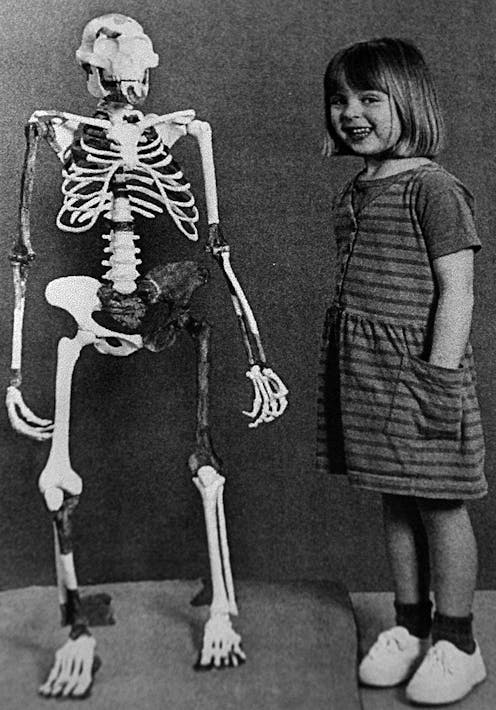
The reconstructed skeleton of Lucy, found in Hadar, Ethiopia, in 1974, and Grace Latimer, then age 4, daughter of a research team member. James St. John/Flickr, CC BY

In 1974, on a survey in Hadar in the remote badlands of Ethiopia, U.S. paleoanthropologist Donald Johanson and graduate student Tom Gray found a piece of an elbow joint jutting from the dirt in a gully. It proved to be the first of 47 bones of a single individual – an early human ancestor whom Johanson nicknamed “Lucy.” Her discovery would overturn what scientists thought they knew about the evolution of our own lineage.

Lucy was a member of the species Australopithecus afarensis, an extinct hominin – a group that includes humans and our fossil relatives. Australopithecus afarensis lived from 3.8 million years ago to 2.9 million years ago, in the region that is now Ethiopia, Kenya and Tanzania. Dated to 3.2 million years ago, Lucy was the oldest and most complete human ancestor ever found at the time of her discovery.

Sign up to read this article
Read news from 100's of titles, curated specifically for you.
Already a member? Sign in here
Related Stories
Top stories on inkl right now
One subscription that gives you access to news from hundreds of sites
Already a member? Sign in here
Our Picks
Fourteen days free
Download the app
One app. One membership.
100+ trusted global sources.