Get all your news in one place.
100's of premium titles.
One app.
Start reading
Euronews
Euronews
Laura Fleischmann

Low Danube water reveals Wehrmacht motorbike on riverbed

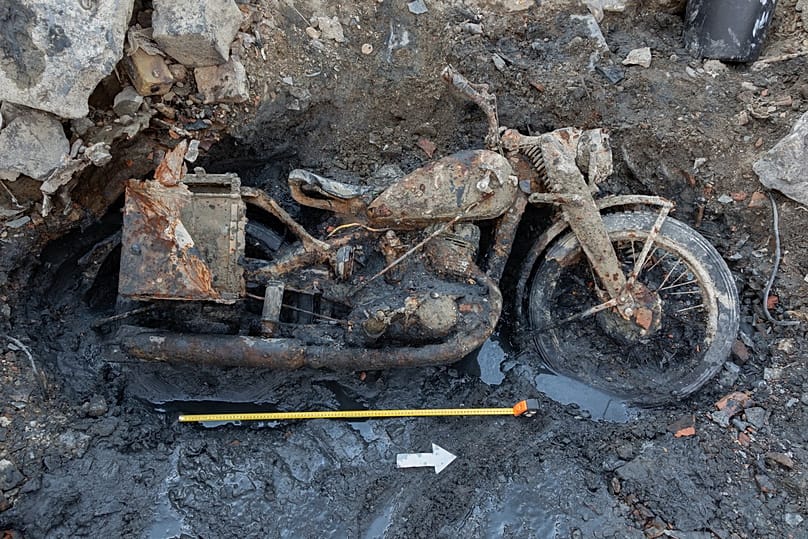
The water level in the Danube has never been this low. The low water has revealed what lay hidden on the riverbed for decades, among them a Wehrmacht motorcycle, a DKW NZ 350-1 model from the Second World War.

It was found in the riverbed in the heart of Hungary's capital, Budapest, at the level of the Hungarian parliament building. For staff at the local Institute and Museum of Military History it is a genuine once-in-a-century discovery. The vehicle is almost completely intact, according to the institute. It was preserved in the Danube's mud.

DKW racing motorcycles from 1939 and 1931, archive (Copyright 2007 AP. All rights reserved.)

The motorcycle recovered is a model that was developed specifically for wartime use and was produced from 1944 onwards. Around 12,000 units were built by the end of the war in 1945. Its predecessor, the DKW (source in German) NZ 350, reached a top speed of 105 km/h, according to the ADAC.

The motorcycle was manufactured by Auto Union AG, a car and motorcycle producer founded in 1932. Auto Union AG was created through the merger of several brands, including Audi.

By autumn 1936 the NZ range, made up of the 250 and 350 models, was ready for mass production. However, because another motorbike range was selling so well, they did not go into series production until 1938.

On earlier models from the manufacturer the frame sections were still bolted together. On the NZ range they were welded. Because this required a large amount of electricity, the work could only be carried out at night, when the power grid was not otherwise under heavy load.

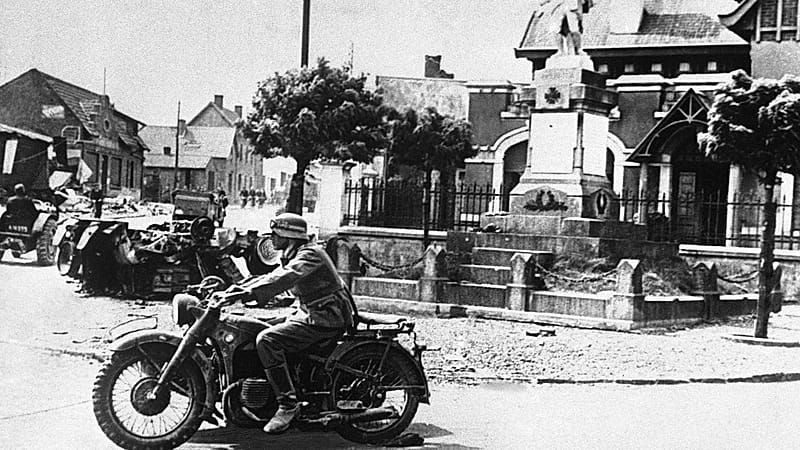
German troops drive through Liège, 30 May 1940 (AP)

German anti-tank mines, remnants of hand grenades and artillery shells have also been found on the bed of the Danube. The Hungarian Institute of Military History says this stretch of the river may have been used as a "war rubble dump".

From March 1944 German troops besieged Budapest. Between October 1944 and February 1945 the Battle of Budapest took place between the Soviet Red Army and German and Hungarian forces. Around 30,000 German, more than 17,000 Hungarian and about 80,000 Soviet and Romanian soldiers were killed. After the surrender of the remaining German units, Budapest was liberated on 13 February 1945.

This text was translated with the help of artificial intelligence. Report a problem : [feedback-articles-en@euronews.com].

Sign up to read this article
Read news from 100's of titles, curated specifically for you.
Already a member? Sign in here
Related Stories
Top stories on inkl right now
One subscription that gives you access to news from hundreds of sites
Already a member? Sign in here
Our Picks
Fourteen days free
Download the app
One app. One membership.
100+ trusted global sources.