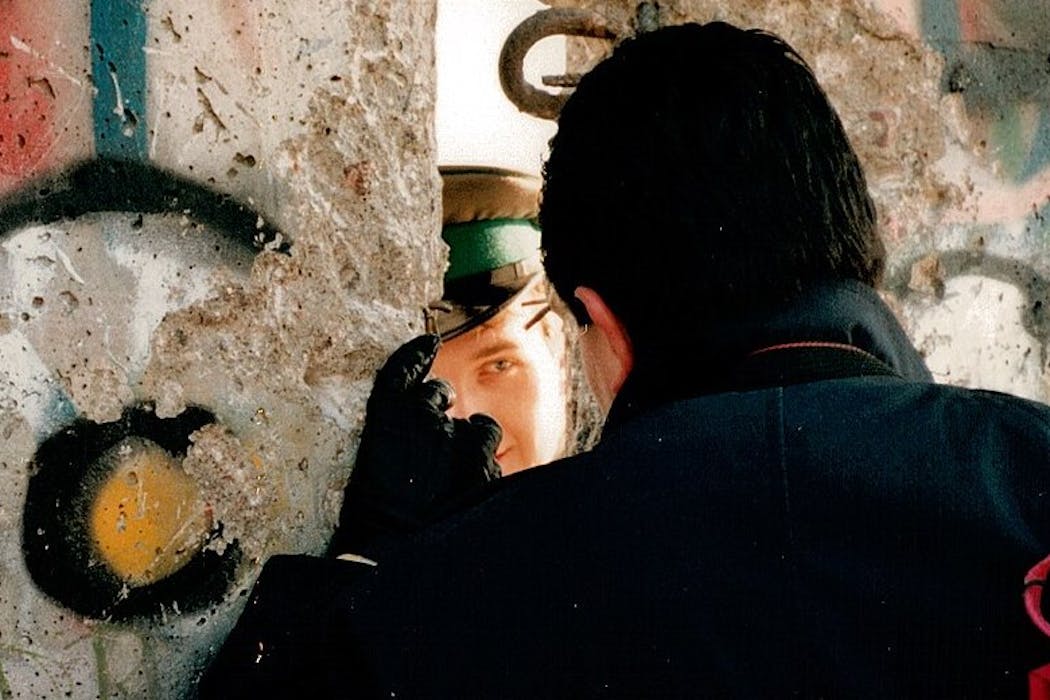
The people of Berlin woke on August 13 1961 to discover that their city had been split in two.
Despite the earlier cold war division of Germany into east and west after 1945, the border between the two halves of Berlin had remained open, allowing most Germans to travel, mix and mingle freely across the city. This abruptly changed in 1961 when the East German authorities closed the Berlin border and began constructing a wall across the city, a formidable barrier which would stand for almost 30 years. Overnight, families, friends and lovers were cruelly separated.

The Berlin Wall inspired David Bowie’s song Heroes (1977), with its poignant lyrics about two lovers, divided by the wall, dreaming of freedom together. However, there are many real-life examples of couples who found themselves divided by the wall, forced to undertake dangerous, daring escape attempts to overcome their separation.
East German propaganda portrayed the division of Berlin as an act of “fraternal love”, necessary to protect their citizens from the dangerous influences of the capitalist west. In reality, the construction of the wall was more like the jealous actions of a spurned lover, as East German authorities tried to halt the increasing number of people who were fleeing the communist state via Berlin, estimated to have reached 3.5 million, or around one-sixth of the East German population, by 1961.
The border closure meant countless German families, friends and lovers were cut off overnight.
Faced with the prospect of indefinite separation from their loved ones in the West, many East Germans tried to cross the border illegally. The risks were high. If intercepted, they could be arrested, imprisoned or even killed. The guards stationed along the wall were ordered to “shoot to kill” and at least 140 escapees died.
Despite the heightened stakes, around 5,000 East Germans successfully escaped through Berlin from 1961-89, utilising an array of daring methods, such as tunnelling, travelling over the wall by zipline or hot air balloon and concealing themselves in specially modified vehicles. For many of these people, their desire to escape was fuelled by love.
The love stories of the wall
Many east-west German couples who refused to see the Berlin Wall as a barrier to their love have shared stories of their daring escapes. Leslie Colitt’s East German fiancée Ingrid disguised herself as his sister and used her American passport to bluff her way past the border guards and into West Berlin.
When Heinz Meixner decided to smuggle both his fiancée Margarete and her mother out of East Berlin in 1963, he did it in style, using a specially modified sports car. With both women carefully concealed inside the vehicle, Heinz casually drove up to the border, before suddenly zooming past the unsuspecting guards, ducking underneath the checkpoint barrier with only two inches to spare and skidding to safety in West Berlin.
In 1971, Regina Albrecht faced a long and perilous journey to happiness, when she escaped East Germany to reunite with her boyfriend, Eckhard. Albrecht endured cramped conditions hidden behind the fuel tank of a modified car, as she travelled through Romania, Yugoslavia and into Austria, before travelling on to West Germany, where she and Eckhard married.
Over 70 tunnels were constructed underneath the Berlin Wall, although many were ultimately unsuccessful. In 1962, a tunnel constructed by a group of engineering students in West Berlin allowed 29 East Germans to crawl to freedom, reuniting many loved ones.
Tunneller Claus’s wife Inge and baby son both made it safely through, while group leader Joachim later fell in love with Eveline, a young woman who had escaped through the tunnel that night. However, another group member, Wolfdieter, who had acted as a courier in exchange for securing his girlfriend Renate’s safe passage from East Berlin, had to wait a little longer for his happy ending. Both Wolfdieter and Renate were caught and imprisoned in East Berlin, although they later reunited and married in 1966.
Similarly, while Joachim Neumann had escaped to West Berlin using a fake passport in 1961, his girlfriend Christa had been caught, imprisoned and was stuck in the east. In 1964, Joachim oversaw construction of a tunnel which enabled 57 East Germans to cross to West Berlin, including Christa. The couple went on to marry and have a family together.
Two become one
The fall of the Berlin Wall in November 1989 was widely celebrated across West and East Germany, leading to many joyous and jubilant reunions. This included former lovers Sigrid and Erik Krause, who had married in 1957, been separated by the division of Berlin in 1961 and subsequently divorced. However, 30 years later, the fall of the wall allowed them to rekindle their romance and remarry.
Personal reunions were accompanied by political fusion, with German reunification in October 1990. However, the subsequent decades of integration have produced challenges as well as opportunities. One recent survey indicated that today, while public opinion still perceives reunification positively, around one-third of Germans are unsatisfied with the level of unity that exists, a figure that rises to half among people in the former East Germany.
Recent research also suggests that the cold war division of Germany may have had an enduring legacy on romantic relations. Only 5% of German couples are composed of East-West partnerships, some of whom have spoken about the challenges they have faced. So, while the Berlin Wall may have crumbled, there are indications that an “invisible wall” continues to divide German minds – and hearts – today.
Looking for something good? Cut through the noise with a carefully curated selection of the latest releases, live events and exhibitions, straight to your inbox every fortnight, on Fridays. Sign up here.
Kelly Hignett does not work for, consult, own shares in or receive funding from any company or organisation that would benefit from this article, and has disclosed no relevant affiliations beyond their academic appointment.
This article was originally published on The Conversation. Read the original article.