
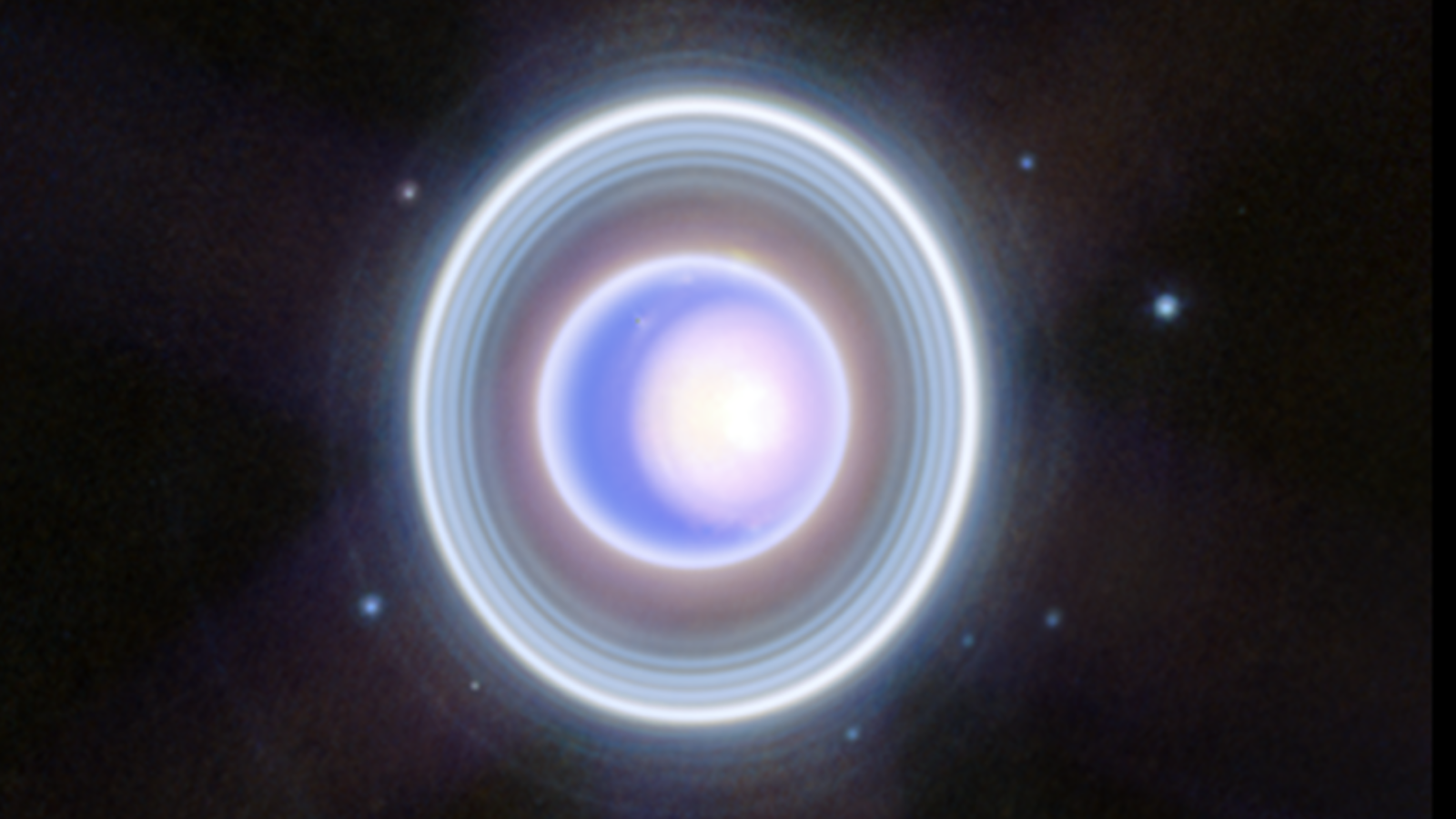
Much of what we understand about Uranus comes from data gathered by NASA's Voyager 2 spacecraft. Thirty-eight years ago, this probe flew by the ice giant, providing humanity with its first close-up glimpse of the seventh planet from the sun.
However, the snapshot delivered by Voyager 2 gave us a peculiar picture of Uranus. It suggested the world has an extreme magnetosphere — at risk of simplification, a giant magnetic field around the planet — that's filled with energized particles swirling around. And, well, this just didn't jibe with scientists' knowledge of the way magnetic fields work. The problem was an observed lack of plasma in Uranus's magnetosphere, which is an expected prerequisite for the energized particles Voyager 2 saw there.