
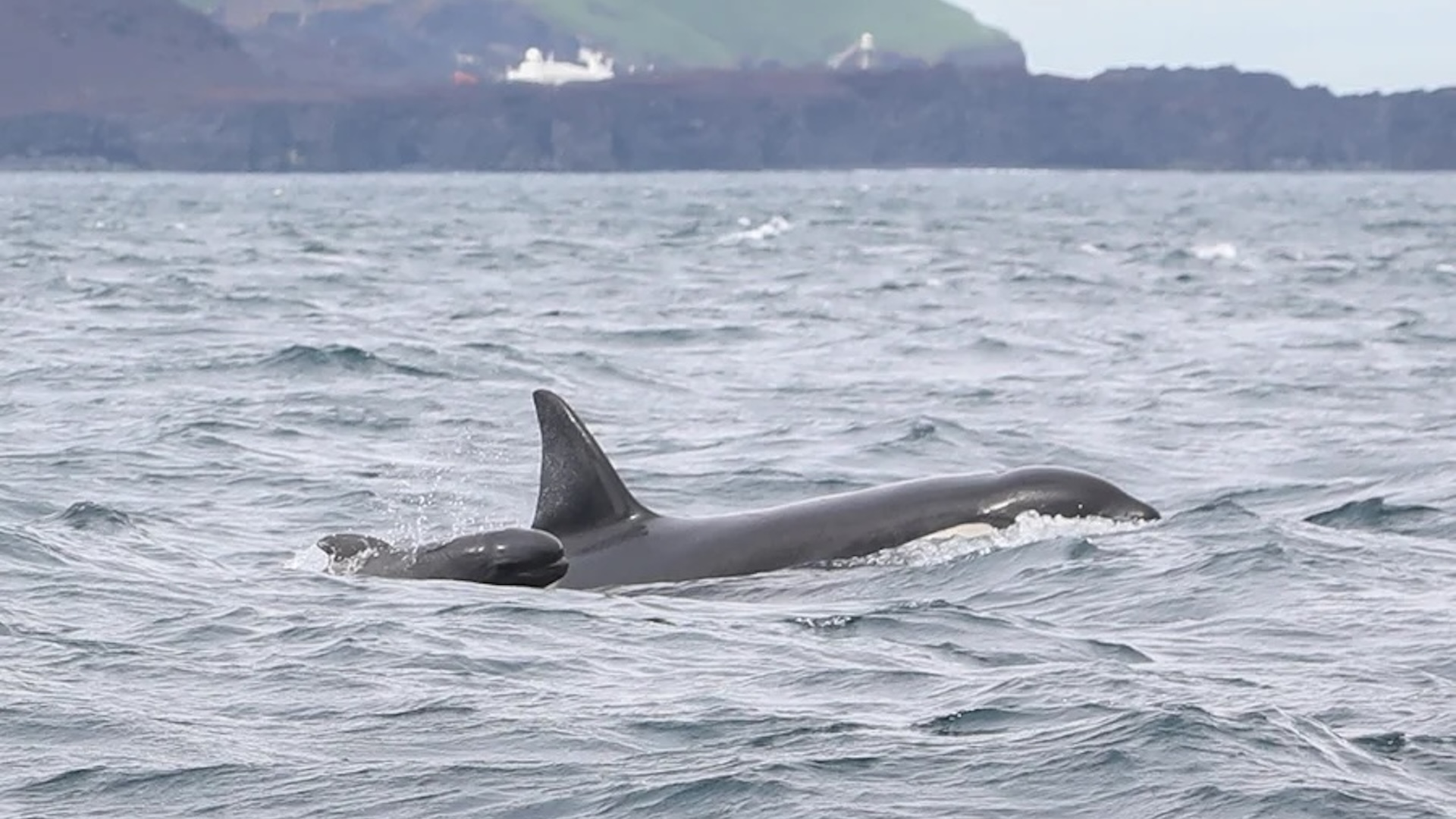
One day in June 2022 Chérine Baumgartner, a researcher at the Icelandic Orca Project, was watching from a dinghy as a pod of killer whales fed on herring — when she noticed something very odd about what seemed to be a young member of the pod. "At first, we were like, 'Oh my god, this killer whale calf has a problem,'" she says. It was far tinier than normal and lacked an infant orca's characteristic black-and-pale-orange coloration. Baumgartner, now a Ph.D. student at the Swiss Federal Institute of Technology Zurich, suddenly realized she was seeing an entirely different species: a baby pilot whale. She and her team observed the pod for nearly three hours before weather conditions forced them back to land. They found the pod the next day, but the pilot whale calf was nowhere to be seen.
Scientists noticed orcas interacting with baby pilot whales off Iceland every year from 2021 to 2023. Each instance was short-lived and featured different individual pilot whales (dark-gray members of the dolphin family with a bulbous forehead) and different pods of orcas. Now, in a new study in Ecology and Evolution, Baumgartner and her colleagues describe the 2022 and 2023 incidents and posit three potential explanations: predation, play or parenting.