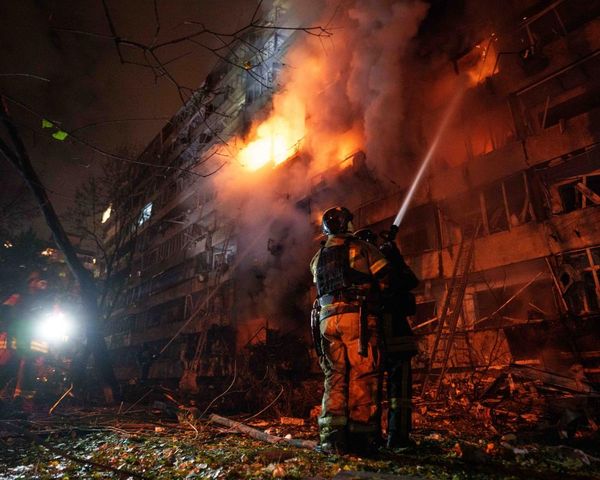
The bombing of Omagh in 1998 is likely to have involved “operational co-operation” between dissident terror groups the Real IRA and Continuity IRA, a public inquiry has heard.
An academic told the hearing into the massacre that the newly formed Real IRA had been small in numbers at the time but had hoped to bring about the “destabilisation” of the Northern Ireland peace process.
The Omagh Bombing Inquiry, chaired by Lord Turnbull, is holding evidential hearings in Belfast.
The hearings, which were delayed for six months, are concentrating on the period before and after the bombing and will examine how it was carried out and who was responsible.
The dissident republican car bombing in the Co Tyrone town on August 15 1998 killed 29 people, including a woman who was pregnant with twins, in the worst single atrocity in the Troubles in Northern Ireland.
The inquiry was set up by the previous government to examine whether the explosion could have been prevented by UK authorities.
Last year, the inquiry heard personal statements from those affected by the massacre.
On Tuesday morning Dr John Morrison, an expert in dissident republicanism at Maynooth University, gave evidence to the inquiry.
He told the hearing that the Continuity IRA had been formed in 1986.
He said the Real IRA had been created when it split from the Provisional IRA in 1997, in opposition to the peace process and a recently announced IRA ceasefire.
Dr Morrison said the newly formed group had “expertise in terms of the identification of where weapons were but also in terms of the development of weaponry”.
He said that Michael McKevitt was the quartermaster general and Liam Campbell had been director of operations.
McKevitt and Campbell were among four men found civilly liable for the Omagh bomb in 2009.
Paul Greaney KC, lead counsel to the inquiry, asked: “Significant operational components of the Provisional IRA are moving to form the real IRA?”
Dr Morrison responded: “Yes”.
Mr Greaney said: “As you understand it, what was the the aim of Michael McKevitt in creating the Real IRA?”
Dr Morrison said: “What this group wanted to achieve is the destabilisation of the peace process.
“They wanted to, in a way, try and push unionists to leave the peace talks and therefore delegitimising it.”
Mr Greaney referred to a report from Dr Morrison where he said McKevitt’s aim had been to “pursue a strategically timed bombing campaign in Northern Ireland and Britain, and ultimately seize back control of the Provisional IRA.”
Mr Morrison said: “That is what some of the sources have indicated, yes.”
The academic told the hearing that Campbell had been in favour of a campaign of car bomb attacks in towns.
Mr Greaney said: “Because the bombs were cheap and easy to manufacture and easy to transport?”
Dr Morrison said: “That is correct.”
He told the hearing that in 1998 the Real IRA had about 90 members and around a third were “violently active”.
Mr Greaney asked the witness about co-operation between dissident republican groups.
He read from a report from the witness which stated, “some form of operational co-operation for the Omagh bombing between the real IRA and the Continuity IRA in particular is deemed likely, even with the leadership of the Real IRA being the lead instigators of the attack”.
Mr Morrison said: “That is correct”
The families of some victims of the bombing are attending the hearings in Belfast.
Professor Angela Gallop has been instructed by the inquiry to lead a team of forensic scientists who have written a report on the findings of the original police investigation into the Omagh bombing.
She told the inquiry that in 1998 forensic science laboratories in the UK, including the then FSANI (Forensic Science Agency Northern Ireland) had operated in similar ways.
Ms Greaney said: “Is it the position that it is not clear to what extent FSANI had a similar relationship with the forensic science laboratory in Dublin as to the relationship it had with laboratories in the United Kingdom?”
Ms Gallop said: “The only information we have about that comes from the recent statements from the original scientists… where they talked about limited engagement with the Dublin laboratory, mostly about cross-border cases, sharing expertise and on occasion providing analytical services to help with case loads.”