There are trillions of charged particles – protons and electrons, the basic building blocks of matter – whizzing around above your head at any given time. These high-energy particles, which can travel at close to the speed of light, typically remain thousands of kilometers away from Earth, trapped there by the shape of Earth’s magnetic field.
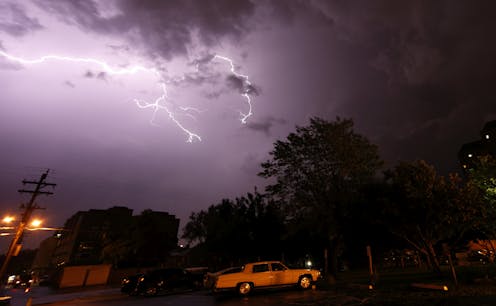
Occasionally, though, an event happens that can jostle them out of place, sending electrons raining down into Earth’s atmosphere. These high-energy particles in space make up what are known as the Van Allen radiation belts, and their discovery was one of the first of the space age. A new study from my research team has found that electromagnetic waves generated by lightning can trigger these electron showers.