
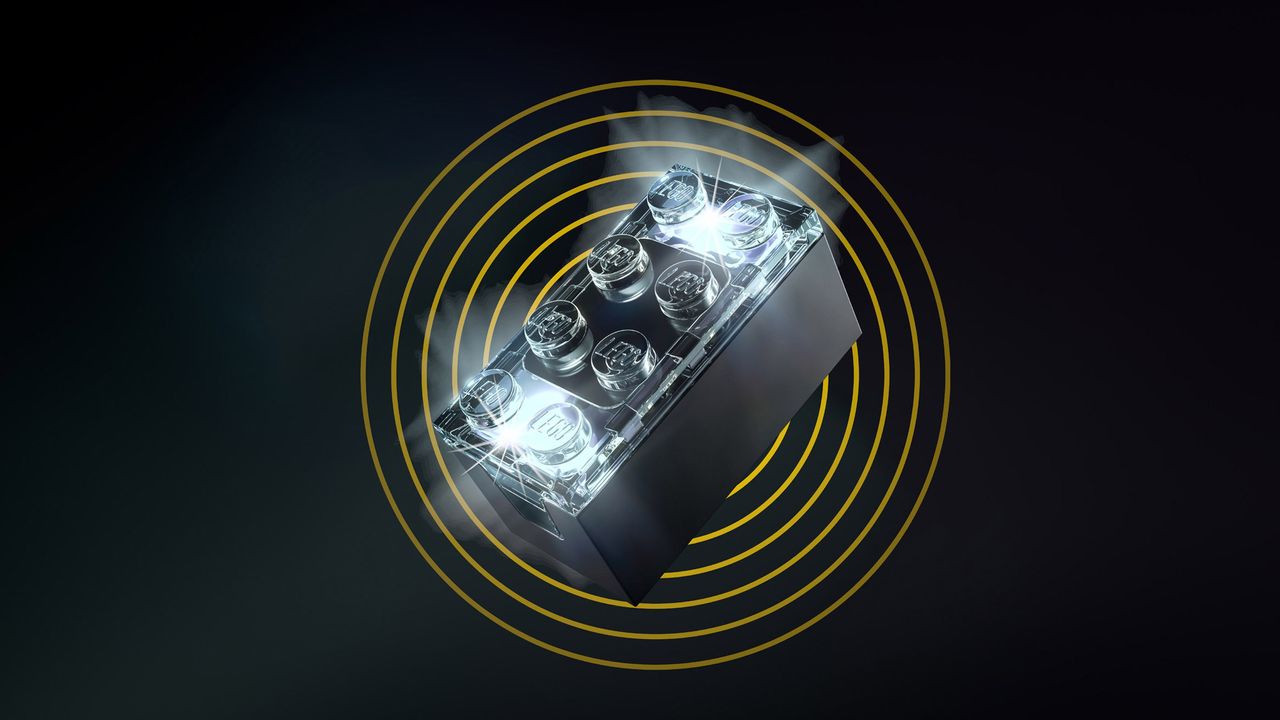
At CES 2026 in Las Vegas, Lego pulled the wraps off a familiar-looking product that behaves like a small computer. The new Smart Play platform centers on a standard 2x4 LEGO brick that packs processing, sensing, audio, wireless networking, and charging into a form factor that can still snap into a model. Tied to a March 1 retail launch, the Smart Brick debuts in three Star Wars sets, with pre-orders opening January 9.
Under the plastic, Lego has built what is effectively a mixed-signal embedded system. The company says the core is a custom 4.1mm ASIC with integrated sensors, RGB LEDs, a tiny speaker, and a radio stack. Power comes from an internal rechargeable battery that charges inductively, designed so the brick can be topped up even when buried inside a build.

Interestingly, Lego says that the brick understands its surroundings. Instead of cameras or optical tracking, Lego is using near-field magnetic sensing. ‘Smart Tags’ embedded in tiles and minifigures carry unique IDs that the brick reads through copper coils. Those same coils enable relative positioning, letting multiple bricks detect distance and orientation to one another. Lego calls the resulting wireless mesh BrickNet, a low-latency network that allows two models to recognize when they are facing off or interacting without an intermediary.
Audio is handled in a similar manner. Rather than storing large sound files, Lego says the Smart Brick generates effects in real time, based on prompts from SMART Minifigures and Tags, thereby keeping memory requirements low and avoiding the need for constant updates just to add new clips. “By breaking down just a few sounds to their most basic principles, you can actually carefully adjust their frequencies and amplitude to create drastically different end results,” a deep divereads. Lego calls this a “synthetic soundscape” and, all in all, it’s a very hardware-first solution to a problem most smart toys solve with a requisite app.

For launch, the Smart Brick appears in three all-in-one Star Wars sets ranging from 473 to 962 pieces, priced between $70 and $160 — expensive, no doubt, even for Lego. Each uses the brick to trigger music, sound effects, and interactive behavior based on how the model is handled. Importantly, Lego has been clear about what the platform does not include: there is no camera, no voice recording, and no cloud-dependent AI layer. The radio link is encrypted, and firmware updates are handled through a companion app rather than an always-on connection.
This isn’t the first time that Lego has added electronics to a toy, but Smart Brick does represent a first in terms of how compact and self-sufficient this implementation is. It’s essentially a computer designed to disappear into the plastic, doing just enough sensing and processing to make a model feel reactive without the need to drag a tablet into the room. For a company built on tolerances measured in fractions of a millimeter, hiding a complete system inside a brick is incredibly on-brand.

Follow Tom's Hardware on Google News, or add us as a preferred source, to get our latest news, analysis, & reviews in your feeds.