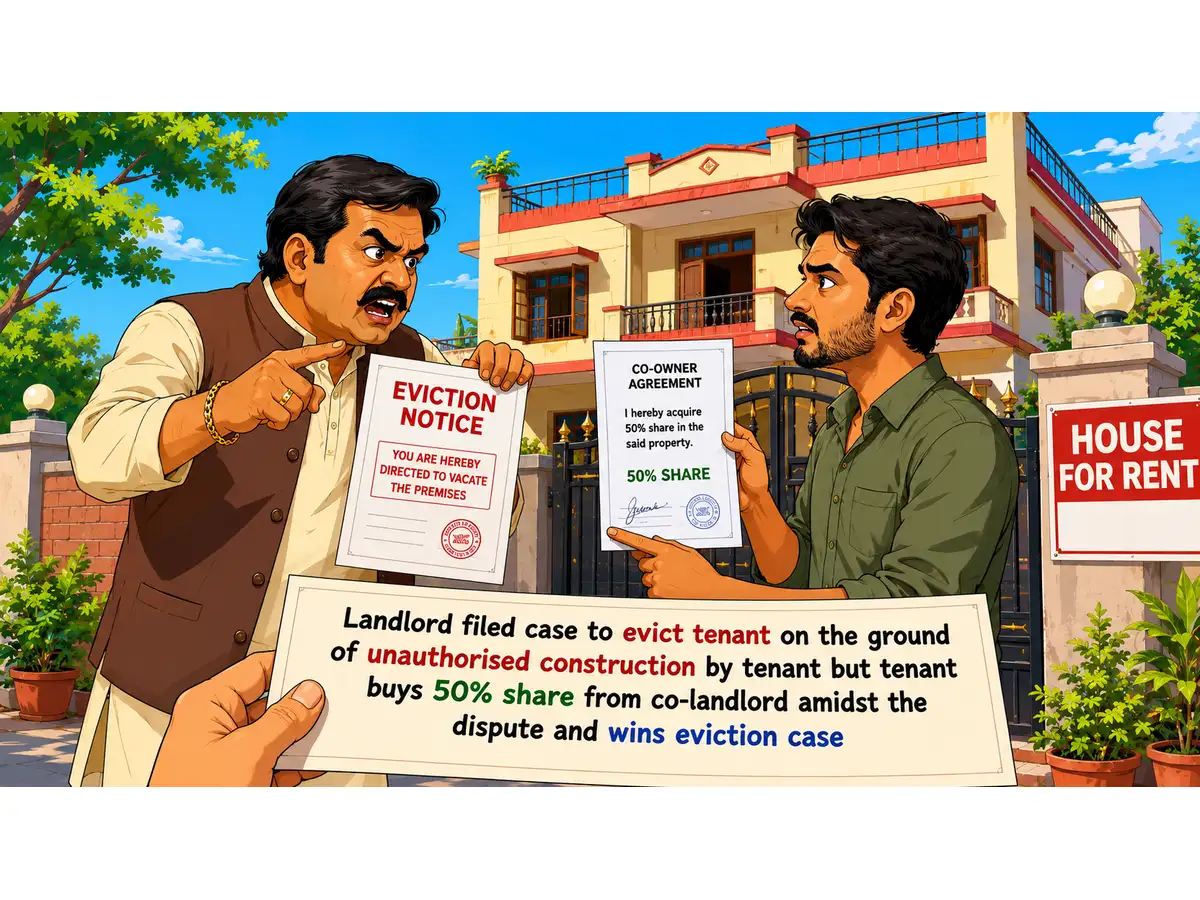
Back in 2002, Mr Varel, a landlord, wanted to evict Mr Kumar from his house because Kumar had built some unauthorised structures in the house and also sub-let a part of the house while also defaulting on rent. So, Varel took the matter to the court under tenant eviction laws.
However, the case dragged on for years and during the ongoing court proceedings, Kumar saw an opportunity to buy 50% share in the property from the legal heirs of one of the co-owners of this property and thus changing his status from a tenant to a co-owner.

He signed the conveyance deed for this purchase on April 22, 2016 and from that day onwards, he was no longer a tenant but a co-owner of the property. He presented this fact before the Bombay High Court and argued that since he is now a co-owner of the property with a legitimate conveyance deed, the tenant eviction case against him should be dropped.
On April 7, 2026, the Bombay High Court ruled that the eviction case cannot go on against Kumar as he had become a co-owner while the dispute was going on. The court observed that once a tenant acquires ownership rights, even if it is just a share, his status changes and eviction proceedings cannot be pursued against him.
Why did the tenant win this case?
Adnan Siddiqui, Partner, King Stubb and Kasiva, said to ET Wealth Online that the tenant succeeded primarily because, during the pendency of the eviction proceedings, he acquired a 50% ownership share in the property through a registered conveyance deed. Once the tenant became a co-owner of the property, the legal relationship changed materially. The Bombay High Court held that a co-owner cannot ordinarily continue eviction proceedings against another co-owner in respect of the same premises.
According to Siddiqui, the high court also relied on the principle laid down by the Supreme Court in Mohinder Prasad Jain v. Manohar Lal Jain and India Umbrella Manufacturing Co., which recognises that while one co-owner may institute eviction proceedings on behalf of all co-owners, such proceedings may not survive where another co-owner objects to the eviction or where subsequent events alter the ownership structure.
Siddiqui says: "Importantly, the Court observed that once the tenant became a co-owner, he held a “dual capacity” - both as tenant and owner, and his ownership rights superseded the earlier landlord-tenant dynamics to that extent."
Bombay High Court tenant eviction order
The Bombay High Court examined the Supreme Court case of Mohinder Prasad Jain v. Manohar Lal Jain [(2006) 2 SCC 724] which recognised that while one co-owner can initiate eviction proceedings, such proceedings cannot continue if another co-owner objects or if subsequent events extinguish the entitlement to evict.
The Bombay High Court also analysed multiple situations in cases of co-ownership and ruled that where a tenant purchases a share in the property during the pendency of tenant eviction proceedings, then he acquires a dual capacity which is owner and tenant.
The Bombay High Court said that considering the dicta of the Supreme Court in the case of Mohinder Prasad Jain (supra) one thing is clear that, where there are two co-owners and an eviction suit is filed against a tenant by one of the co-owners, such a suit is maintainable and he doesn't need a written consent from the other co-owner.
The Bombay High Court said that in a situation where there are two co-owners, even if one of the co-owner's share is purchased by the tenant who now becomes a co-owner out of many and decides not to proceed with the eviction proceeding, in such a situation, the eviction proceedings can't be proceeded further at whichever stage it may be.
The Bombay High Court said that if a sitting tenant purchases the entire ownership right of the tenanted premises by way of registered conveyance, he becomes absolute owner and his tenancy rights qua the premises gets converted into the superior right of ownership.
The high court said that once a tenant also becomes a co-owner, he is in a dual capacity, that of the ownership to the extent of share purchased and tenancy to the extent of his tenancy agreement as on date.
The high court said: "As soon as he purchases a part of ownership right, another co-owner can't file or continue eviction proceedings under Rent Act against him qua the tenancy premises."
The Bombay High Court further stated that even if one of the co-owners has transferred his share to the tenant and has expressed unwillingness to continue the proceedings, the eviction process cannot go ahead. The high court said subsequent events directly affect the co-owner's right to seek eviction, as reported by LiveLaw.
The Bombay Court also noted that the tenant in this case had become the owner of 50% share of the property and had also initiated proceedings for partition of the property. It held that in view of the change in status and the objection of one of the co-owners, the eviction proceedings could not be sustained.
Accordingly, the High Court approved the civil revision application, annulled the judgment and decree passed by the Appellate Court, and restored the Trial Court's decision to dismiss the tenant eviction suit.