Tuesday afternoon brought Japan's southern Kyushu island its most violent shaking in a decade: a quake centered near Uto, in Kumamoto Prefecture, splitting pavement, snapping a highway bridge, and reducing sections of centuries-old Kumamoto Castle to rubble. A tsunami advisory came and went within hours, but a shopping mall collapse in nearby Kashima Town has left rescue crews digging through the night.
How Big Was It, Really?
The rupture hit at 4:27 p.m. local time at a depth of roughly 10 kilometers — shallow enough that the U.S. Geological Survey recorded shaking severe enough to hit level 7, the ceiling of Japan's shindo intensity scale. Pinning down the quake's actual size has been messier: Japan's Meteorological Agency reported a preliminary reading of magnitude 7.1, roughly half a point above the USGS's own estimate of 6.8. A magnitude-6.1 aftershock followed about 40 minutes later, one of dozens that have continued through the night.
An Evacuation Order Nobody Can Quite Pin Down
Seven Kyushu prefectures — Kumamoto, Nagasaki, Kagoshima, Fukuoka, Saga, Oita, and Miyazaki — received emergency alerts telling residents to seek shelter. Kyushu Electric Power says somewhere between 40,000 and 45,000 homes and businesses briefly lost power, JR Kyushu suspended its high-speed rail lines across the region as a precaution, and the utility's Sendai and Genkai nuclear stations kept running without incident.
Inside the Kashima Mall Collapse
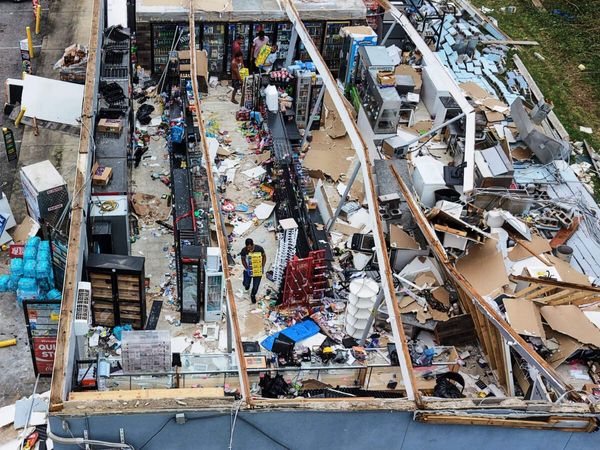
Nowhere took a harder hit than an AEON Mall in Kashima Town, where the second floor buckled after what witnesses on the scene described as an explosion. Public broadcaster NHK, via reporting from BNO News, put the confirmed toll at two — both women in their twenties — with a third person pulled from the wreckage in cardiac arrest. Police initially said 20 to 30 mall employees couldn't be reached by phone once the dust settled; later coverage suggests that figure has since shifted leaving the true scale of who's still missing genuinely unclear as of this writing. Kumamoto officials aren't ruling out a higher final toll once crews finish clearing the site.
Away from the mall, a chimney stack at a Nippon Paper Industries plant in Yatsushiro City snapped and crashed into the buildings below it, leaving nine employees unaccounted for. About 3,600 troops from Japan's Self-Defense Forces have been deployed into the prefecture to help. Speaking to reporters, Prime Minister Sanae Takaichi confirmed that people had been hurt, fires had broken out, and roads, bridges, and buildings had sustained damage, while adding that officials were still working out the full scope of the destruction.
The Tsunami Advisory That Came and Went
Coastal residents along the Ariake and Yatsushiro Seas — which touch Kumamoto and three neighboring prefectures — were briefly told to expect a wave near one meter and to move inland. Japan's Meteorological Agency canceled that advisory roughly two hours later, once it became clear no destructive wave had materialized.
Beyond Japan's own coast, no government issued a tsunami alert tied to this quake. The Pacific Tsunami Warning Center was unambiguous that Hawaii and American Samoa faced zero risk, and the warning never grew into anything Pacific-wide. Compare that to the magnitude-8.8 quake near Kamchatka, Russia — which struck almost a full year before this one — and was powerful enough to send tsunami waves rolling clear across the ocean, prompting evacuations from Hawaii to Mexico, Ecuador, and Chile. Tuesday's earthquake caused plenty of damage on the ground, but it wasn't strong enough to displace the volume of seawater a basin-crossing wave requires.
Will This Set Off Quakes Elsewhere on the Ring of Fire? Almost Certainly Not
Kyushu lies along the Pacific "Ring of Fire" — the horseshoe-shaped, roughly 25,000-mile belt of volcanic and seismic activity that also passes beneath Mexico, Central America, and the Pacific side of South America. That geography naturally raises the question of whether a major quake here makes another one along that same belt more likely, even thousands of miles away. Researchers who've studied similar coincidences say it doesn't work that way.
Something similar came up in 2016, when a major earthquake struck this same corner of Kyushu just days ahead of a powerful quake in Ecuador. CBC's Johanna Wagstaffe was quick to point out that the two disasters sat more than 15,000 kilometers apart, noting that "the distance [is] much too great for these earthquakes to be connected." Stress genuinely can jump from one fault to the next, scientists say — but typically only within roughly the same fault segment or its immediate neighbor, never across an entire ocean basin.
That pattern held up again just last month. When Japan, California, and Venezuela were all hit by quakes within roughly a day of one another, geologists were quick to note that Venezuela's tremors originate from the boundary of the Caribbean plate — a completely different system from the Ring of Fire — which makes any real seismic link between the events next to impossible. So far, no government seismology agency — not in Japan, the United States, or anywhere in Latin America — has drawn any connection between Tuesday's Kyushu earthquake and added fault risk in places like South America, Central America, or Mexico.
What Kyushu Residents Are Actually Worried About
The comparison locals keep bringing up isn't some distant chain reaction — it's April 2016, when back-to-back earthquakes claimed more than 270 lives in this very same corner of Kyushu. Officials say they're tracking aftershock patterns closely over the coming days, wary that another strong jolt could pile new damage on top of what Tuesday's quake already caused.