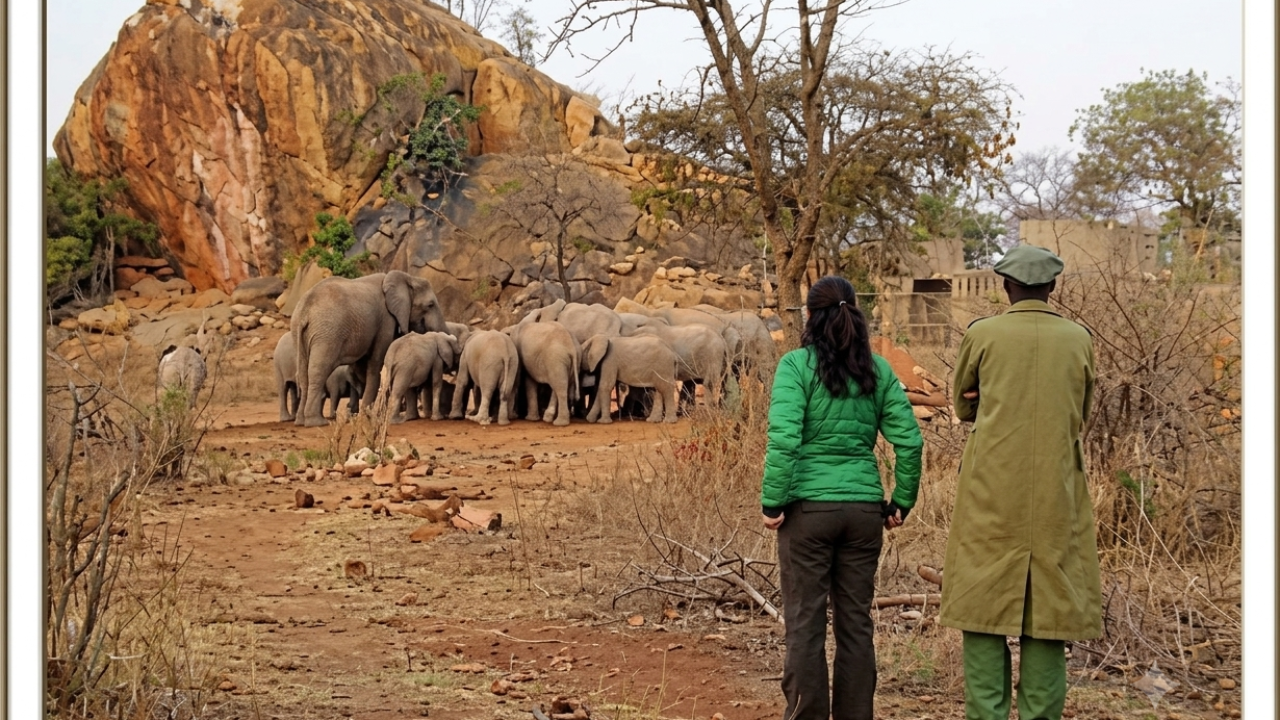
In 2009, a holiday in Kenya brought actress Kristin Davis into an unexpected encounter with an abandoned elephant calf. While staying in the Chyulu Hills, Davis and staff from Kampi Ya Kanzi came across the young elephant on its own. When the calf was still without its mother several days later, a decision was made to intervene. The orphan, later named Chaimu, was about a year old and was taken into the care of the David Sheldrick Wildlife Trust, now known as the Sheldrick Wildlife Trust. Sixteen years on, Chaimu has become part of a very different story. After years of rehabilitation and time learning alongside wild elephants, she has returned to the wild.
Get breaking news anytime, anywhere. Download the TOI app now!

Kristin Davis helps rescue an abandoned elephant calf in Kenya
Davis was holidaying in the Chyulu Hills when she and people working at Kampi Ya Kanzi spotted the calf. At first, there was uncertainty over whether the elephant had simply become separated from its herd. But the situation did not change over the following days.
With the calf continuing to remain alone, the group decided that intervention was necessary. The DSWT was contacted and arrangements were made to rescue the young elephant. She was named Chaimu and, at roughly one year old, began a rehabilitation process that would eventually take her from the Nairobi Nursery to the organisation’s reintegration programme in Tsavo East.
From the nursery to Tsavo East: Chaimu learns life among wild elephants
Chaimu’s care did not end with her arrival at the Nairobi Nursery. Orphaned elephants in rehabilitation need to develop many of the behaviours they would ordinarily learn from their families, including how to interact with other elephants and function within a herd.
After graduating from the nursery, Chaimu moved to the Ithumba Reintegration Centre in Tsavo East. The centre allows older orphan elephants to spend increasing amounts of time around wild elephants before making the transition away from human care.
That process was reflected in Davis’s later descriptions of Chaimu. The elephant was regularly mixing with wild herds and learning the skills needed for life outside the sanctuary system.
A 2011 Kenya visit strengthens Davis’s ties to elephant conservation
The encounter did not become an isolated episode in Davis’s life. She continued supporting the organisation and used her public profile to draw attention to its work with orphaned elephants and wider conservation issues.
Her involvement included visits to Kenya. In July 2011, she returned with her friend Ame and filmmaker Roz Edwards, spending time at the Nairobi Nursery before travelling to Ithumba in Tsavo East. During that visit, she stayed at Ithumba Camp, which had been established alongside the reintegration centre and was intended to support limited responsible tourism in the northern part of Tsavo East.
Davis also spoke publicly about Chaimu and the charity’s work, including an appearance on The Oprah Winfrey Show. She has continued to identify elephant conservation and the illegal ivory trade among the issues she has highlighted.
A longer commitment to wildlife conservation
Davis’s work with elephants has since extended beyond her connection with Chaimu. She also served as a Goodwill Ambassador for UNHCR, the UN Refugee Agency, in 2017, according to The UN Refugee Agency.
Her interest in conservation has also crossed into film. The Perfect World Foundation Award says that in 2014, she executive produced and financed Gardeners of Eden, a documentary about the Sheldrick Wildlife Trust and its efforts to protect elephants. The film received recognition at several film festivals, including the Elephant Hero Award at the UN-sponsored International Elephant Film Festival in 2016, and was later a finalist for a Peabody Award.
In September 2023, Davis received The Perfect World Foundation Award for her contribution to raising awareness around wildlife and biodiversity conservation.
Chaimu becomes part of a larger conservation project
Years after the original rescue, Chaimu’s story became connected to The Great Elephant Migration, a conservation art project involving a travelling collection of elephant sculptures. Davis has supported the project and said she wanted to help raise awareness and funds for conservation work.
A sculpture representing Chaimu is part of the migrating herd. Its inclusion links the animal Davis encountered as an orphaned calf in Kenya with the elephant she later saw progressing through rehabilitation and towards life in the wild.
By then, Chaimu was 16 years old and had been reintegrated into the wild. Her story therefore spans much more than the original rescue. It covers the long period between being found alone in the Chyulu Hills and eventually becoming capable of living beyond the protection of the rehabilitation programme.
From an orphaned calf to life in the wild
Chaimu’s journey illustrates the lengthy nature of elephant rehabilitation. The rescue itself happened quickly once it became clear that the calf was not being reunited with her herd, but the process that followed took years.
From the Nairobi Nursery to Ithumba, Chaimu gradually spent more time in an environment where wild elephants could provide experiences and social interactions that a young orphan would otherwise have gained from its family. Her eventual return to the wild marked the later stage of that process.
For Davis, the connection began with an encounter during a Kenyan holiday in 2009. More than a decade later, Chaimu’s name remains attached to her conservation work, this time through a sculpture travelling with The Great Elephant Migration and representing an elephant that survived the loss of its original herd and went on to rejoin wild elephants.