Get all your news in one place.
100's of premium titles.
One app.
Start reading
The Times of India
The Times of India
World
TOI World Desk

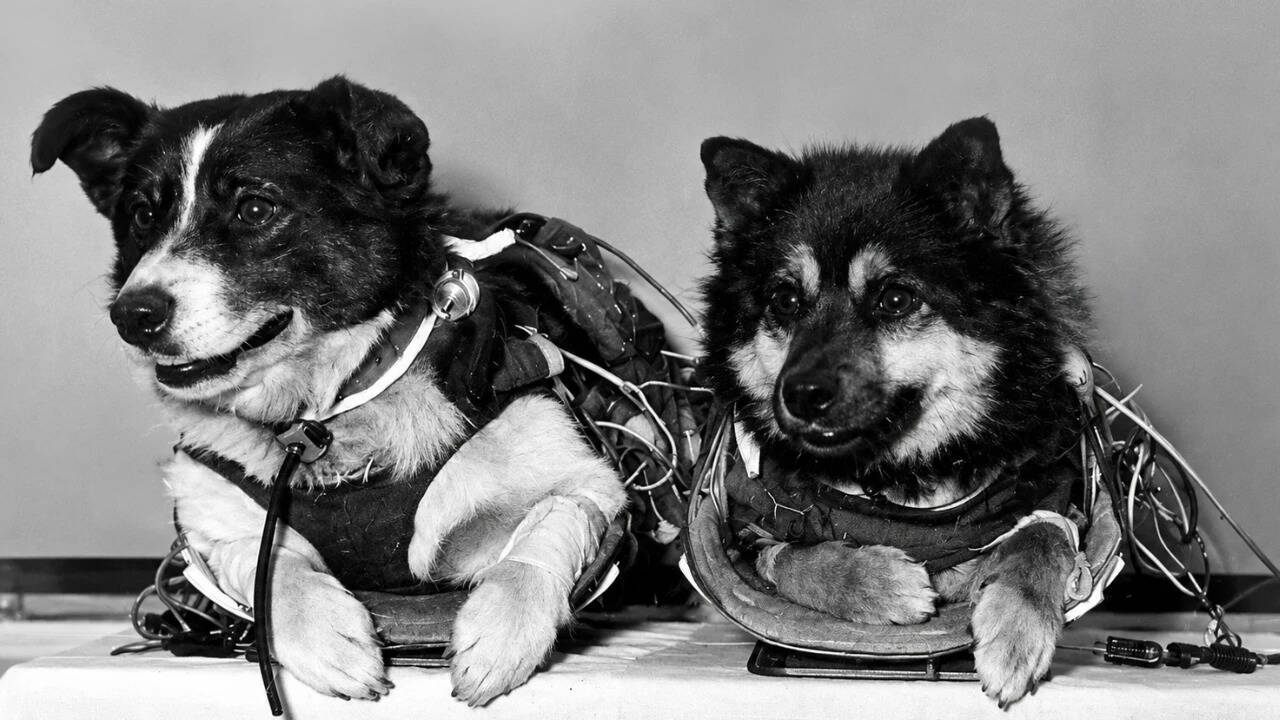
Kosmos 110 Mission: dogs Veterok and Ugolyok endure 21–22 days in orbit; study prolonged weightlessness

Before humans spent weeks in orbit, Soviet scientists needed to understand what prolonged spaceflight could do to living bodies. In February 1966, two small dogs, Veterok and Ugolyok, were placed inside a spacecraft and sent into orbit aboard Kosmos 110. They remained there for about 22 days before returning alive. The mission was designed to examine the effects of extended weightlessness and radiation, but it also exposed the physical difficulties that came with keeping an animal in space for weeks.

Get breaking news anytime, anywhere. Download the TOI app now!

A mission beyond the usual few orbits

Soviet scientists had already sent many canine passengers into space before Veterok and Ugolyok were chosen for Kosmos 110. Previous launches were designed to test the preparations for sending human cosmonauts to space. What made this mission different from earlier launches was its longer time in orbit.

According to NASA , Veterok and Ugolyok were launched on February 22, 1966. Their names meant “little breeze” and “little ember”, respectively. Kosmos 110 was placed in a highly elliptical orbit that reached into the region of the Van Allen radiation belts. The mission therefore allowed Soviet scientists to study both prolonged weightlessness and the biological effects of increased radiation exposure.

Dogs had different responsibilities. According to the history written by NASA about the Russian program, Veterok was the test dog, and Ugolyok was the control dog. The spacecraft was equipped to monitor their health throughout the mission and to supply food and water. The goal was not only to survive launch and re-entry but also to see how their bodies reacted to long-term life in orbit.

What happened inside the spacecraft

The mission continued for more than three weeks, although it did not reach the planned 25-day duration. By March 14, Soviet officials were concerned about a gradual deterioration in the composition of the cabin air. A commission subsequently decided to end the mission early, and the spacecraft began its return sequence on March 16.

When they returned to Earth, Veterok and Ugolyok were alive. But their condition showed that the long journey had put significant strain on their bodies. According to NASA, their heart function was irregular, and they showed changes in coordination and other physiological measures. Later examinations found muscle atrophy, loss of bone calcium, and changes in blood chemistry. Research published in Biology Bulletin of the Academy of Sciences of the USSR later considered physiological adaptation to weightlessness using data from Soviet biosatellite experiments. It found that prolonged weightlessness could produce changes in muscles, bones and metabolic systems, while many of the observed changes were reversible after the animals returned to Earth.

A record that outlasted the dogs' mission

Kosmos 110 mattered for more than the two dogs themselves. NASA notes that Veterok and Ugolyok completed the longest canine spaceflight ever recorded. The mission lasted 22 days, a duration that was exceeded by humans during the Soyuz 11 mission in 1971. Guinness World Records also gives the duration as 22 days and identifies the flight as the longest spaceflight by a dog. The experiment reflected an early phase of the Space Race, when animals were used to test conditions too dangerous for human crews. Earlier Soviet missions had already shown that animals could survive launch, orbit, and landing. Kosmos 110 went even further by asking what happens if an animal stays in orbit for several weeks.

The experiment did not present spaceflight as either completely safe or impossible. It gave scientists many findings to evaluate once the animals returned. Veterok and Ugolyok were launched as test subjects in a biological satellite and returned as survivors of a mission that showed how much the body must endure on long space journeys.

Sign up to read this article
Read news from 100's of titles, curated specifically for you.
Already a member? Sign in here
Related Stories
Top stories on inkl right now
One subscription that gives you access to news from hundreds of sites
Already a member? Sign in here
Our Picks
Fourteen days free
Download the app
One app. One membership.
100+ trusted global sources.