Get all your news in one place.
100's of premium titles.
One app.
Start reading
The Economic Times
The Economic Times
Muskan Singh

Kenya’s farmers turn to beehive fences to keep crop-raiding elephants away, creating a surprising path toward human-elephant coexistence

In southern Kenya, farmers facing crop-raiding elephants found an unusual barrier between their fields and hungry pachyderms- living beehives. The idea began with a surprising observation. Elephants could ignore a quiet hive, but when bees erupted from it, the animals ran. That discovery led zoologist Lucy King to develop beehive fences designed to protect crops without harming elephants. What followed was an experiment in whether something as simple as a swarm of angry bees could help ease one of the most difficult conflicts between people and wildlife. The report is sourced from Save The Elephants and Scientific American.

The approach has since spread to farms in Africa and Asia, while farmers have also gained another benefit from the hives: honey.

READ ALSO: Conservationist Matt Conn bought 67 acres of damaged Louisiana land. For a decade, he personally rebuilt it; the restored wetland had recovered diverse native vegetation and multiple ecosystems

Why are elephants entering farms?

The problem is rooted in a growing competition for space and food. In parts of Africa, human-elephant conflict increased significantly during the 2000s. While Kenya has experienced some recovery in its elephant population through conservation efforts, the wider African elephant population has declined dramatically. At the same time, sub-Saharan Africa's human population increased from about 870 million to 1.1 billion between 2010 and 2020, according to the World Bank.

For farmers living near elephant habitat, the consequences can be devastating.

“Elephants are disturbing us a lot,” a Kenyan farmer told researcher Sophia Weinmann while discussing crop raids in Sagalla, Kenya. “I planted about six kilos of green grams; they were all eaten. One time I just fainted in the field after waking up and seeing that happen.”

An elephant can consume an entire farm's harvest in a day, threatening both household income and food security. Elephants can also become dangerous when they enter sheds or move through homes while searching for food.

Some farmers have responded by shooting elephants, according to King, adding another layer to an already serious conservation problem.

READ ALSO: Each female red crab can carry 100,000 eggs to the sea; Christmas Island closes roads and deploys bridges to protect the moon-timed journey

How did bees become an elephant deterrent?

King's idea came from an unexpected moment in the Kenyan bush. In 2007, she was watching an elephant known as Mohican resting beneath an acacia tree. A beehive was hanging above the animal, yet the elephant appeared completely unconcerned. King had already documented elephants fleeing when confronted by bees. The animals kicked up dust, shook their heads and appeared to warn others as they escaped. Even recordings of buzzing bees had prompted elephants to run.

Mohican seemed to contradict everything she had observed.

Then King asked her research assistant to throw a stone at the hive.

“I was completely thrown by this,” King says, recalling the moment. “I was like ‘No!’”

The hive was disturbed. The bees erupted.

“And then suddenly, the bees just erupted,” King says. “And the elephants just fled.”

The explanation was simple. A quiet hive did not necessarily bother an elephant. A swarm did.

That realization became the foundation for the beehive fence.

READ ALSO: In 1845, two British ships entered the Arctic with 129 men searching for the Northwest Passage; both vessels and every member of the expedition disappeared

How does a living fence protect crops?

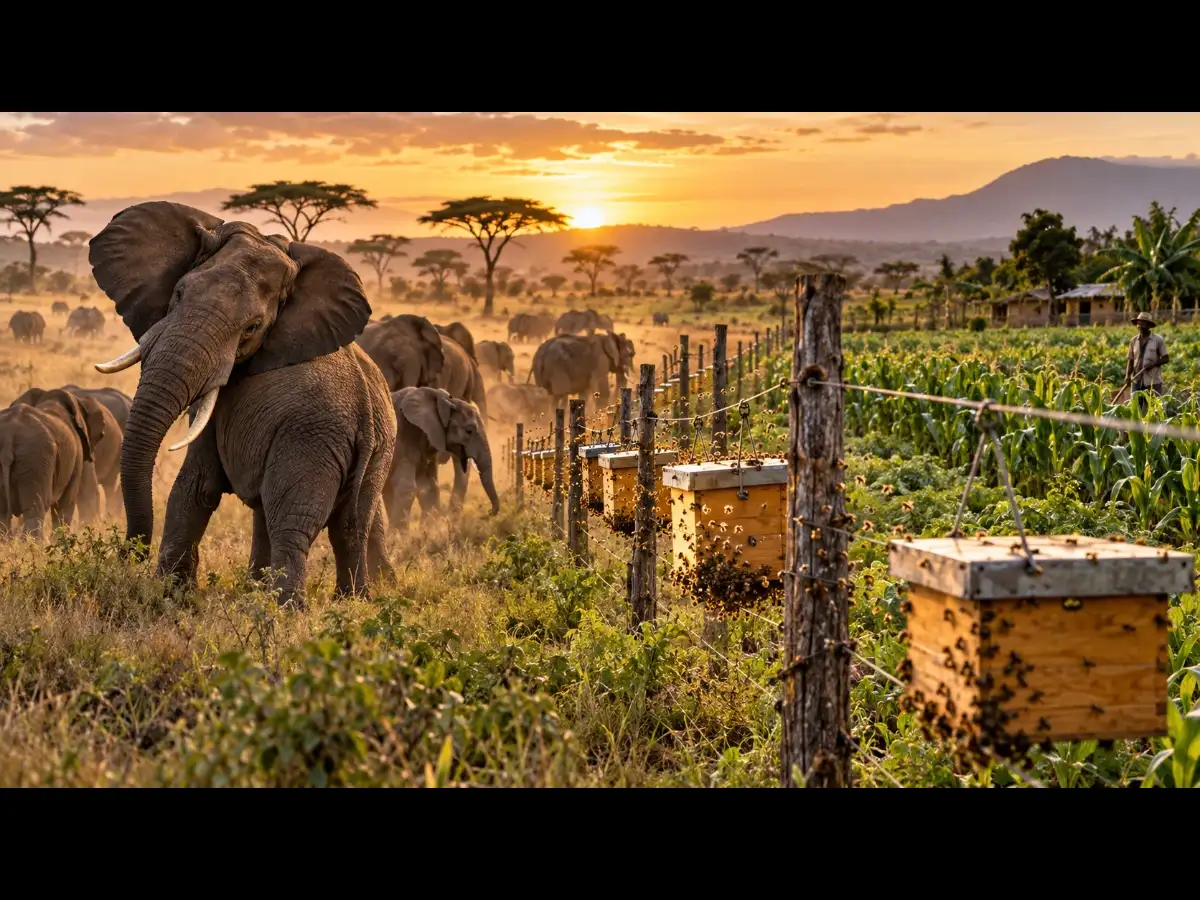
The design uses hives suspended from wires between wooden posts around farmland.

When an elephant attempts to enter, it encounters the wires and shakes the hives. The disturbance can trigger the bees, sending a swarm toward the animal.

Save the Elephants provides farmers with beehive-fence kits containing 12 active hives and 12 dummy hives. The dummy hives create additional objects that resemble real hives, extending the appearance of the barrier without requiring the same expense and upkeep.

According to King's research, the approach has shown promising results. In a 2017 field study, bee fences installed at 10 farms near a national park in Kenya deterred elephants 80 percent of the time.

In Weinmann's interviews, 61 percent of farmers said the fences were “more effective” than other deterrents, including thorn barriers, sheet metal, burning rubber tires and lit torches.

The method has since expanded far beyond the original experiments, with King estimating that nearly 10,000 beehive fences have been built at sites across 20 African and Asian countries.

But the fences are not without problems.

Honey badgers and baboons can raid hives, sometimes causing bees to abandon them. Elephants may then exploit the unprotected sections. Metal cages have helped shield some hives. Dry conditions can also cause bees to leave in search of wetter areas and better floral food, while drought can wipe out bee populations at farms.

READ ALSO: In 2008, Tom Brady and Gisele Bündchen bought 4 acres in LA's Brentwood and built with solar, composting and gray water. 4 years later, 90% of its materials were reclaimed

Can the bees help farmers as well?

The hives offer something beyond protection. Through the Save the Elephants program, farmers receive beekeeping training and protective equipment, including suits, smokers, rubber boots and gloves.

The honey can then become a source of income. King says a family can earn between $50 and $200 from a harvest, which generally takes place twice a year.

“The honey is a huge benefit,” says Esther Serem, a field officer at Save the Elephants' research center in Kenya's Tsavo region.

The idea has also developed into a larger enterprise in Botswana. Mavis Nduchwa founded Kalahari Honey, which trains women on farms with beehive fences and helps them market their honey.

“We have seen the decline in the numbers of the gender-based violence cases as women are more empowered and have jobs,” says Nduchwa, who employs more than 1,500 female farmers. “It might sound crazy, but a jar of honey saves elephants and feeds more families.”

The work in Kenya has also grown into a broader effort focused on coexistence. Dr. Lucy King's success with the beehive fence in Sagalla inspired the local community to donate an acre of land to what was initially the Elephants and Bees Research Center, now the Human-Elephant Coexistence Centre.

The center safeguards farms, has 14 staff members and employs eight people from Sagalla. It also conducts workshops and provides training for NGOs, communities and project managers working toward peaceful elephant coexistence.

Save the Elephants, founded by zoologist Iain Douglas-Hamilton in 1993, conducts research into elephant ecology and behavior. Its Samburu Research Centre in northern Kenya has recorded more than 900 identified elephants using the reserve along the Ewaso Ny'iro river over many decades. Its Tsavo research and coexistence work continues to explore ways of reducing the long-running conflict between elephants and communities.

Bee fences are not presented as a complete solution to human-elephant conflict. King has also explored other approaches, including encouraging farmers to grow crops elephants dislike, odor-based fences and “buzz boxes” that play recordings of swarming bees.

But the beehive fence offers something rare: a deterrent that can protect a farmer's crops while creating an additional source of income and avoiding direct harm to elephants.

READ ALSO: Japanese Proverb of the Day: 'Even the head of a sardine can become holy with devotion'- Japanese philosophy reveals a powerful lesson on faith, belief, and the power of the human mind

FAQs

Do elephants fear bees?

They can flee when disturbed hives release swarming bees.

Do bee fences help farmers?

Yes. They can protect crops while also producing honey for income.

Sign up to read this article
Read news from 100's of titles, curated specifically for you.
Already a member? Sign in here
Related Stories
Top stories on inkl right now
One subscription that gives you access to news from hundreds of sites
Already a member? Sign in here
Our Picks
Fourteen days free
Download the app
One app. One membership.
100+ trusted global sources.