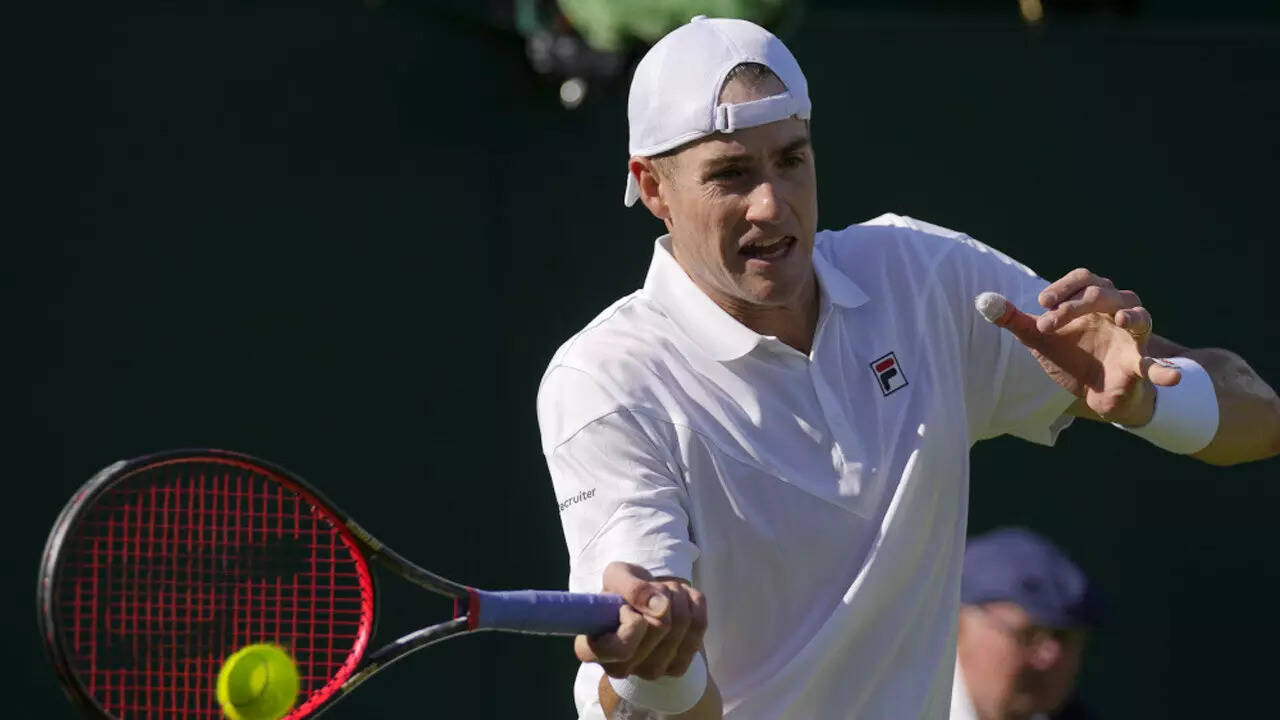
If you thought John Isner might have happy memories of Court 18 at the All England Club, you are in for a rude shock.
The American, one of the tallest players on the men’s tour, emerged as the winner in the longest match in tennis history when he beat Frenchman Nicolas Mahut 70-68 in the fifth set on the very same court in 2010.

With tie-breaks having been introduced at all Grand Slams now, the match, at 11 hours and five minutes and played over three days, will hold the record for foreseeable future.
The 37-year-old Isner was again in action at Court 18 on Monday and faced another Frenchman, 206th ranked Enzo Couacaud. This time the recent rule change ensured the match didn’t meander into another epic but still lasted four hours and 39 minutes with the 6-foot 10-inch Isner coming through 6-7, 7-6, 4-6, 6-3, 7-5.
Asked if he had post-traumatic stress disorder while playing a fifth set again on the particular court, Isner did not hold back.
“A lot. Everybody asked me about my memories on that court, and it's nightmares,” he said.
“I lost in five sets last year on that court. I won one today. I've spent a lot of hours playing on that court.”
Had it ever crossed his mind to request for a court change, Isner said: “I'm a nobody. I can't go request what court to play on at Wimbledon. You know, let's be honest.
“I just was kind of praying I wouldn't be on that court. The schedule came out, and I go, ‘shit’. It happens.”
But the reward for Monday’s win for Isner was a match on Centre Court, where he had played only twice in his whole career.
Unfortunately, he will be up against home favourite and former world no. 1 Andy Murray, against whom he has not won a match in eight meetings.
Murray, of course, has two titles at Wimbledon and also beat Roger Federer for the Olympic gold in 2012. In simple terms, the 35-year-old Scot is familiar with the Centre Court.
Murray was humble in his response when asked about his success against Isner and other big-serving players.
“I don't know exactly why my record is as it is against those guys,” he said.
“They're obviously very tough players to play against because of the nature of how the matches go. You're not necessarily always in control of them.
“You can go four or five service return games where you're not getting any opportunities. There's not always lots of rhythm in the match, so it’s difficult.
“But for whatever reason I've always played well against them. The matchups have been good for me.”
Talking of serves, Murray produced an under-arm serve in his four-set win over Aussie James Duckworth. Later, he said there was no need to attach any stigma to the shot.
“I don't know why people have ever found it potentially disrespectful ... I've never understood that. It's a legitimate way of serving,” he said.
“I would never use an underarm serve if someone was standing on the baseline … If they stand four or five meters behind the baseline, then why would you not do that to try to bring them forward if they're not comfortable returning there?
“No one says it's disrespectful for someone to return from six meters behind the baseline to try to get an advantage.”