
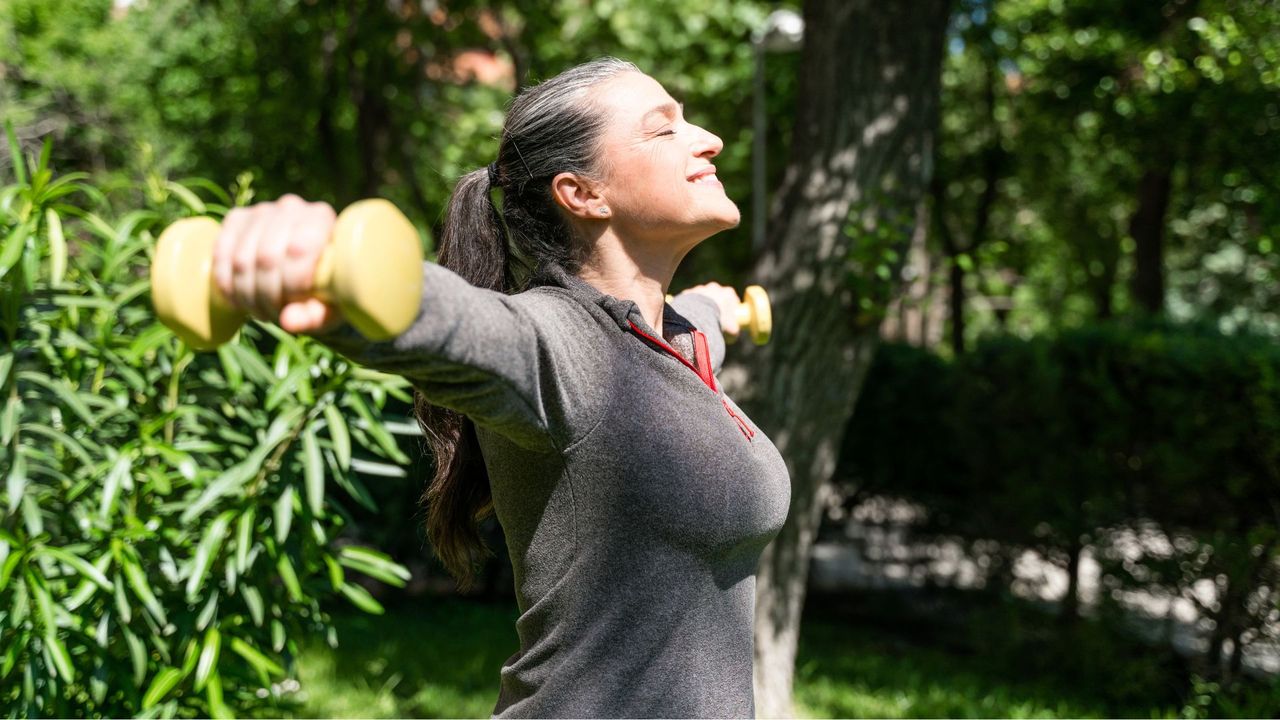
Shoulder stability and mobility become even more important as we age. It's a small part of the body, but one that's responsible for essential movements like lifting, carrying, and reaching.
There's a huge range of upper-body dumbbell workouts you can do that include shoulder exercises, but one of the "simplest" is the lateral raise, says Ben Bruno, a personal trainer who counts Jessica Biel and Chelsea Handler among his celebrity clients.

He took to Instagram to share variations of the lateral raise he puts into his sessions. "Five years ago, I started focusing on getting stronger on laterals and now use 25-30-pound dumbbells, depending on the variation," he says. "I love a little cap on the shoulders, so laterals are actually awesome for that."
Lateral raises are an isolation exercise, meaning they use fewer muscles than other moves such as chest press (a compound exercise). If you try to lift something too heavy, you’ll probably 'swing' the dumbbells more than you'll do the actual movement.
Light weights only here. The PT says many of his female clients start with 5lb (2.2kg) weights before building up to 8- 10 lb (3.6- 4.5 kg) after concentrating on their form and movement control.
A post shared by Ben Bruno (@benbrunotraining)
A photo posted by on
How to do a lateral raise
- Stand shoulder-width apart with two dumbbells by your sides.
- Brace your core and retract your shoulders by bringing your shoulder blades back and down.
- Lift the weights to shoulder height, keeping your arms straight.
- Pause at the top, then lower your arms back down slowly.
- Try doing three sets of 10 reps, either with both arms at once or one at a time.

A hexagonal set of dumbbells may feel a little more stable than round ones. You can put them on the floor without worrying about them rolling away, and this set comes with two included.
Ben shares nine ways of doing a lateral raise. Along with traditional dumbbell and cable lateral raises, he combines the movement with lunges, split squats, and a side plank variation to make it easier to do your regular full-body dumbbell workout.
"I see so many complex form tutorials for lateral raises online, and I’ve never understood that because form-wise it’s one of the simplest moves there is in my mind," he says. "I try to keep my arms straight and lift in a way that I could pause each rep at the top, but not robotically slow."
You'll notice that he's using the same weight across all the variations. "Even the split squat iso[lation] holds," he says. "So even though there's a lower body stability component, it's still really hard for the shoulders."
If you’re new to lateral raises, remember to start light and speak to a physio or PT for advice about how to do it with correct form and avoid injury.







