Get all your news in one place.
100's of premium titles.
One app.
Start reading
LiveScience
LiveScience
Ivan Farkas

James Webb telescope detects 'galaxy-killing wind' near the dawn of time — and it could preview the death of the Milky Way

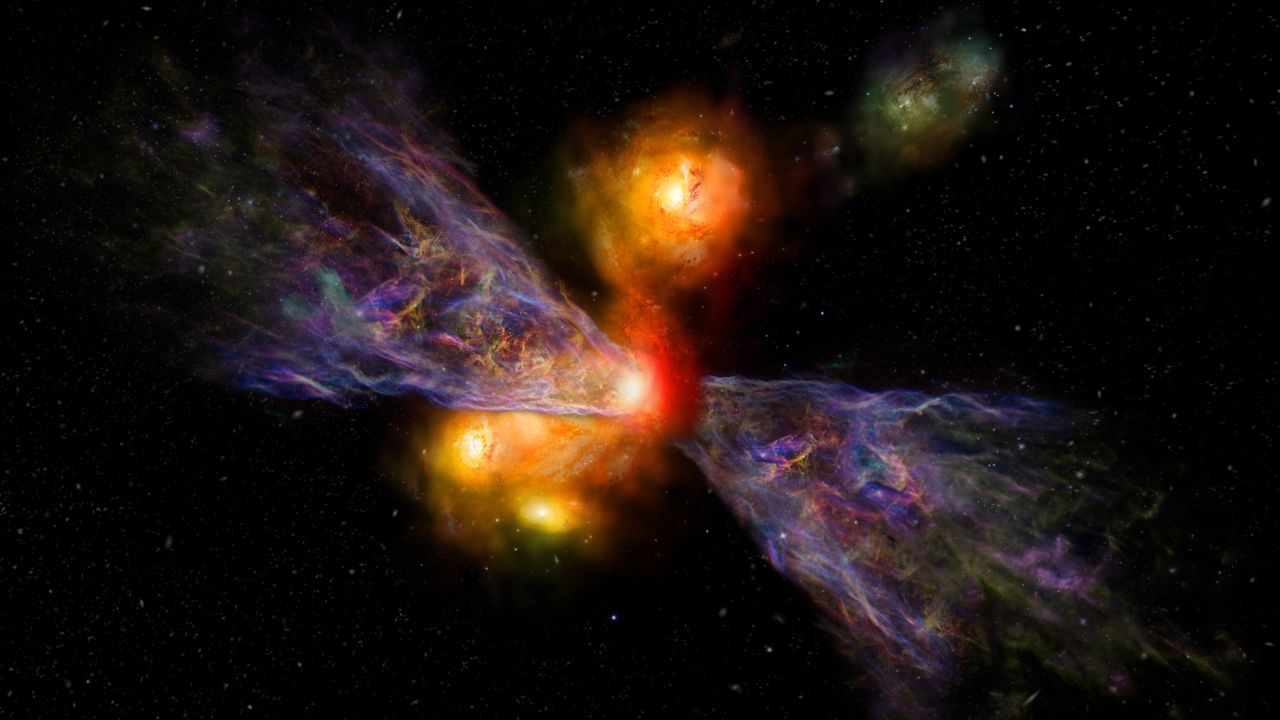
An illustration of the galaxy system CRISTAL-02, with an outflow of gas almost as large as the system itself, suggesting that star-forming gas is streaming away. .

When galaxies collide, it's less like a train wreck and more like a marriage: Two separate entities merge into a single massive celestial structure. But relationships are hard, whether you're a human or a galaxy — and this process may also "kill" the merging galaxies by unleashing star-quenching winds.

This mechanism may help to explain an enigma in the early universe. A glut of James Webb Space Telescope (JWST) observations have shown that galaxies grew surprisingly massive within 1 billion years of the Big Bang. Just as unexpectedly, many of these galaxies appear to have already stopped producing stars and grown quiescent (or dead) only about a billion years later.

Sign up to read this article
Read news from 100's of titles, curated specifically for you.
Already a member? Sign in here
Related Stories
Top stories on inkl right now
One subscription that gives you access to news from hundreds of sites
Already a member? Sign in here
Our Picks
Fourteen days free
Download the app
One app. One membership.
100+ trusted global sources.