
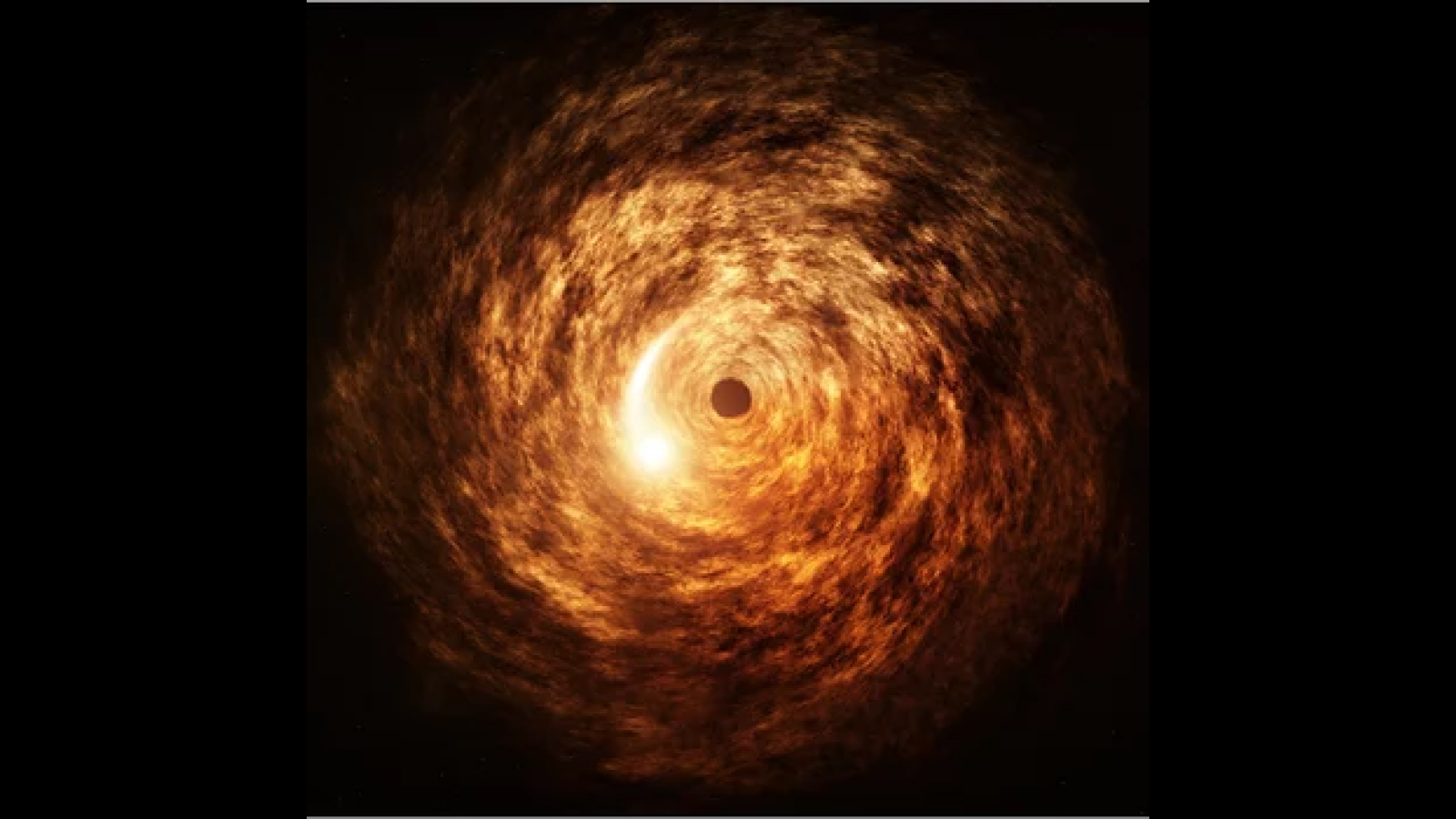
The James Webb Space Telescope (JWST) has detected a flare from the supermassive black hole at the center of the Milky Way — and it could help explain why these strange outbursts occur..
Sagittarius A* is 4 million times the mass of the sun and sits 26,000 light-years away from Earth, according to NASA. The disk of dust and gas orbiting this black hole regularly sends off flares, or high-energy flashes of light, probably caused by magnetic field disturbances. Simulations hint that flares happen when two magnetic field lines connect, releasing a burst of energy, researchers from the Max Planck Institute for Radio Astronomy in Germany said in a statement. Energized electrons zip along these connected lines at near the speed of light, emitting high-energy radiation photons, or light particles.