
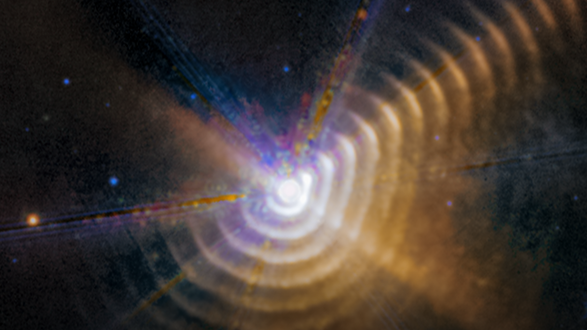
Life as we know it is based on carbon chemistry, and now the James Webb Space Telescope may have shown where much of that carbon originates. The discovery is thanks to shells of carbon dust expanding outward from a duo of massive stars.
The system in question is called WR 140, and incorporates two massive stars that will both ultimately go supernova. Located just shy of 5,000 light-years away from us in the constellation of Cygnus, the Swan, one of the stars is a massive O-type behemoth — the hottest, most luminous kind of star with a powerful wind of radiation. Its partner is a Wolf–Rayet (WR) star. Such stars are massive as well, but toward the end of their life they become tumultuous as internal instabilities lead them to hurriedly shed mass in bursts and torrents, ultimately revealing their evolved interiors.