
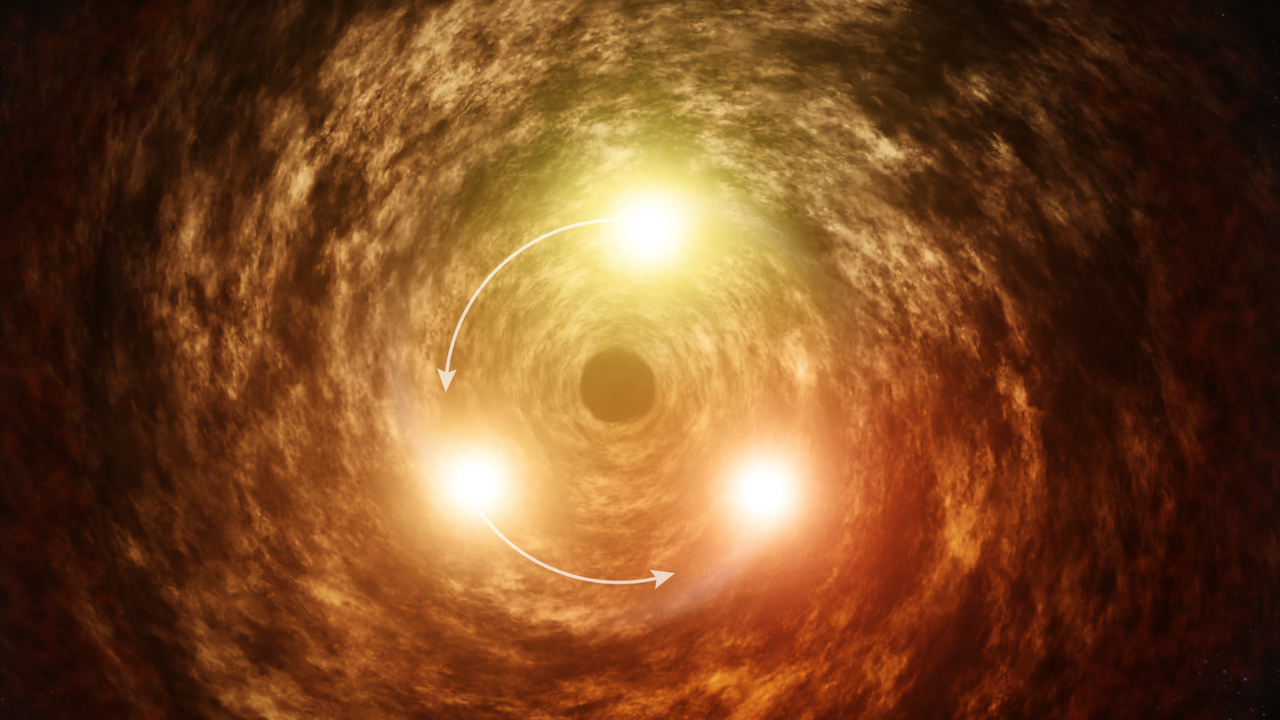
Astronomers have used the James Webb Space Telescope (JWST) to observe flares from Sagittarius A*, the supermassive black hole at the heart of the Milky Way, in a new light. The new modelling of these observations could help scientists get to the bottom of how black holes launch these flares, as well as reveal the role magnetic fields play in sculpting matter around these cosmic titans.
The team, including Sebastiano von Fellenberg of the Max Planck Institute for Radio Astronomy in Bonn, Germany, observed flaring from Sagittarius A* (Sgr A*) in the mid-infrared regime for the first time. Flares have been routinely observed in the near infrared regime and in other wavelengths of light before, with each offering a different view of the same flares. That is because all the changes that happen to a black hole flare after its launch and before it fades aren't present in all different wavelengths of light. Thus, observations of a flare in different wavelengths can help better understand the mechanisms black holes use to launch flares and the timescales over which these flares evolve.