
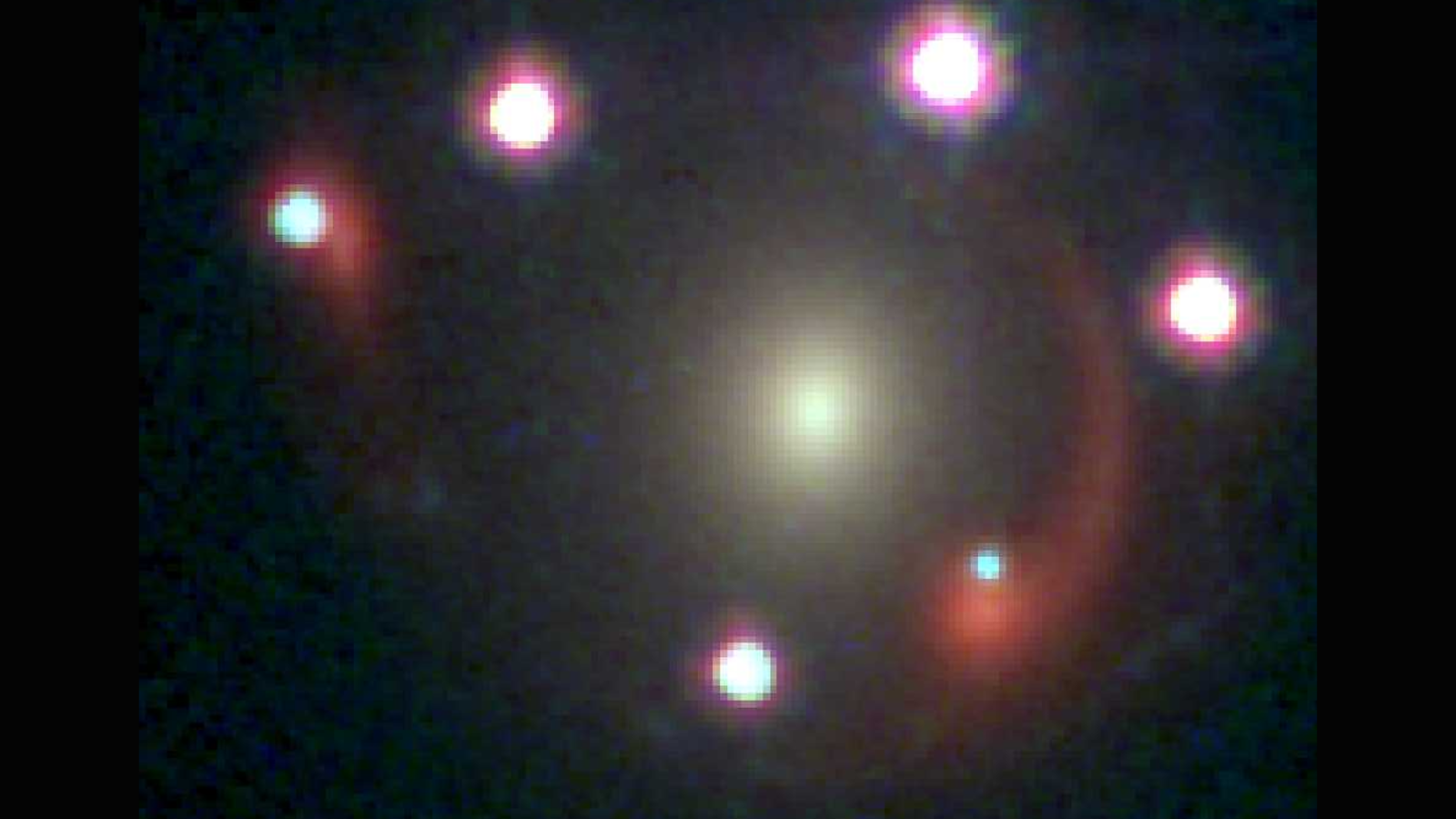
Using the James Webb Space Telescope, astronomers have discovered the first "Einstein zig-zag," an image of one quasar repeated six times in a single image. The arrangement was created thanks to an effect first proposed by Albert Einstein in 1915 called "gravitational lensing," and it could help scientists avert a crisis in cosmology.
This system, designated J1721+8842, is comprised of a quasar — which is an extremely luminous galactic core — lensed by two widely separated, but perfectly aligned, galaxies. Not only is this sighting incredibly rare, marking a fascinating example of a curious spacetime-bending phenomenon introduced in Albert Einstein's magnum opus theory of gravity, general relativity, but the J1721+8842 zig-zag also has a power that standard gravitational lenses don't.
The first Einstein zig-zag seen by humanity could help scientists tackle two of cosmology's greatest mysteries. The first mystery concerns is the nature of dark energy, or the force driving the accelerating expansion of the universe that accounts for around 70% of the cosmic energy and matter budget, and the second has to do with a disparity scientists find when measuring the value of the speed of the universe's expansion: the Hubble constant.















