
Get all your news in one place.
100's of premium titles.
One app.
Start reading
Space
Space
Science
Monisha Ravisetti

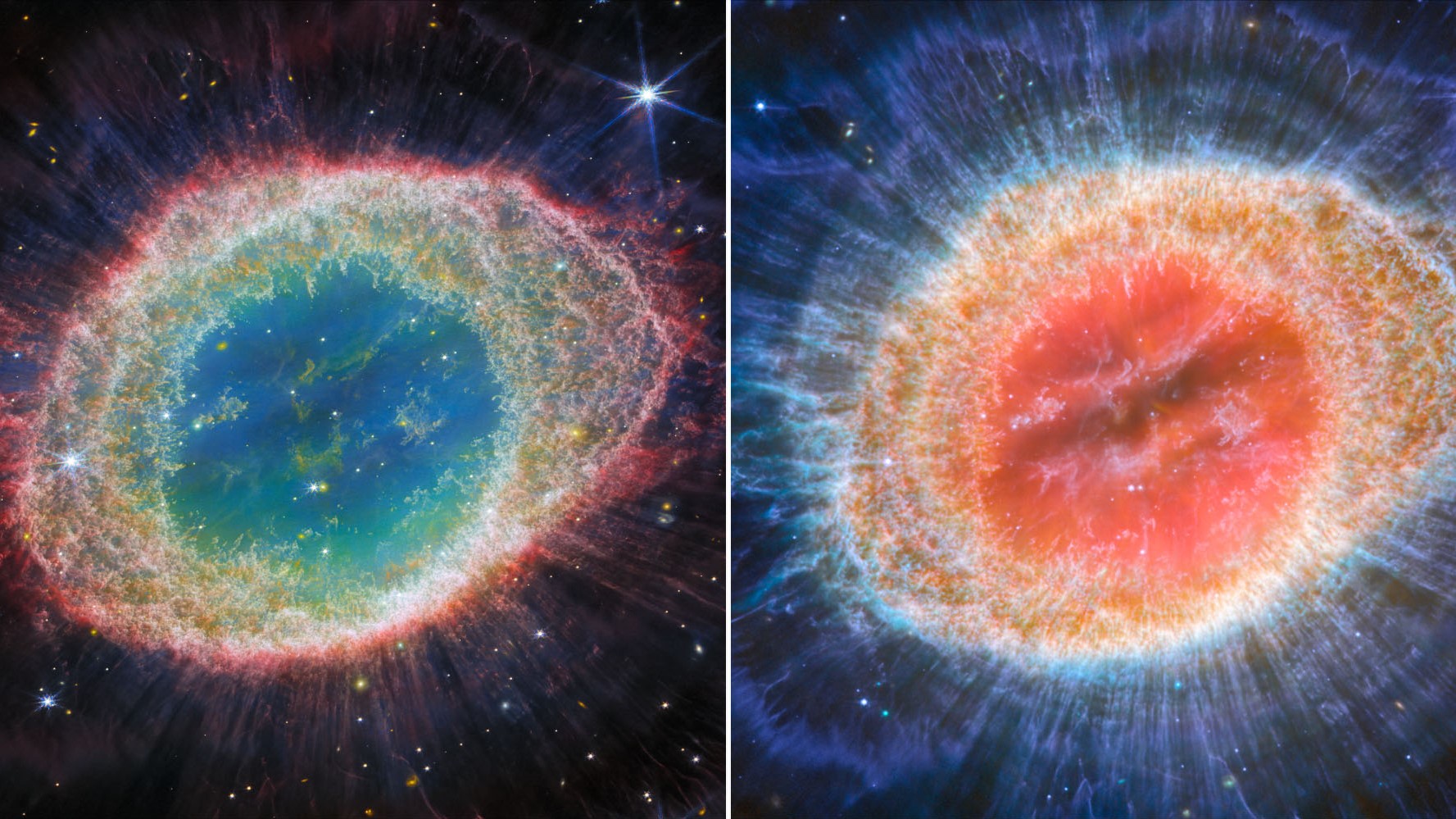
James Webb Space Telescope offers a mesmerizing look at the Ring Nebula (photos)

Side-by-side images of the Ring Nebula where the nebula appears as a distorted doughnut. On the right, the nebula’s inner cavity hosts shades of blue and green, while the detailed ring transitions through shades of orange in the inner regions and pink in the outer region. On the left, the nebula’s inner cavity hosts shades of red and orange, while the detailed ring transitions through shades of yellow in the inner regions and blue/purple in the outer region. The ring’s inner region has distinct filament elements.

Approximately 2,200 light-years from where you're sitting lie the Cheerio-shaped remains of a dying star — remnants that form a structure famously known as the Ring Nebula. And on Monday (Aug. 21), scientists announced the James Webb Space Telescope has struck gold once again, earning a rather beautiful new view on this iconic cosmic halo.

"When we first saw the images, we were stunned by the amount of detail in them. The bright ring that gives the nebula its name is composed of about 20,000 individual clumps of dense molecular hydrogen gas, each of them about as massive as the Earth," Roger Wesson of Cardiff University said in a statement.

Sign up to read this article
Read news from 100's of titles, curated specifically for you.
Already a member? Sign in here
Related Stories
Top stories on inkl right now
One subscription that gives you access to news from hundreds of sites
Already a member? Sign in here
Our Picks
Fourteen days free
Download the app
One app. One membership.
100+ trusted global sources.