
Get all your news in one place.
100's of premium titles.
One app.
Start reading
Space
Space
Science
Robert Lea

James Webb Space Telescope finds 'puffball' exoplanet is uniquely lopsided

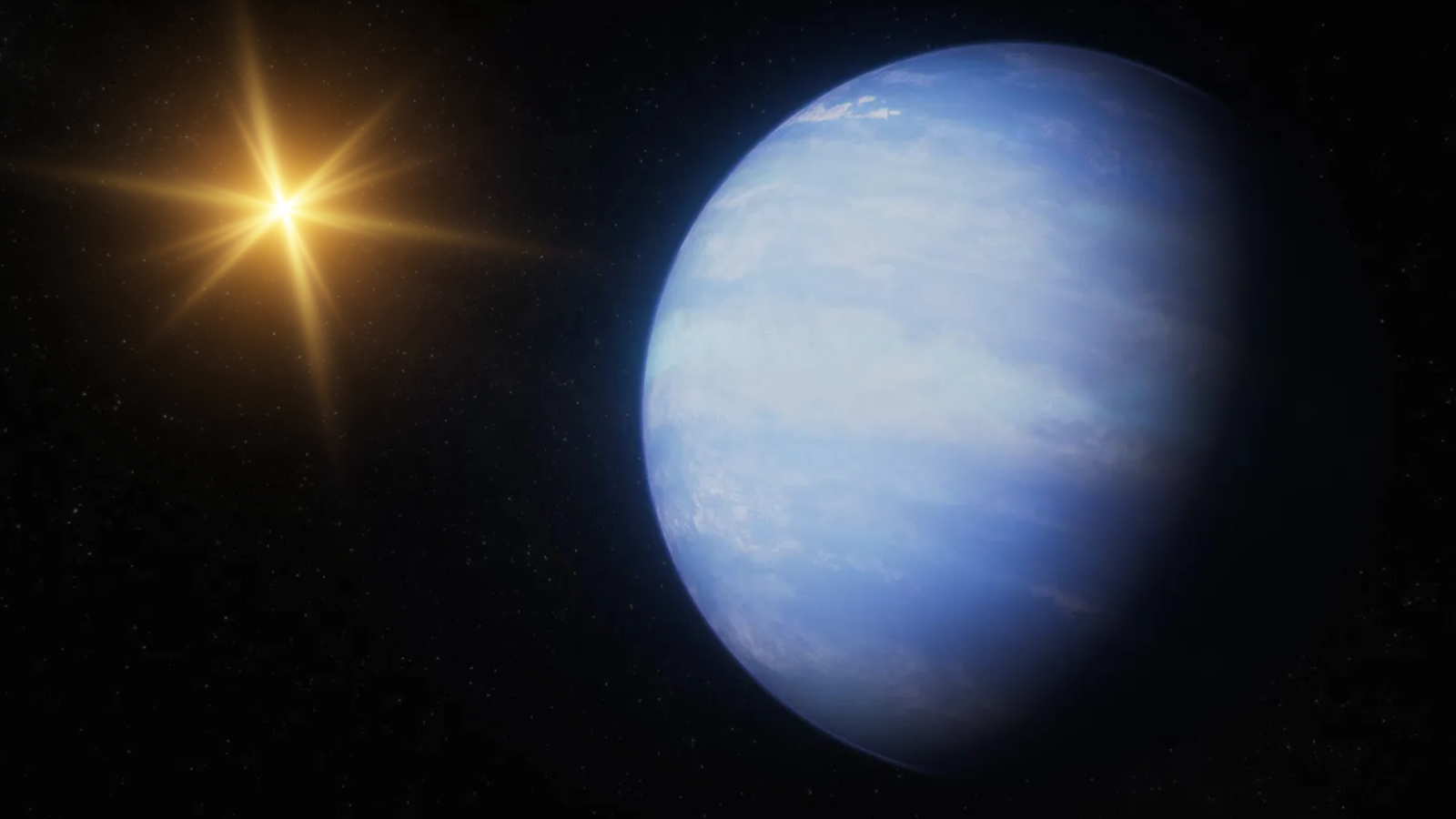
An illustration of the inflated exoplanet WASP-107 b orbiting its star.

Using the James Webb Space Telescope (JWST), astronomers have discovered that a "puffy" planet is asymmetric, meaning there is a significant difference between one side of the atmosphere and the other.

The extrasolar planet or "exoplanet" in question is WASP-107 b, which orbits an orange star smaller than the sun located around 210 light-years away. Discovered in 2017, WASP-107 b is 94%  the size of Jupiter but only has 10% of the mass of the solar system gas giant. This means it is one of the least dense exoplanets ever discovered, far "puffier" than expected. 

Sign up to read this article
Read news from 100's of titles, curated specifically for you.
Already a member? Sign in here
Related Stories
Top stories on inkl right now
One subscription that gives you access to news from hundreds of sites
Already a member? Sign in here
Our Picks
Fourteen days free
Download the app
One app. One membership.
100+ trusted global sources.