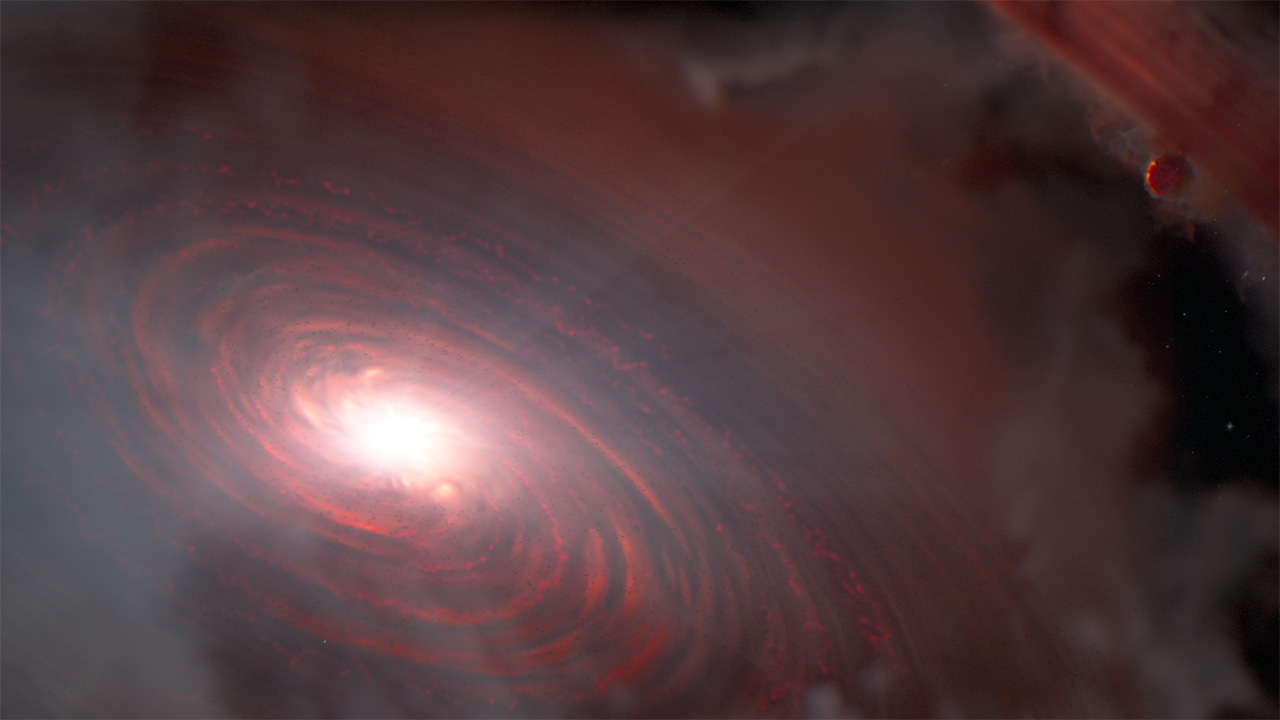
Left of center, a bright light source illuminates a surrounding disk colored dusky red. The disk is tilted from upper left to lower right, and has spiral features that are most prominent near the star. Small, rocky objects are scattered throughout the inner disk. At upper right, there is a gap through which background stars can be seen. At the outer edge of this gap is a dusky globe representing a gas giant planet. Beyond it, in the top right corner, is additional outer disk material, some of which is falling onto the planet.
The James Webb Space Telescope (JWST) has spied planet-forming disks letting off a cold "steam," providing crucial evidence for a leading theory describing how planets are built.
This excess water vapor was detected by the James Webb Space Telescope in two compact disks of gas and dust surrounding young stars that are just 2 million to 3 million years old — which is incredibly young in the scope of our universe's timeline. The disks are located in the Taurus star-forming region, which sits about 430 light years away.
Sign up to read this article
Read news from 100's of titles, curated specifically for you.