Most of us know Janmashtami. Many know about Krishna's playful stories in Vrindavan. But there is another festival where Krishna, or a form of Vishnu depending on the regional tradition, is quite literally taken out for a water journey. Sounds almost like a divine boat day, right? That is the charm of Jal Jhulni Ekadashi. The festival is particularly visible across parts of Rajasthan, Madhya Pradesh and Gujarat, where temples can turn the occasion into colourful processions filled with flowers, music, bhajans and decorated palanquins. In some traditions, the deity is taken to a river, lake, pond or temple tank for a ceremonial water ride or bathing ritual. And there is more to this seemingly simple journey than meets the eye.

So, what exactly is Jal Jhulni Ekadashi?
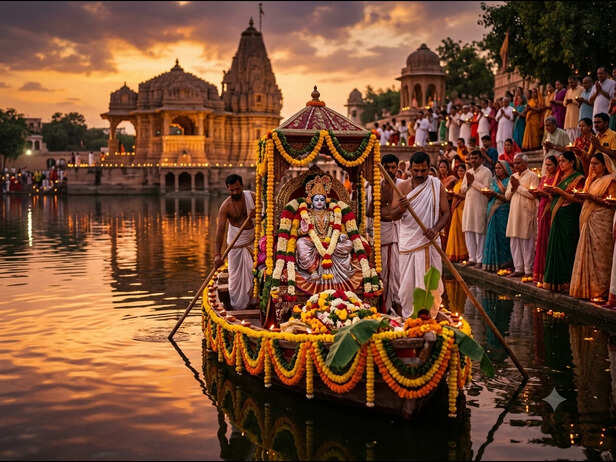
Jal Jhulni Ekadashi falls on the 11th day of the bright fortnight of Bhadrapada and is associated with several names, including Parivartini Ekadashi and Jal Jhilani Ekadashi. The name itself gives away part of the story. "Jal" refers to water, while "Jhulni" or "Jhilani" is associated with swinging or gently rocking on water. The most eye-catching tradition is the Jal Vihar, or water journey. A temple deity is dressed in elaborate clothes and ornaments, placed in a palanquin and taken in a procession towards a water body. At the water's edge, prayers are performed and, in traditions where a boat is used, the deity is placed in it for a symbolic ride. Devotees accompany the ritual with devotional singing and celebrations. So yes, the image of Krishna "travelling" on water is not just poetic language. It reflects an actual ritual observed in several communities.
The Krishna connection makes the festival even sweeter
One popular tradition connects Jal Jhulni Ekadashi with Krishna's playful association with the Yamuna. According to a tradition preserved by the BAPS, Shri Krishna took the Gopis sailing on the Yamuna and asked for yogurt as the fare for the ride. This is why donating curd is also associated with the day in that tradition. There is something particularly beautiful about this interpretation. Instead of portraying Krishna only as a distant divine figure, the tradition remembers him through an intimate, almost playful image: a boat, the Yamuna, his companions and a simple offering of curd. That everyday quality is part of what makes the festival feel so different from grander religious celebrations.
But why does Vishnu suddenly "turn" on this day?
Here comes the other side of the festival. Jal Jhulni Ekadashi is also known as Parivartini Ekadashi, with "Parivartini" referring to a change or turning. According to Vaishnava tradition, Lord Vishnu enters a period of yogic sleep during Chaturmas. On this Ekadashi, he is believed to change his sleeping position, symbolising a shift during this sacred four-month period. This is why the festival has two fascinating layers. One is cosmic and deeply symbolic: Vishnu turns in his divine sleep. The other is wonderfully visual and celebratory: the deity leaves the temple and journeys towards water. Together, they make Jal Jhulni more than just another date on the religious calendar.
The festival can look completely different depending on where you are
There is no single uniform Jal Jhulni celebration across India. In parts of Madhya Pradesh, beautifully decorated Krishna idols are carried in swings or palanquins through the streets, accompanied by bhajans, traditional performances and dancing. In Rajasthan, the celebration can become much larger. At the Shri Sanwaliya Seth Temple in Mandaphiya, Chittorgarh, the 2026 festivities are scheduled across September 21 to 23, with processions, devotional performances and a ceremonial journey of the deity to a local water body. In Gujarat and Swaminarayan traditions, the ritual can involve placing a small murti in a decorated boat and taking it across a river, lake or temple water body while devotees perform aarti and sing bhajans. So the festival has a common emotional thread, but the actual celebration changes from place to place.
More than a boat ride, it is a festival about movement
Perhaps the most interesting thing about Jal Jhulni Ekadashi is the idea of movement. The deity moves from the temple to the water. Vishnu symbolically changes his position. Devotees move together through the streets in a procession. And spiritually, the festival represents a transition within Chaturmas. That makes the water ritual feel less random. Water itself has long carried associations of purification, renewal and life in Indian religious traditions. For devotees, taking the deity towards water becomes an act of affection and service, while the songs, procession and shared rituals turn personal devotion into a community experience. The festival offers a glimpse into one of those lesser-known traditions that can easily get overshadowed by India's more famous festivals.
When Krishna Takes a Boat Ride
Jal Jhulni Ekadashi may not have the celebrity status of Diwali or Janmashtami, but its rituals tell a surprisingly intimate story. A decorated deity is carried out of the temple. Devotees walk alongside, singing and praying. Eventually, the journey reaches the water, where Krishna or Vishnu is symbolically taken for a Jal Vihar, turning an ordinary water body into the centre of a sacred celebration. And perhaps that is what makes this festival so memorable. For one day, devotion is not just something that happens inside a temple. It steps outside, travels through the streets and floats on water.
Unlock insightful tips and inspiration on personal growth, productivity, and well-being. Stay motivated and updated with the latest atMy Life XP