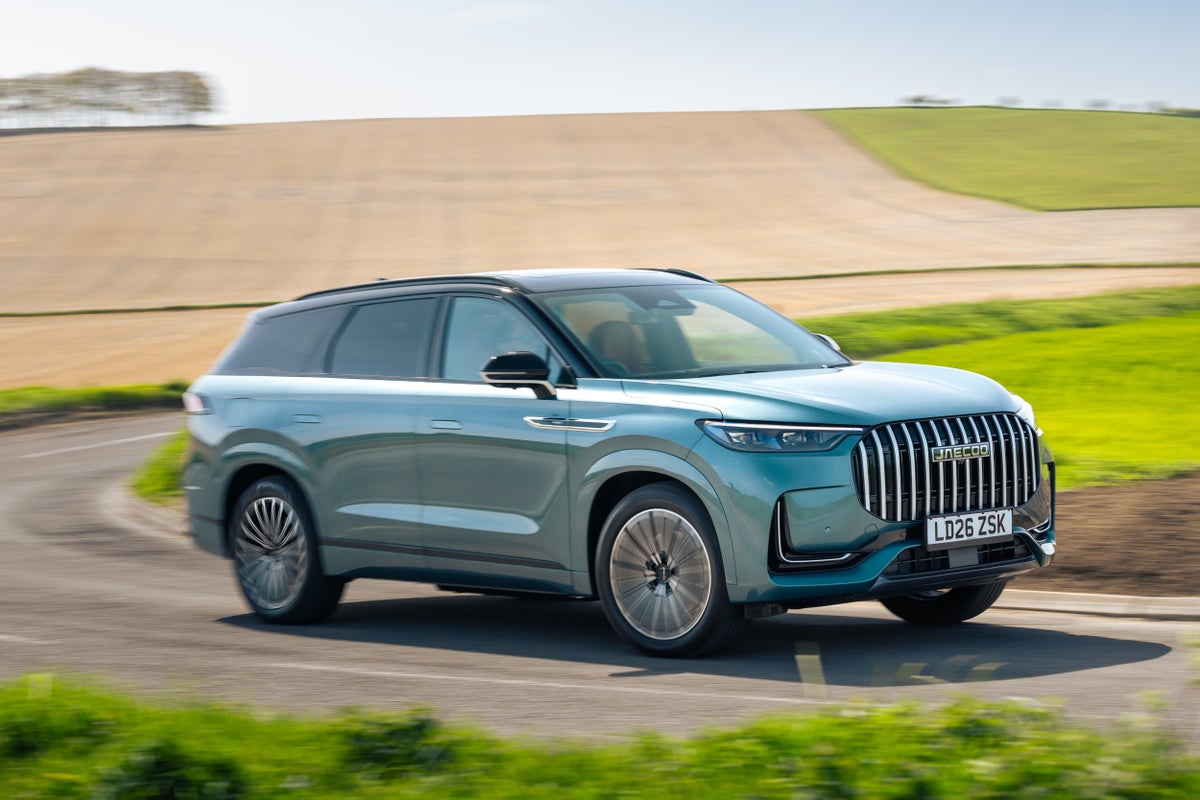
It hasn’t taken Jaecoo long to go from being a brand most people had never heard of to having a range that now stretches all the way up to this, the Jaecoo 8. And there’s nothing shy or retiring about the company’s new flagship.
It’s a striking-looking thing, particularly from the front where that huge waterfall grille gives it plenty of presence and character. From the side there’s more than a hint of Range Rover Velar to the shape and proportions, which makes the pricing all the more interesting when you get to that later.
The Jaecoo is ever-so-slightly longer than a Velar, although it’s a little narrower. At 4,820mm long, 1,930mm wide and 1,710mm tall, with a 2,820mm wheelbase, this is a big car whichever way you look at it, although unlike the five-seat Velar the Jaecoo has three rows of seats. You can have it as the seven-seat Luxury, officially described as a 5+2, or the six-seat Executive 4+2 with four individual captain’s chairs.
My car was the latter, finished in Amazonite Blue with Cognac Synthetic leather, and it certainly looked the part. The paintwork was good, the detailing felt properly considered and, inside, the overall style and quality make a strong first impression. There are still one or two plastics that aren’t as plush as I’d have hoped in something that’s clearly trying to feel premium, but there’s plenty here that looks and feels expensive.
Jaecoo has also managed to get from its smaller models to the 8 pretty quickly, and my time in the car suggested the learning is happening just as fast. Some of the things I’ve criticised on other Jaecoos have already improved noticeably here, particularly the driver-assistance systems. There are still bits to work on, but this feels like a more mature Jaecoo.
How we tested
I drove the Jaecoo 8 extensively, including a 400-mile return day trip from London to Liverpool, assessing its comfort, efficiency, driver-assistance systems, technology, passenger space and everyday usability. It got the usual Fowler car park test to assess how easy it is to use day-to-day, too.
Jaecoo 8: £45,500, Jaecoo.co.uk
Independent rating: 8/10
- Pros: Striking looks, smooth and efficient plug-in hybrid system, seriously strong performance, impressive electric range, upmarket cabin, loads of equipment
- Cons: Touchscreen operation takes some learning, driver display is difficult to read, shallow rear window, ride can get bobbly, some plastics disappoint, third row is tight
Jaecoo 8 specs
- Price: £45,500
- Engine/Battery size: 1.5-litre/34.46kWh
- Maximum claimed range: Over 700 miles
- Electric-only range: 83 miles
- Charging : 70kW, 30 to 80 per cent in around 20 minutes
Battery, range, charging, performance and drive
Like other plug-in hybrids from the wider Chery Group, the Jaecoo 8 uses what the company calls its Super Hybrid System, now badged SHS-P for its plug-in hybrid models. There’s a 1.5-litre turbocharged petrol engine, a three-speed dedicated hybrid transmission, all-wheel drive and a sizeable 34.46kWh battery.
Combined output is 422bhp with 580Nm of torque, so performance is seriously quick for such a large family SUV. The 0-62mph sprint takes just 5.8 seconds and top speed is 112mph. Do you really need a big six- or seven-seat SUV to accelerate that quickly? Probably not, but there’s certainly no shortage of performance when you want it.
More useful is the maximum claimed electric range of 83 miles, which is impressive for a plug-in hybrid. In fact, for a lot of normal day-to-day use I’d simply run the Jaecoo in EV mode. When the petrol engine does join in, the transition between the two power sources is impressively smooth, just as I’ve found with other Chery Group plug-in hybrid systems.
My biggest test was a return day trip from London to Liverpool, around 400 miles in total. The football finished 0-0, so it was a rather longer-feeling journey home than I’d hoped, but the Jaecoo made a very good long-distance companion. Even after all that mileage, there was enough indicated range left between the fuel tank and battery for me to turn around and go a very long way back in the direction I’d just come from – if I wanted to. Better still, although the car had been running as a hybrid for much of the journey, it was still showing some electric range when I got home.
Jaecoo claims more than 700 miles of total driving range from a full 70-litre tank and fully charged battery. The battery can (fairly) rapid charge at up to 70kW, with a claimed 30 to 80 per cent time of around 20 minutes, while the technical information lists 5.5 hours for a full AC charge. There’s also 6.6kW vehicle-to-load capability for powering electrical equipment externally.
The chassis gets standard continuous damping control, adaptive suspension and all-wheel drive, while this is the first Jaecoo to get lockable differentials alongside the company’s adaptive all-terrain system. Ground clearance is 162mm and the quoted wading depth is 600mm.
On the road, though, it’s the way the Jaecoo behaves in normal driving that’s more relevant. The ride can get a little bobbly at times, but the body control is good. This isn’t one of those big SUVs that floats and wallows around when the road starts twisting but it doesn’t ride as firmly as some Audi SUVs do.
The bigger improvement is in the driver assistance. On that long motorway run, the adaptive cruise control and lane-keeping assistance were way better than I’ve experienced in any other Jaecoo. The various warning beeps appear to have relaxed a little, too. They can still be more annoying than in some rivals, but the direction of travel is encouraging. Jaecoo appears to be listening.
Interior, practicality and boot space
The Jaecoo 8 is available in two different seating arrangements. The £45,500 Luxury has seven seats in a conventional 5+2 layout, while the £47,500 Executive I drove swaps the middle-row bench for two substantial individual captain’s chairs, making it a 4+2 six-seater.
Those captain’s chairs certainly help give the Executive its limousine-like feel. All four main seats are heated, ventilated and have massage functions, and the front passenger gets what Jaecoo calls a zero-gravity seat, with a 123-degree adjustable angle and a Boss Button that allows its position to be controlled more easily. There’s extendable thigh support for the driver, too.
The problem is that those huge middle-row chairs inevitably take up space. They don’t do third-row legroom or access to the very back any favours and, although the two rear seats themselves are pretty substantial, headroom is very tight for adults once you’re right at the back. Personally, if I regularly needed all three rows, I think the seven-seat Luxury without those enormous captain’s chairs would make more sense.
The rest of the cabin is a much happier story. Jaecoo has clearly worked hard on the look and feel of the 8 and, for the most part, it’s paid off. The design is clean rather than fussy, there’s a panoramic roof bringing plenty of light into the cabin and the main surfaces look and feel good. My Cognac-trimmed test car had a properly upmarket ambience.
Not everything quite lives up to that first impression. A few of the plastics aren’t as plush as I’d hoped, particularly when you start looking beyond the areas you first touch, but overall the quality is good and certainly consistent with the 8’s ambitions.
Jaecoo quotes 73-litres of luggage space as a five-seater, increasing to 2,021-litres with the rear seats folded. That gives the 8 the sort of carrying capacity you’d expect from a car of this size, although exactly how much usable boot you have will obviously depend on which of those rear seats are in use.
Visibility is more mixed. The view forwards and to the side is fine and the door mirrors are a good size, but the rear window is almost comically shallow. It’s more letterbox than window. Get somebody driving too closely behind you and there’s a fair chance they’ll disappear from view completely, although the 540-degree camera system does at least make parking and manoeuvring a big SUV rather easier.
Technology, stereo and infotainment
The Jaecoo 8 gets a pair of 12.3-inch displays as standard, one for the main infotainment system and another ahead of the driver. There’s also a head-up display, which is useful because the driver display itself still suffers from hopelessly small graphics and some of the information can be difficult to read quickly.
The central touchscreen is okay, although 12.3-inches now feels slightly modest in a market where rival manufacturers seem to be involved in some sort of competition to fit the biggest TV possible into their dashboards. More important is the way it works, and that takes a little getting used to.
Wireless Apple CarPlay and Android Auto both fill the entire screen, which looks good but means the normal Jaecoo shortcut keys disappear with them. That includes quick access to things such as the climate controls and, initially, even the obvious route back to Jaecoo’s own interface.
The trick is to swipe upwards from the bottom of the display, which brings those controls back. Once you know, you know, so it’s no biggie, but other manufacturers have come up with better solutions that leave essential functions permanently accessible. You can also swipe down from the top for a selection of commonly used features, and those can be personalised, which is useful once you’ve set the car up the way you like it.
Again, what struck me was how quickly Jaecoo seems to be learning. The technology itself doesn’t feel as intrusive as it has in some earlier models and those improved adaptive cruise and lane-keeping systems made a genuine difference over hundreds of motorway miles. There are up to 19 driver-assistance systems, along with 10 airbags, blind-spot detection, rear cross-traffic alert and autonomous emergency braking.
There’s a 50W wireless phone charger, online navigation, 4G and wifi connectivity, app-based remote functions and over-the-air software updates. Jaecoo’s Hello Jaecoo voice assistant can also control various functions without having to go digging through menus.
The 14-speaker Sony audio system is reasonable, but this is one area where I think Jaecoo still has some work to do. It’s clear enough but lacks a bit of dynamism and excitement, especially in a flagship model where the rest of the equipment list is so generous.
There are a couple of speakers built into the front headrests, which is a clever touch. They allow navigation instructions or phone calls to be directed more personally towards the driver without bothering everybody else in the car. It’s the sort of thoughtful feature I like, even if the overall sound system itself could do with a bit more sparkle.
Prices and running costs
Prices start at £45,500 for the seven-seat Jaecoo 8 Luxury, while the six-seat Executive costs from £47,500. Both come on 20-inch alloy wheels with all-wheel drive, adaptive suspension, the 34.46kWh plug-in hybrid system, panoramic roof, dual 12.3-inch displays, head-up display, 14-speaker Sony stereo, wireless Apple CarPlay and Android Auto and the comprehensive safety and driver-assistance package.
The Executive brings those four individual heated, ventilated and massaging captain’s chairs, along with Nappa leather as part of its standard specification and extra interior trim upgrades. My six-seat Executive was finished in Amazonite Blue, a £750 option, with Cognac Synthetic leather at £1,000, putting the car at £49,200.
And that’s where things get interesting. An equivalent Hyundai Santa Fe is more than £10,000 dearer, while other obvious three-row rivals include the Kia Sorento and Peugeot 5008. Then there’s that Range Rover Velar resemblance. The Velar is only available with five seats, and the plug-in hybrid starts at around £7,000 more than my well-equipped Jaecoo. If it’s a similarly generous grille you’re after, an Audi Q7 will cost you more than £30,000 extra.
Of course, badge appeal is part of the equation at this end of the market and Jaecoo is still a relatively new name in Britain. But the 8 demonstrates the company’s strategy pretty clearly: give buyers the size, equipment and visual presence they associate with substantially more expensive cars, then price it far below them.
Running electrically as often as possible should make the most sense for anyone buying the plug-in hybrid. An 83-mile maximum claimed electric range gives you far more scope to do that than in plenty of PHEVs, while my long-distance drive showed how smoothly the system can fall back on petrol and electric power together when you’re covering serious mileage. Jaecoo quotes CO2 emissions of 14g/km.
The ownership cover is competitive, too. The car gets a seven-year or 100,000-mile manufacturer warranty and the battery is covered for eight years or 100,000 miles.
The verdict: Jaecoo 8
The Jaecoo 8 looks expensive, feels mostly expensive and has a smooth, efficient plug-in hybrid system. There are niggles, but against similarly sized rivals the price makes it looks pretty compelling – I’d say this is Jaecoo’s most convincing model to date.
Jaecoo 8 rivals
FAQs
How long does it take to charge?
The Jaecoo 8 has a 34.46kWh battery and supports DC rapid charging at up to 70kW. Jaecoo says charging from 30 to 80 per cent takes around 20 minutes in suitable conditions.
How much does it cost and is it worth it?
The seven-seat Jaecoo 8 Luxury starts at £45,500, while the six-seat Executive starts at £47,500. My Executive test car, with Amazonite Blue paint and Cognac Synthetic leather, was £49,200. That puts it more than £10,000 below a Hyundai Santa Fe, while combining strong performance, an 83-mile maximum claimed electric range, lots of standard equipment and an upmarket cabin. There are compromises, notably the touchscreen operation, difficult-to-read driver display, tight third row in the six-seater and some less impressive plastics.
Does Jaecoo replace batteries for free?
The Jaecoo 8’s high-voltage battery is covered for eight years or 100,000 miles, while the rest of the car gets a seven-year or 100,000-mile manufacturer warranty.
Why trust us
Our team of motoring experts have decades of experience driving, reviewing and reporting on the latest EV cars, and our verdicts are reached with every kind of driver in mind. We thoroughly test drive every car we recommend, so you can be sure our verdicts are honest, unbiased and authentic.