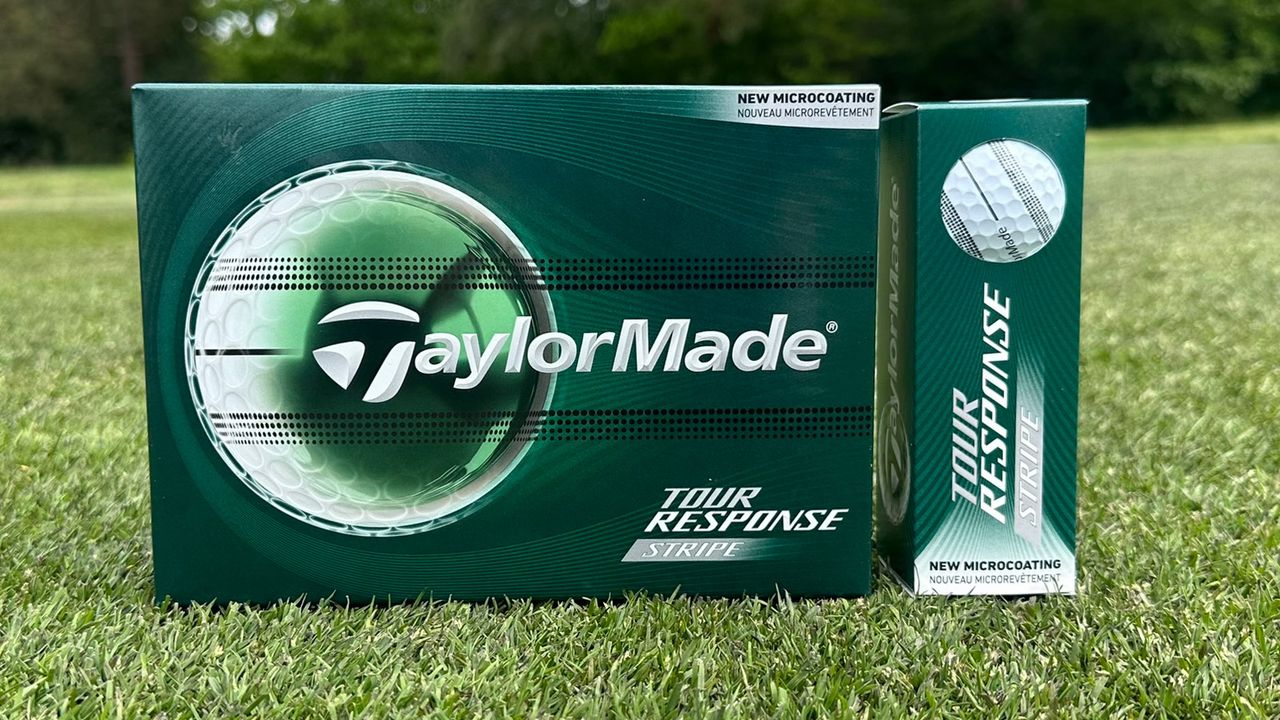
TaylorMade's Tour Response franchise has always been held in high regard in the mid-price, three-piece ball category, suiting those who want reliable performance without paying the premium price tag that comes with some of the best golf balls.
Having tested the previous iterations of this popular ball, I was keen to see how the new 2026 TaylorMade Tour Response stacked up when put to the test both indoors on a Foresight Sports GC3 launch Monitor and out on the golf course.

The big story for the 2026 Tour Response is the introduction of Microcoating technology, which TaylorMade first introduced into the TP5 and TP5x golf balls earlier in the year.
This process sees the application of an ultra-thin paint layer (thinner than a human hair) across the ball's entire surface, reducing any pooling in dimples, which ultimately affects how the ball flies through the air. This helps promote consistent peak heights, reliable distances, and a much tighter dispersion on full shots.
I'll be completely honest - I'm not a huge fan of how large the stripe is on these golf balls. I feel as though it's a little too large, and when using it, I feel my aim is far too vague.
The decreased width of the stripe on the 2026 TP5 and TP5x is exactly what I would want to have seen implemented on these golf balls, as that smaller stripe has really helped me aim more precisely and allowed me to be more diligent when setting up my putts. The stripe is also great for when practicing your putting, helping identify if you’re rolling the ball end-over-end.
One of the primary reasons recreational golfers gravitate to this ball is its feel, and the 2026 model does not disappoint, providing a really soft feel off the face with the driver, irons, and putter.
Thanks to the 100% cast urethane cover, the soft cover genuinely rivals the feel of some of the best premium golf balls on the market, and I feel it gives it a nice edge on similar balls in the price range such as the Srixon Q-Star Tour - of which I took to the studio and the course to compare the performance.
When hitting chips and pitches, that urethane cover on the Tour Response provided exceptional greenside spin, even on firm playing surfaces. It offered brilliant trajectory control and stopping power, and looking at the data from my 50-yard pitch test, the Tour Response edged out the Srixon Q-Star Tour with a spin rate of 7945 rpm compared to the Srixon's 7890 rpm.
The Tour Response also launched slightly higher (30.3° vs. 28.7°), which gave me that quick check-and-stop performance I look for around the greens and made it perfect for when short-sided and playing over bunkers.
Taking both balls indoors and using the GC3 launch monitor, the 2026 Tour Response held its own beautifully, demonstrating its ability to excel in this category and arguably punch a little heavier than its weight.
When testing with my 7-iron, the high-flex SpeedMantle layer within the Tour Response showcased its energy transfer capabilities, producing a touch more speed at 129.2mph, as opposed to the 125.3 of the Q-Star Tour. However, it was the additional spin that caught my attention, with the Tour Response spinning noticeably more (6631 rpm compared to 6290 rpm).
Due to the higher spin, the carry distance was a fraction shorter at 182.1 yards versus 183.4 yards for the Srixon, but I did see the ball falling at a noticeably steeper descent angle. I’ll happily sacrifice a single yard of carry for the added stopping power that the 6600+ rpm spin provides, particularly in the summer.
Off the tee, the Tour Response's Speed Wrapped Core - a soft inner core with a progressively firmer outer layer - did its job in generating fast ball speeds, very comparable to some of the premium balls I have tested this year, such as the Callaway Chrome Tour and its elder sibling, the TP5.
I clocked ball speeds of 167.9 mph with the Tour Response, compared to 164.8 mph with the Q-Star Tour with my driver. This little boost in speed, combined with a slightly lower launch (13.9°) but a towering peak height of 125 feet, gave me a carry distance of 291.3 yards - nearly two yards longer than the Srixon.
Now don’t get me wrong, two yards isn’t much to shout about, but with a little more spin and a touch higher flight, I felt a little more in control of the Tour Response.
When comparing the Tour Response to the TP5, I was seeing around 800rpm more with a 7-iron and around 400rpm more with the driver, which is what saw it lose around 13 yards of carry compared to the brand's premier model (291 yards vs 304 yards). Other than that, the short game control felt very comparable, and there was little to no difference when it comes to the face off the putter.
TaylorMade has managed to refine an already excellent golf ball and make this ball a serious proposition for those wanting tour-level performance at a considerably cheaper price point - $45/£39 for the Stripe model.
The introduction of Microcoating on these balls alongside the TP5 and TP5x golf balls shows just how dedicated the TaylorMade team is to producing a reliable and more affordable golf ball, and the narrowed Stripe design is a massive improvement for visual alignment.
If you are looking for a three-piece ball that produces fast ball speeds, towering iron shots, and offers plenty of short game control all at a reasonable price point, the 2026 TaylorMade Tour Response should be firmly on your radar.