Get all your news in one place.
100's of premium titles.
One app.
Start reading
Tom’s Guide
Tom’s Guide
Technology
Jason England

'It’s going to be that shift from phones to glasses': Snap Specs chief on design, target audience and that $2,200 price tag

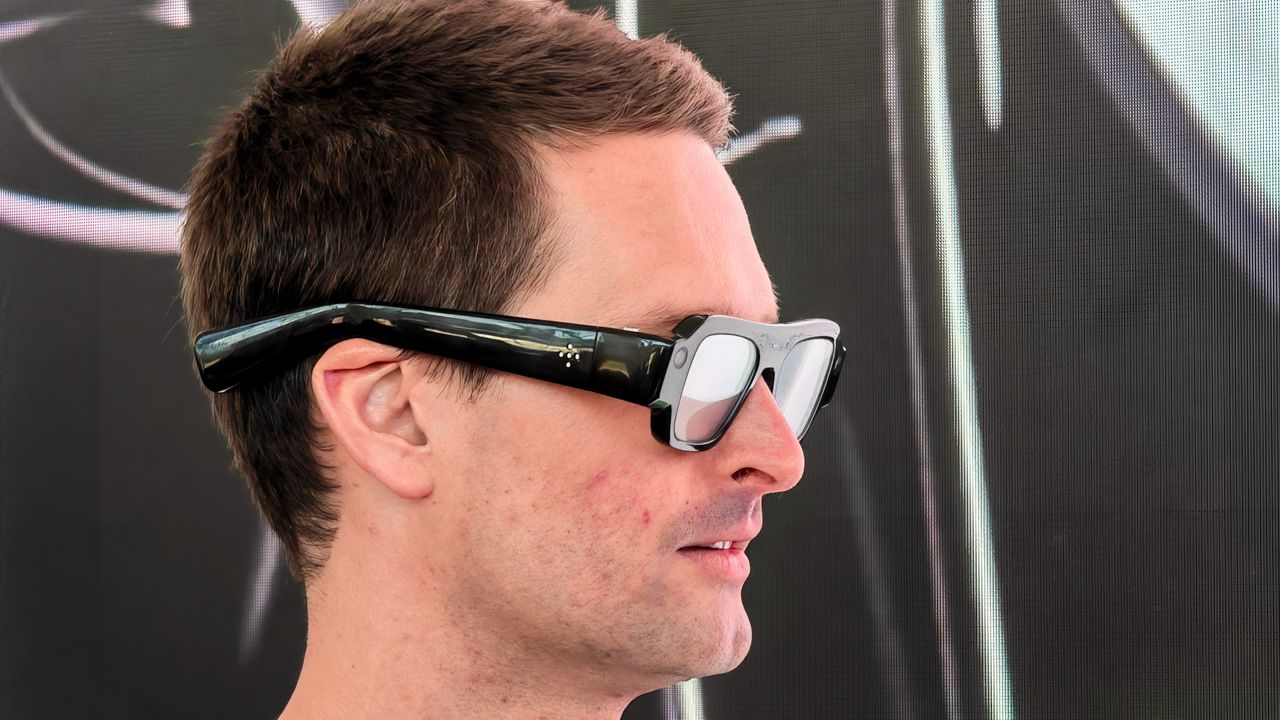
Snap Specs.

Snap Specs are a very ambitious pair of AR glasses. They transcend that idea of AI glasses like the Ray-Ban Metas, and actually give you an Apple Vision Pro-esque experience in something much more wearable than a bulky headset with a battery pack wired to it.

But I could only imagine how much of a challenge designing something like this actually is, given the fact it’s got 2x Snapdragon chips, a battery and a ton of sensors built in (and no compute puck to offload that).

It’s a massive undertaking, so I got to chat to Russell Patton, product manager for Specs at Snap, about the past decade that has led to this moment — the challenges faced, what the Specs are, and how he sees these as a new paradigm of computing.

@tomsguide ♬ original sound - Tom’s Guide

Who are the Snap Specs for?

(Image credit: Snap)

So as I watched Evan’s keynote at AWE 2026, it’s clear he’s a fan of the Steve Jobs showmanship, and aimed for this to be Snap’s own personal iPhone moment — defining a new category of product and doing so with flair. I spoke to Russell about the idea of glasses as the next category and he provided a little more detail.

“We’ve seen these different shifts in computing happen, and we see a shift is coming,” Patton stated. “Going forward, it’s going to be that shift from phones to glasses, and I think it’s not just taking the apps that are on our phones and putting them into glasses.”

(Image credit: Future)

Instead, he theorizes a new computing generation that works around “truly spatial content,” which I’ve been able to sample a bit of over the past year in Specs’ development — AR-infused AI that’s able to not just guide you to fix a car with text, but actually label all the key components in an AR space to better aid you.

That’s one of the huge parts of Snap OS from all my experiences testing it. Visual AI from things like Gemini on Android XR products like Xreal Aura is all well and good — looking at what you’re showing and verbalizing an answer. Instead, Snap Specs and the many lenses built for it by the over 450k developers on Snap’s platform, use this in a much more visual mode, and it’s a real difference maker in spatial computing.

On designing the glasses

(Image credit: Future)

I also talked to Russell about getting to this point and designing the glasses around the huge amount of tech going into them. After speaking to Snap’s former hardware VP last year, it was clear that the mission was to make them “substantially smaller,” and Snap’s done this by working the aesthetic around the size demands of the internal hardware.

“You need to look at how we can make things efficient. How can we really take optical displays, really push down the size but at the same time deliver the capability to do true spatial computing?” Russell commented.

(Image credit: Future)

Asking more about the design, it became clear that the display optics became one of the real challenges in making these a reality. For those uninitiated, these use Waveguide display tech — tiny projectors that refract an image through millions of grooves imprinted directly onto the lenses themselves (rather than a prism like you see on other AR glasses).

“You need it to be efficient so that you can make the battery a reasonable size, and you need it to be compact so the projector is not driving the size of the glasses to be large. A huge amount of work on the optics and the entire mechanical design happened to just do a really thoughtful integration,” Russell added.

About that $2,200 price

(Image credit: Future)

Snap Specs are available to pre-order now for $2,195 (£1,995 for my fellow Brits), and they’re coming out this fall. It’s fair to assume that a lot of you reading this may see a massive price here, and that’s understandable.

Of course it's worth noting that this is defining a whole new category of wearable computing in a way your standard display glasses like the Ray-Ban Display can’t come close too. But it’s still a tough pill to swallow, so I asked Russell what the big pitch is.

“It’s about unlocking multiple categories of really exciting value,” Patton said. “So utilities, whether that’s AI assistance, measurement, listening to audio, having that large virtual display, browsing the web, or streaming video from your other device.”

A lot of AR glasses already do these things, but Russell expanded: “Using this very large external manager can create a really engaging, rich spatial AR experience. I think it’s really for someone who is excited to be experiencing a new computing platform and engage with those capabilities.”

Outlook

(Image credit: Future)

So I’ll be real — it’s clear these are for the (very rich) early adopters. But from my time talking to Russell, trying Snap OS for myself and seeing the glasses, those early adopters are in for a treat.

It’s the first true realization of my vision for smart glasses when I tested my first pair years ago: taking the computational capabilities of a bulky VR headset and squashing them down into glasses. Not only that, but taking advantage of that compression to give you some real-world killer apps.

I’m excited to try these out more as we close in on a fall launch.

More from Tom's Guide

Sign up to read this article
Read news from 100's of titles, curated specifically for you.
Already a member? Sign in here
Related Stories
Top stories on inkl right now
One subscription that gives you access to news from hundreds of sites
Already a member? Sign in here
Our Picks
Fourteen days free
Download the app
One app. One membership.
100+ trusted global sources.