Get all your news in one place.
100's of premium titles.
One app.
Start reading
Guitar World
Guitar World
Entertainment
Jim Beaugez

“It sounded too clean to me, honestly, but when I heard itwith everything else, it was amazing”: How a little songcraft and a lot less gain brought chart success for emo-punk vets Joyce Manor

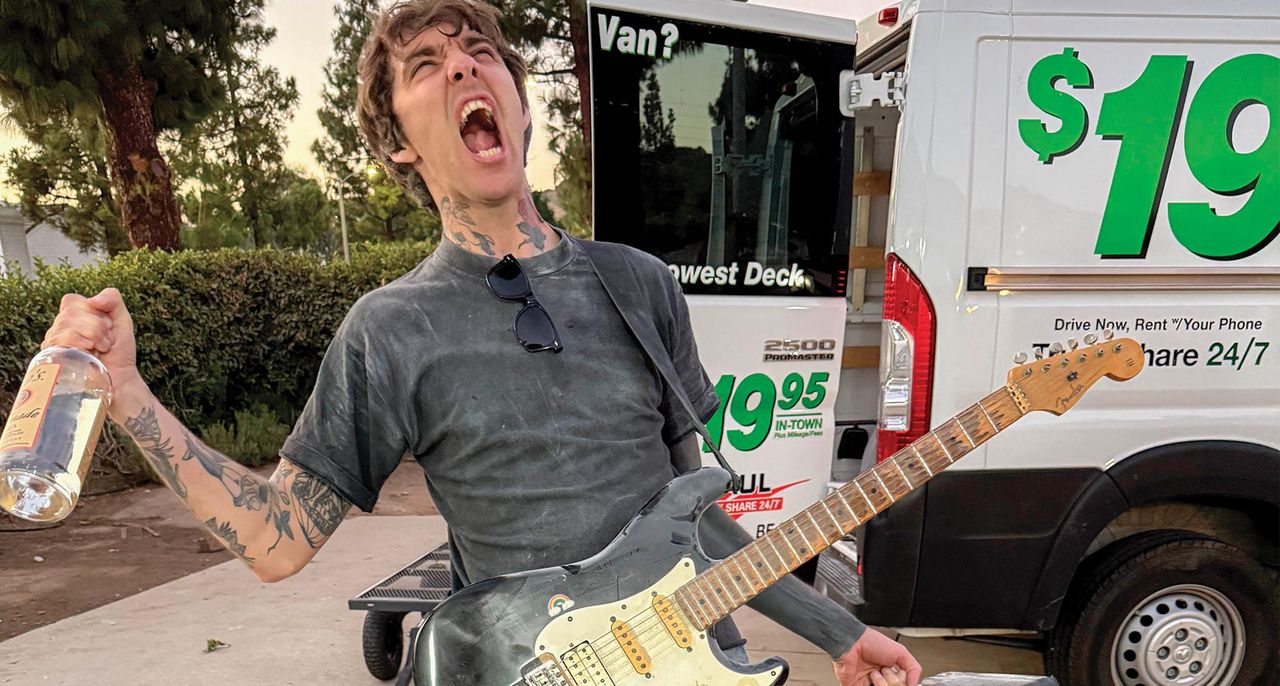
Joyce Manor's Barry Johnson with Strat, amp – and tequila.

South Bay L.A.’s Joyce Manor have built a reputation for crafting short, spirited blasts of emo-punk, but there’s something different about their latest LP, I Used to Go to This Bar. And producer Brett Gurewitz has as much to do with it as the band themselves, according to frontman Barry Johnson.

For the first time, they didn’t double-track the rhythm guitars, and they also eighty-sixed the high-gain amps. But instead of trashing the band’s energetic sound, the simplified production leveled up their performances and the guitar interplay between Johnson and co-guitarist Chase Knobbe.

“The perceived increased fidelity is just more intentional guitar sounds,” Johnson says, while Knobbe adds that Bad Religion guitarist and Epitaph label head Gurewitz didn’t labor much over guitar sounds – he simply knew what’d work.

Most of the tones on the album came from a ’50s Les Paul Junior through a vintage Fender Deluxe Reverb and a Mesa Boogie cab, with an occasional assist from a Vox AC30 and a Gibson ES-330.

“We’d get it to where the amp was on the edge of breaking up,” he says. “It sounded too clean to me, honestly, but when I heard it with everything else, it was amazing.”

That straightforward approach serves the songs well. The chord inversions on All My Friends Are So Depressed, which gave them their first Billboard hit seven albums in, wouldn’t work as well behind a wall of gain.

Even barn-burner I Know Where Mark Chen Lives benefits from the restraint as Johnson and Knobbe build the tension before detonating a powder keg on the chorus.

“The parts on this record are written very specifically,” Knobbe says. “We’ve gotten pretty obsessed with making the guitar parts kind of weave, where we’re not really playing the same parts. It’s all the same melodic information, but you find ways to sort of fuck up the rhythm a little bit so it locks in.”

The band also employed a “trick” they learned from producer Rob Schnapf, who produced 2016’s Cody.

“He’s like, ‘When you do everything four times, the listener begins to expect what you did previously. On the second verse, do something slightly different.’ It keeps the song interesting in a way, and it’s just a bit more sophisticated.”

Sign up to read this article
Read news from 100's of titles, curated specifically for you.
Already a member? Sign in here
Related Stories
Top stories on inkl right now
One subscription that gives you access to news from hundreds of sites
Already a member? Sign in here
Our Picks
Fourteen days free
Download the app
One app. One membership.
100+ trusted global sources.