
Get all your news in one place.
100’s of premium titles.
One app.
Start reading
Homes & Gardens
Homes & Gardens
Tenielle Jordison

Statement Succulents Are the New Design Essential – These 5 Low-Effort Varieties Will Transform Your Home

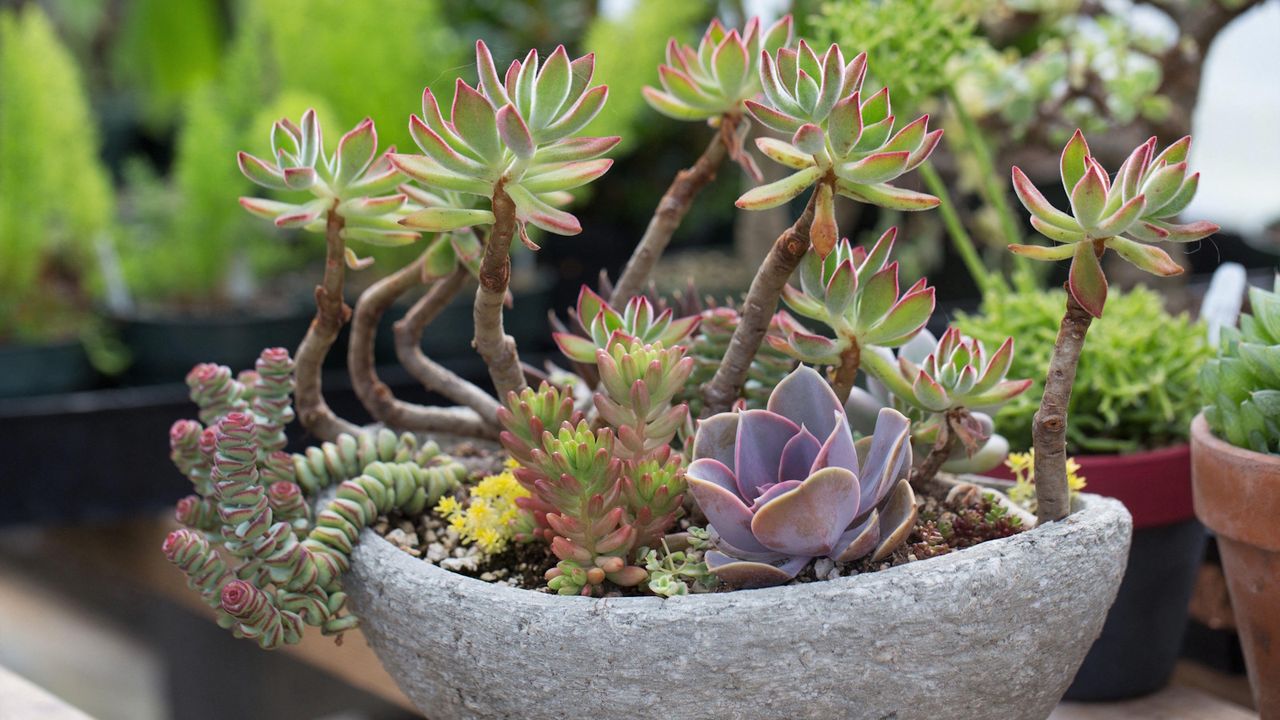
Succulent bowl full of different types of succulents of all different colors.

When it comes to succulents, there truly is a variety for everyone. No matter your interior aesthetic, these beauties come in so many shades, shapes, and textures to choose from, effortlessly uplifting any room they're styled in.

In fact, statement succulents are becoming increasingly popular as pieces of décor, rather than just filler plants for gaps on windowsills. I'm not just talking about the typical indoor succulents you find on supermarket shelves, but rather the oversized, variegated, and quirky-shaped succulents that instantly capture your eye and evoke intrigue.

The best part is, statement succulents need the same succulent care as those you already know, so they're easy to incorporate into existing indoor gardens. Here, with the help of a houseplant expert, I've pulled together five of the best statement succulents to add drama to your home.

(Image credit: Graptopetalum paraguayense gray leaves / Getty Images)

5 Statement Succulents for Every Home

Some of these statement succulents take such interesting forms that they're often houseplants you may not realize are succulents.

Of course, this can be problematic and lead you to make succulent mistakes. For this reason, take care to water all of these plants moderately and provide plenty of bright light.

1. Tree Houseleek

(Image credit: Jacky Hobbs/Future)

If you're looking for a tall houseplant in the succulent family, there's no better choice than tree houseleek (Aeonium).

'These plants have a unique appearance featuring long, arching stems and rosettes of thick, fleshy leaves which are used to store moisture,' describes houseplant expert Anastasia Borisevich of Plantum.

As they mature, tree houseleeks grow longer trunk-like stems, making them a unique take on indoor trees.

They're primarily native to the Canary Islands and love to bake in direct sun, making them a good choice for a sunny conservatory or near a south-facing window.

Aeonium arboreum 'Black Rose' is a particularly striking choice of houseplant with dark foliage. You can actually purchase cuttings of 'Black Rose' from Amazon to root at home. A rooting hormone can help speed up this succulent propagation.

2. Crassula 'Buddha's Temple'

(Image credit: Alexandra Glen via Alamy)

This is a smaller statement succulent (typically reaching a height of six inches), but one that still makes an impact.

'‘Buddha’s Temple’ is a hybrid cultivar of Crassula pyramidalis and Crassula perfoliata var. minor,' says Anastasia. 'Inheriting key characteristics from Crassula pyramidalis, the plant forms tightly stacked leaves arranged along a slender stem,' she describes.

Not only is the tiered foliage of 'Buddah's Temple' beautifully architectural, it also produces some of the most unique blooms with clusters of pink or white flowers in the warmest months. You will need to provide plenty of direct sun to encourage this, however.

'You should start feeding this succulent slowly. From mid-spring to fall, feed your plant with fertilizers formulated for succulents (like this from Amazon) once every four weeks,' Anastasia advises.

You can purchase a starter 'Buddha's Temple' plant from Amazon.

3. African Milk Tree

(Image credit: Tomás Llamas Quintas via Alamy)

While this is on the list of houseplants to never place in a bedroom (due to its irritant sap), this one of the most eye-catching statement succulents to choose for the home.

'It has a dark-green upright stem with a number of branches,' says Anastasia. 'It can flower, but it's extremely rare.'

To get an African milk tree (or Euphorbia trigona) to flower, you need to recreate its native Central African desert habitat – pretty much impossible indoors in the US. For this reason, it's rather grown for its impressive stems.

'During spring and fall, water the plant approximately once every two weeks. Increase watering in summer, but only after the soil has dried out,' says Anastasia. 'In winter, give this euphorbia a drink just once a month. It's better to underwater than to overwater succulents,' she adds.

You can avoid overwatering your African milk tree (and the rest of the statement succulents on this list) by using a soil moisture meter (available on Amazon) to first check if its soil has dried out before picking up your watering can.

Order a live African milk tree from Lowe's.

4. Spiral Aloe

(Image credit: Rob Carter via Alamy)

If you love aloe plants, then consider opting for an unusual variety: the spiral aloe (Aloe polyphylla).

It's exactly what it sounds like, an aloe with foliage growing in a spiral habit. When planted en masse in a pot, it creates a particularly satisfying arrangement.

They're native to Southern Africa and demand bright sun and well-draining succulent soil (like this potting mix from Amazon).

As one of the more rare houseplants, it's a harder succulent to find. Though, specialist nurseries will stock them.

If you're feeling up for a challenge, you can try growing spiral aloe from seed (with these spiral aloe seeds from Walmart).

5. Variegated String of Pearls

(Image credit: Hazrat Bilal via Alamy)

This is a succulent that makes a subtle, yet elevating, statement: the variegated string of pearls.

Just the same as a regular string of pearls, this beauty is native to dry and arid regions of South Africa.

What makes it different is its variegated foliage, with creamy-pink colors painting the pea-sized foliage. And supplied with bright light, it will produce tiny daisy-like white and pink flowers in spring and summer.

Style variegated string of pearls by making the most of vertical space.

Cascading down a bookcase or shelf, this dainty houseplant will undoubtedly charm your visitors. But, you'll need to keep it consistently watered to prevent shriveling string of pearls – a less attractive sight.

One of the best parts of growing this plant is that it's easy to propagate string of pearls.

All you have to do is cut strands just below a leaf node (ideally the cutting should be five inches in length), pop the bottom end back in the soil to make the original plant more full, or root it in a new pot with potting mix to grow an additional plant.

Find a regular string of pearls at The Sill and a variegated string of pearls on Amazon.

FAQs

Can You Grow Succulents and Cacti Together?

As long as they have similar needs, you can plant succulents and cacti in the same pot together. But, you should be aware that some succulents and cacti are not compatible. For example, tropical humidity-loving succulents (like the Christmas cactus) will not survive in the drier environment desert cactus plants demand, and vice versa. For this reason, you should always research the care requirements of the plants you have before deciding to grow them together.

Depending on your hardiness zone, it's possible to landscape with succulents and cacti and many of these statement succulents make good choices for dramatic structure in the yard.

Shop Succulent Accessories

Sign up to read this article
Read news from 100’s of titles, curated specifically for you.
Already a member? Sign in here
Related Stories
Top stories on inkl right now
Our Picks
Fourteen days free
Download the app
One app. One membership.
100+ trusted global sources.