Summary
It’s approaching 5am in Tel Aviv and we’re pausing our blog here. You can read all our coverage of the Israel-Hamas war here and in the meantime here’s a summary of the key developments:
Israel’s campaign against Hamas in Gaza appeared to be reaching a key moment, with close-quarter battles raging around the most important hospital in the heart of its biggest city. Residents said Israeli forces had been fighting Hamas gunmen all night and throughout Saturday in the neighbourhood in Gaza City where the al-Shifa hospital is located, considered a key strategic area.
Israeli prime minister Benjamin Netanyahu pushed back against growing international calls for a ceasefire, saying Israel’s battle to crush Gaza’s ruling Hamas militants would continue with “full force”. A ceasefire would be possible only if all 239 hostages held by militants in Gaza are released, Netanyahu said in a televised address.
The UN undersecretary general for humanitarian affairs and emergency relief coordinator has released a statement saying: “Hospitals must be places of greater safety, not of war.” In a tweet on Saturday, UN aid chief Martin Griffiths said: “There can be no justification for acts of war in healthcare facilities, leaving them with no power, food or water, and shooting at patients and civilians trying to flee.”
Médecins Sans Frontières has warned that patients and medical staff in Gaza are “trapped in hospitals under fire” and called on the “Israeli government to cease this unrelenting assault on Gaza’s health system”. In a statement released on Saturday, the humanitarian organization said: “MSF urgently reiterates its calls to stop the attacks against hospitals, for an immediate ceasefire and for the protection of medical facilities, medical staff and patients.”
The Israeli military will help evacuate babies trapped in Gaza’s Dar al-Shifa hospital on Sunday, the chief Israeli military spokesperson rear admiral Daniel Hagari said on Saturday. “The staff of the Shifa hospital has requested that tomorrow we help the babies in the pediatric department to get to a safer hospital. We will provide the assistance needed,” Hagari told a news conference.
Two premature babies have died due to power cuts at al-Shifa hospital, Physicians for Human Rights Israel said on Saturday. “As a result of the lack of electricity, we can report that the neonatal intensive care unit has stopped working. Two premature infants have died, and there is a real risk to the lives of 37 other premature infants” at Al-Shifa hospital, the group said, citing doctors at the hospital, Agence France-Presse reports.
Netanyahu announced the deaths of five more Israeli soldiers in Gaza. The Israeli military said 46 had been killed since its ground operations there began.
Israel’s three major TV news channels, without citing named sources, said there was some progress toward a deal to free hostages held by Hamas in Gaza. Netanyahu said he would not discuss details of any possible deal, which according to N12 News would involve 50 to 100 women, children and elderly being released in stages during a three to five day pause in fighting.
The head of Lebanon’s powerful Hezbollah party said its armed wing had used new types of weapons and struck new targets in Israel, and pledged that the front against its sworn enemy would remain active. In a televised address, only his second speech since the conflict between Israel and Hamas began in October, Sayyed Hassan Nasrallah said Hezbollah had shown “a quantitative improvement in the number of operations, the size and the number of targets, as well as an increase in the type of weapons”.
Israeli defence minister Yoav Gallant warned Hezbollah not to escalate fighting along the border. “Hezbollah is dragging Lebanon into a war that might happen,” Gallant told troops in a video aired by Israeli television channels.
Arab and Muslim leaders condemned Israeli forces’ “barbaric” actions in Gaza but declined to approve punitive economic and political steps against the country at an extraordinary summit of Arab-Islamic leaders in Saudi Arabia, highlighting regional divisions. The final declaration on Saturday rejected Israeli claims that it is acting in “self-defence” and demanded that the UN security council adopt “a decisive and binding resolution” to halt Israel’s “aggression”.
Iran’s president Ebrahim Raisi has called on Islamic governments to designate Israel’s military a “terrorist organisation”, citing its current operations in the Gaza Strip. “Islamic governments should designate the army of the occupying and aggressor regime as a terrorist organisation,” Raisi told the summit in Saudi Arabia.
Anti-war protesters gathered in Tel Aviv late Saturday to call for a ceasefire and the release of hostages by Hamas. Many demonstrators carried signs reading, “Israelis for ceasefire,” “War has no winners” and “Only peace talks with solve this”.
Philippe Lazzarini, the commissioner general of the UN Agency for Palestine Refugees (UNRWA), has urged the joint Arab-Islamic summit to “act now to change the trajectory” of the crisis in Gaza. Lazzarini called for support for a humanitarian ceasefire, a continuous flow of humanitarian aid and support for the UNRWA.
Hundreds of thousands of people marched peacefully through central London yesterday to protest against Israel’s continued bombardment of Gaza. The Metropolitan police said about 300,000 people had converged on the capital from all parts of the country, while organisers of the pro-Palestinian event put the number closer to 800,000 and claimed it was one of the biggest marches in British history.
In case you missed our live blog on the London protests earlier, the Metropolitan police said around 300,000 people had converged on the UK capital, while organisers of the event put the number closer to 800,000 and claimed it was one of the biggest marches in British history.
The attendance will add to political pressure on both the prime minister Rishi Sunak and the Labour leader Keir Starmer to back calls for a ceasefire in the conflict.
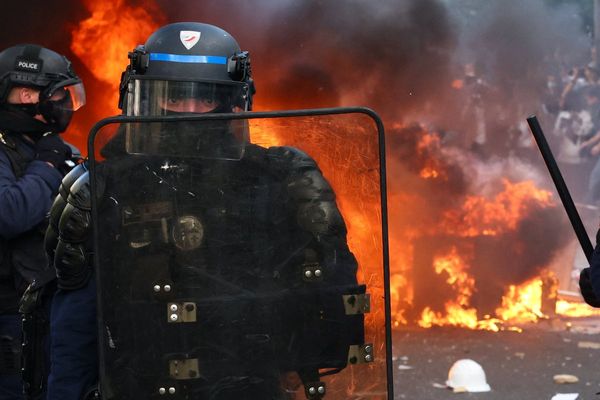
Around 150 pro-Palestinian demonstrators were detained by police in Grosvenor Place, Belgravia in the evening. According to the Met, the breakaway group from the main march were firing fireworks and many were wearing face coverings. Arrests were made after some of the fireworks struck officers in the face.
Matt Twist, assistant commissioner at the Met, said a further 126 people had been arrested as police sought to stop a group of far-right counter-protesters from ambushing the main rally. Scuffles broke out as police attempted to stop a crowd of far-right activists, Islamophobes and football supporters carrying St George’s flags.
In a statement, he called the extreme violence from rightwing protestors towards the police “extraordinary” and “deeply concerning”.

Rishi Sunak condemned “violent scenes” from the far-right group the English Defence League and associated groups and “Hamas sympathisers”.
Here is our full story: