
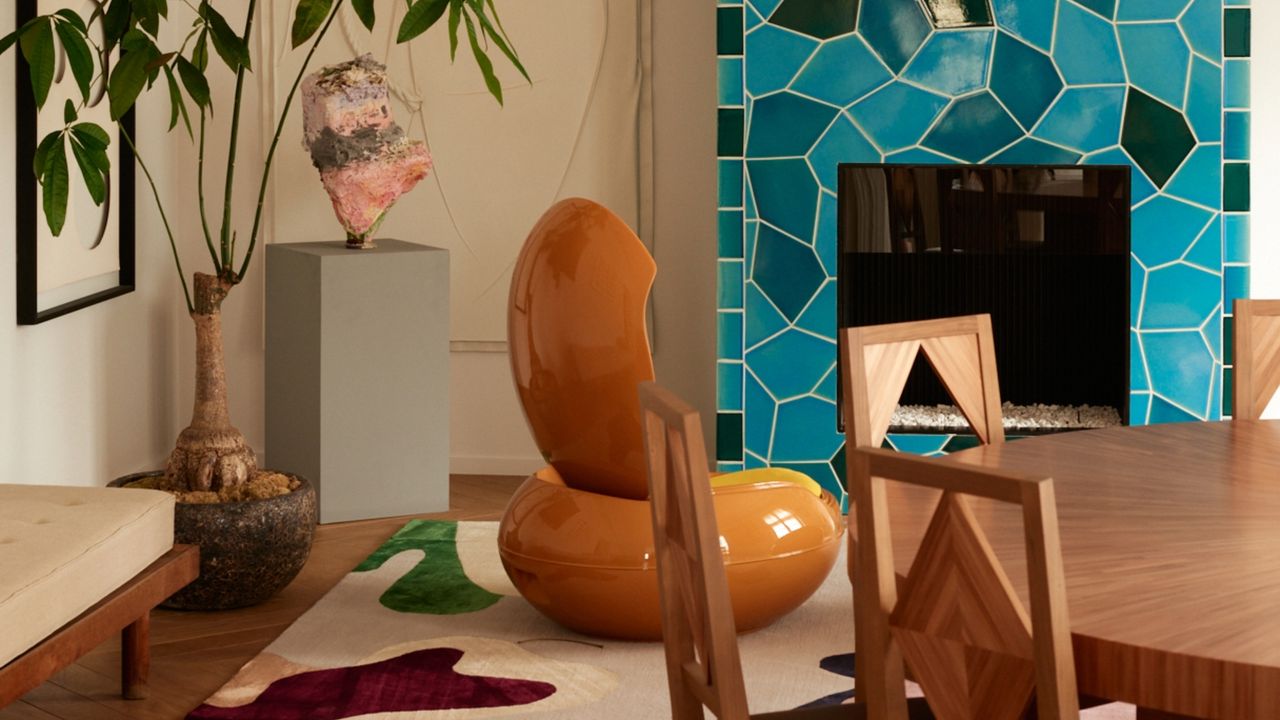
Interior designers are asking their clients a simple question — why so serious? The increasing popularity of chubby furniture and tactile, almost interactive materials taps into the rise of neotenic design. This emerging look, which we’re spotting in projects across the globe, balances child-like aesthetics with seriously refined decorating choices.
The interior design trend embraces unexpected tactility, sculptural forms, and whimsical color combinations to spark positive emotion, which sits at the heart of neotenic design. "As adults, we simply don’t play enough," reflects interior designer Leah Ring. "Designing for joy and adding elements of surprise makes you smile with delight when you walk into a space."

So, what is neotenic design and why is it trending now? And how can you translate this playful look for your own home? Read on, and let’s have some fun.
What Is Neotenic Interior Design?

The term ‘neotenic’ comes from biology, describing youthful characteristics that are retained in adulthood. In design terms, it’s about having fun with intuitive forms, whimsical styling, and childlike colors without veering entirely into the immature. Less about contrived naïveté or an attempt to artfully dumb down a space, then, and more about pushing boundaries in a playful, design-led way.
"The look is meant to be experimental and playful, to inspire conversation, and not to be taken too seriously," explains Leah Ring, principal at Another Human. The designer led the living room project pictured above, featuring a custom curvy fireplace and an irregularly shaped sofa. "It’s an energy related to how you approach the space," she says. "Individual pieces should have a dialogue with unexpected details that make you smile."

“Materials and finishes also contribute to this dynamic, creating a tension that brings a quiet sense of surprise,” agrees Samantha Hauvette from Hauvette & Madani. “Neotenic principles come through in subtle shifts in perception, using elements that slightly disrupt the expected balance in a space.”
Exaggerated forms, playful combinations, and a few ‘wow’ moments are key. A highly-textured, colorful rug (Anthropologie has heaps) becomes a sensory experience underfoot, for example, while a sculptural piece of lighting can command instant attention.
Don’t be afraid of adding these pieces — introducing contrast to a refined base is the whole point. “Remember that elegance and playfulness are not opposing forces,” says Samantha.
Why Is Neotenic Design Trending?

At Paris Déco Home in January, Buchanan Studio launched its first collaboration with lighting brand Original BTC. Titled the ‘Neotenic collection’, it features hand-blown glass in ice cream colors and shades resembling mushroom caps. "In many ways, this range is a natural reaction to the increasing desire for spaces that feel softer and more nurturing," explain co-founders Angus and Charlotte Buchanan.
"After years of very pared-back interiors defined by straight lines and harder edges, people are moving away from environments that feel overly controlled," the pair adds. "We introduced these softer silhouettes to embrace comfort, tactility, and individuality, aligning with how our clients actually want to live now." It’s not about being playful for playful’s sake, but rather a gentle rejection of polish and perfection.

More and more of us are also shrugging off the copycat interiors flooding social media, and this playful, almost nostalgic look really allows for personality. "The era of the dictating designer is over," believes Nicole Dohmen, founder of Amsterdam-based Atelier ND. "The future is creative and open-minded. Designers are translating their clients’ ideas and instincts in a more playful way."
"Attitudes are changing toward more expressionism, as we want vibrant spaces to reflect our own colorful lives," adds interior designer Sam Buckley. There’s a marked shift towards individual creativity, with neotenic design answering the call for spaces that revel in a feeling of ‘fun’ rather than just good looks.
How To Bring Neotenic Design Into Your Home

Neotenic design is, essentially, a delicate balance. Done well, whimsical elements become a feature in layered spaces and not a distraction in one that feels almost juvenile. "The key is contrast, so individual pieces draw attention rather than dominate," explain Angus and Charlotte Buchanan. "Pairing something soft and expressive with more restrained elements makes it feel intentional rather than excessive."
"Aim to go out of your comfort zone and choose a color palette that keeps things interesting," suggests Another Human’s Leah Ring. "Using an unexpected combination is a shortcut to making a space feel fun and lively."
Opt for color where others might rely on a neutral failsafe — a colored sofa, ceiling, or tiled floor, for example. It’s less about coloring wildly outside the lines and more about designing as though your white, gray, or beige crayons are simply unavailable.

If you’re going for a whimsical, more playful look, don’t fall into the trap of filling your space with oddities. Layering expressive pieces slowly (and with moderation) is often far more successful. "Don’t simply stuff a room full of the weird and the wacky,” instructs Sam Buckley. Start with one or two 'amazing' things; give them a little breathing space, and go from there.
"You want to bring the perfect pop of the unexpected," agrees Gabriela Eisenhart, founder and creative director of Silo Studio. In the kitchen pictured above, the designer chose chubby, tubular bar stools for a soft, lighthearted counterpoint to the luxe marble surfaces and raw oak cabinetry. "The different design languages come together to feel playful as well as elevated," she explains.
While neotenic design incorporates childlike elements, it’s not at all devoid of elegance. Whimsy can feel delightfully ‘grown-down’, yes, but only when it plays a counterbalancing role in a more restrained space. Don’t be afraid of loosening up — just keep a sense of control that leaves room for contrast and surprise.
Need more inspiration? Read up on lore-building interiors, which are hyper-personal spaces totally unique to you.
And for more design advice, make sure you're subscribed to Livingetc's newsletter.