Jupiter has had its length and breadth measured again, and it turns out the giant planet is skinnier and shorter than scientists had thought.
"Textbooks will need to be updated," said Yohai Kaspi of the Weizmann Institute in Israel in a statement. "The size of Jupiter hasn't changed, of course, but the way we measure it has."

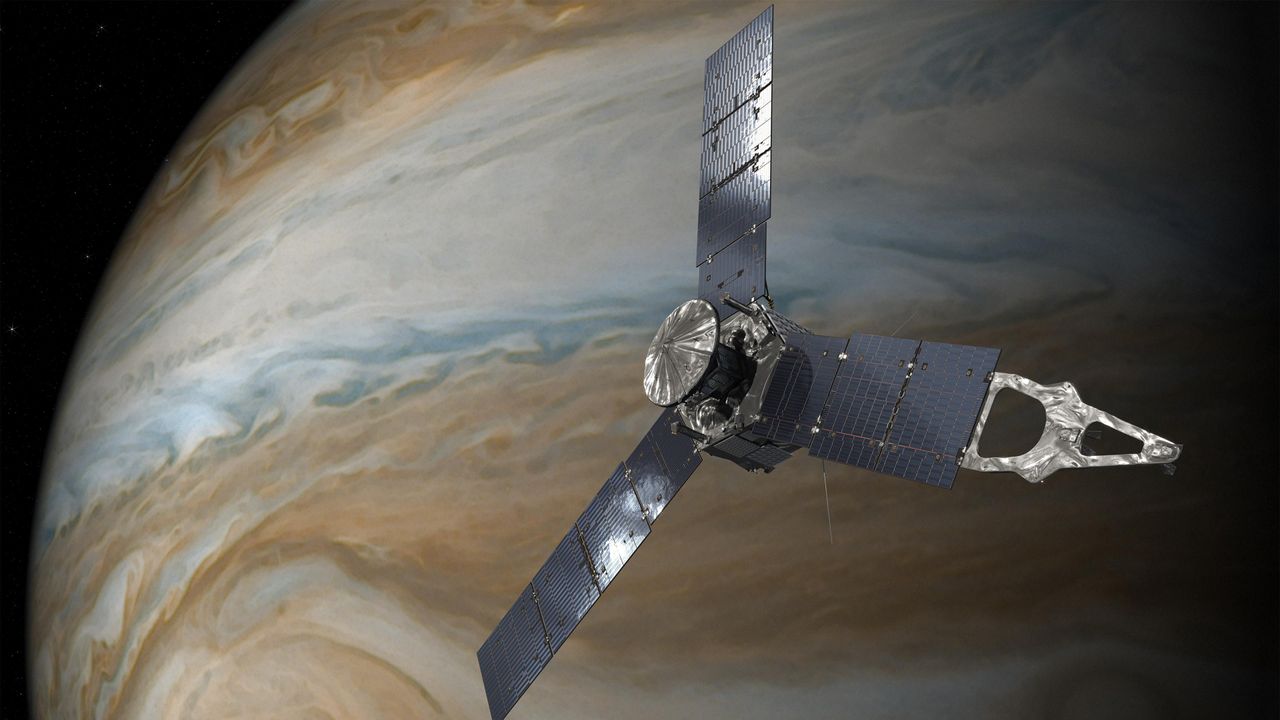
Jupiter is a gas giant planet, and the largest planet in our solar system to boot. The textbooks currently state that Jupiter is 88,846 miles (142,984 kilometers) across at its equator, and 83,082 miles (133,708 km) from pole to pole. In other words, Jupiter is flatter at its poles than at its equator, the result of its fast rotation (just under 10 hours) creating an equatorial bulge. However, the new measurements, courtesy of NASA's Juno spacecraft that is currently orbiting Jupiter, shaves about five miles (8 km) off the equator and about 15 miles (24 km) off at the poles.
The previous measurements had come from NASA's Pioneer 10 and 11 and Voyager 1 and 2 missions, amounting to just six data points in total, whereas Juno has been able to add another 26 measurements.
Juno has been orbiting Jupiter on an elongated orbit since 2016, but since its mission extension in 2021, Juno has moved onto a different trajectory that gives it close fly-bys of Jupiter's Galilean moons as well as passes behind Jupiter as seen from Earth, which previously it never did.
The trick to measuring how large a planet like Jupiter is involves the spacecraft passing behind Jupiter from our point of view while beaming radio signals back to Earth. Where the signals are bent by the effect of Jupiter's upper atmosphere, or cut out completely by the bulk of the planet only to reappear on the opposite limb, tells us how large Jupiter must be.
"We tracked how the radio signals bend as they pass through Jupiter's atmosphere, which allowed us to translate this information into detailed maps of Jupiter's temperature and density, producing the clearest picture yet of the giant planet's shape and size," said the Weizmann Institute's Maria Smirnova, who developed the techniques necessary to process the raw Juno data.
And although a few kilometers off here and there doesn't sound like much, it's actually quite a big deal for accurately modeling the interior of Jupiter.
"These few kilometers matter," said Weizmann's Eli Galanti, who led the research. "Shifting the radius by just a little lets our models of Jupiter's interior fit both the gravity data and atmospheric measurements much better."
Indeed, by adjusting Jupiter's dimensions to those measured by Juno, Galanti's team found that current state-of-the-art models describing the interior density structure of Jupiter worked even better. And since Jupiter is the gold standard for understanding gas giant planets, the better we know Jupiter, the better astronomers can understand other gas giant planets too — not just in the solar system but also around other stars.
The new measurements of Jupiter are reported in a paper published on Feb. 2 in the journal Nature Astronomy.