Get all your news in one place.
100's of premium titles.
One app.
Start reading
The Conversation
The Conversation
Kimberly Cowell-Meyers, Associate Professor of Government, American University School of Public Affairs

Irish reunification is more complicated than Trump may think

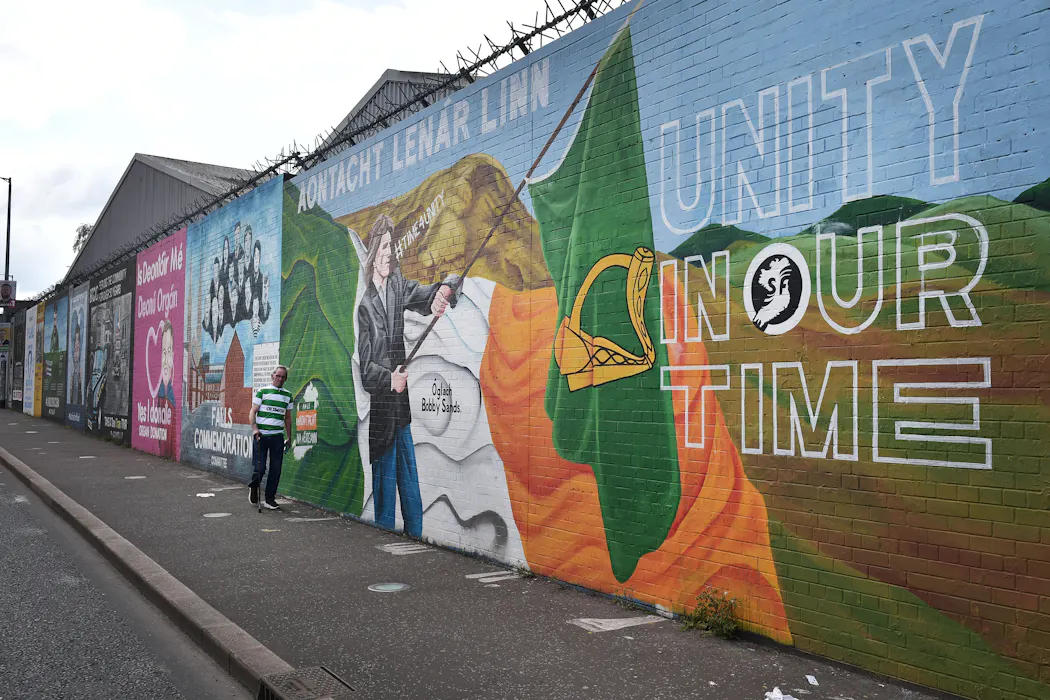
A man walks past a mural calling for Irish unity in Belfast, Northern Ireland. Charles McQuillan/Getty Images

President Donald Trump raised eyebrows across the Atlantic recently with his surprise remarks in favor of Irish unification.

His statements marked a stark departure from American policy on the issue and quickly stirred controversy across the U.K., an entity that includes Northern Ireland.

In London, the leaders of the Conservative and Reform parties denounced the comments; in Northern Ireland, Unionists – who identify as British – were especially sharp in their criticism. Even Micheál Martin, the Irish taoiseach, or prime minister, downplayed the visiting U.S. leader’s comments, despite his party having reunification as one of its core goals.

A man in a suit sits flanked by two flags.
U.S. President Donald Trump during a meeting with Ireland’s Prime Minister Micheál Martin in Dublin on Sept. 12, 2026. AP Photo/Julia Demaree Nikhinson

Regardless of Trump’s stance, Irish unification is not likely to happen in the near future. The Good Friday Agreement and a subsequent treaty lay out a process through which it can happen, but the criteria have not been met, and there are numerous other technical questions that need to be resolved first.

Nonetheless, as scholars who research Irish American lobbying and the peace process, we believe Trump’s comments signal a potential lobbying role for pro-unification voices in the United States.

Conflict in Northern Ireland

In 1921 the British and Irish governments signed the Anglo-Irish Treaty, which granted Ireland a degree of independence after centuries of colonial British rule over the island. But it also allowed Northern Ireland, where Protestant settlement had been concentrated, the opportunity to opt out of the new, predominantly Catholic Irish Free State and remain part of the United Kingdom.

The new government in Northern Ireland, dominated by Protestant Unionists, systematically discriminated against Catholic Nationalists – in employment, housing and education – which eventually sparked a civil rights movement in the 1960s, and soon thereafter a 30-year conflict known as “The Troubles.” Around 3,700 people were killed, with thousands more injured or otherwise traumatized.

The conflict ended in 1998 with the Good Friday Agreement, signed by the governments of the U.K., Ireland and the main political parties in Northern Ireland.

A youth throws a projectile toward a man in uniform carrying a shield.
Youth clash with riot police in the Bogside District of Londonderry, also known as Derry, Northern Ireland in 1969. Stan Meagher/Daily Express/Hulton Archive/Getty Images

The consent principle

The agreement ended the armed conflict involving various paramilitary groups and the British state – in part, by creating a democratic path to resolving it. All relevant parties agreed that Northern Ireland would remain part of the U.K. until the majority decides otherwise.

However, the agreement says little about the criteria for calling a referendum. In fact, it established only one mechanism for initiating the referendum in Northern Ireland: The secretary of state for Northern Ireland, a British Cabinet official, must call a referendum if “at any time it appears likely to him that a majority … would express a wish to form part of a united Ireland.”

It does not spell out how to identify that majority. Should the secretary of state rely on polling data, population data on the number of Catholics and Protestants, or support for Unionist or Nationalist political parties during elections? Should all three options be used?

Those questions have never been fully answered, but, nonetheless, some of these boxes can be checked at this point. Nationalist parties dominate Northern Ireland’s delegation in the U.K.’s House of Commons, Unionist parties no longer hold the majority in the Northern Ireland Assembly, and Catholics outnumber Protestants in Northern Ireland for the first time since partition.

But polls don’t consistently show a majority in favor of a united Ireland. Not all Catholics are willing to leave the U.K., and many people worry about what it would mean for their access to U.K. healthcare and pensions.

As recently as late August 2026, British Prime Minister Andy Burnham said the issue of a unity referendum was “off the table.”

Issues to sort out

The prospect of reunification raises many questions. The most pressing is what sort of government a united Ireland would have.

Currently, there are two parliaments on the island of Ireland: the Dail, which governs the Republic of Ireland; and Stormont, a devolved parliament within the United Kingdom that governs Northern Ireland.

The Northern Ireland assembly was created by the Good Friday Agreement so that Unionists and Nationalists would share power. The Northern Ireland Executive, for example, has a first minister and a deputy first minister – one each from the main Unionist and Nationalist parties – to ensure that neither can oppress the other. Would a united Ireland retain both parliaments?

A related problem is how a new Ireland would integrate Unionists, who largely oppose unification. They may aim to keep the carefully balanced institutions of Northern Ireland in place, although some commentators believe they might have more power as kingmakers in a unified parliament.

At minimum, the inclusion of Unionist voices in Irish politics would force all the other political parties to adapt. The Irish flag, Irish emblems, the national anthem and many institutions of Irish society would likely need to change to reflect the new state.

Another concern is the continued existence of Loyalist paramilitaries, who fought to preserve Northern Ireland’s place in the U.K. during the Troubles. Although these groups nominally supported the peace agreement, they never stood down and continue to maintain arsenals and recruit new members. Unification could reignite their violent campaign.

Many Loyalist factions are also involved in criminal activity, including extortion, drug-running and illegal money-lending. In addition, Loyalist paramilitaries have been heavily involved in coordinated attacks against immigrants. It’s not clear if the Irish police force, the Gardai, is prepared to police paramilitaries, or whether citizens of the Irish Republic are prepared for how paramilitaries might change their country.

A further issue is cost. In 2025, Northern Ireland received approximately US$21.5 billion more in government spending than it paid into the British system through taxes. This is not surprising given the economic damage caused by the Troubles, and the generational nature of peacebuilding.

Some of these costs may not carry over into a united Ireland. Still, studies suggest that covering the gap could cost a unified Irish government between €8 billion to €20 billion a year, equivalent to around $9 billion to $23 billion, for the first 20 years.

While some supporters of Irish unity hope the U.S. or the EU will contribute, their assistance is not guaranteed; government decisions on resource allocation could be politically divisive.

In “Building a Green Wall,” our book on Irish Americans’ role in preventing a hard border following the U.K.’s vote to exit the EU – the Republic of Ireland is still a member of the bloc – key political leaders told us that a unity referendum should only occur after these issues are worked out.

They pointed to the Brexit referendum as a cautionary tale, noting that many voters did not know what they were voting for, and the process of figuring that out continues to disrupt U.K. politics a decade later.

A role for Irish Americans?

Most Irish Americans support Irish reunification, but Irish American leaders are divided on what role the U.S. government should have in the process.

A man in a green sweater wears a red 'Make America Great Again' cap.
An Irish American MAGA supporter celebrates St. Patrick’s Day on March 17, 2025. Roy Rochlin/Getty Images

Some believe it should be similar to what Irish American leaders’ role was during the peace talks – providing space for talks outside the hothouse atmospheres in Dublin and Belfast and insisting on fair play. Others want to push for a united Ireland.

The Friends of Sinn Fein, a powerful Irish Republican lobbying group in the U.S., for example, are actively working to engage Irish Americans in this campaign.

Given Irish Americans’ traditional attachment to the Democratic party, Trump’s declaration of support for a united Ireland came as a surprise for many political observers in the U.S., too. But in our research we found that Irish Americans are now as politically divided as the rest of the country.

Irish Americans in the MAGA movement who support unification have, for now, signed up a powerful ally in President Trump. Whether the rest of Irish America will join them, work through separate channels or remain neutral remains to be seen.

This article was originally published on The Conversation. Read the original article.

Sign up to read this article
Read news from 100's of titles, curated specifically for you.
Already a member? Sign in here
Related Stories
Top stories on inkl right now
One subscription that gives you access to news from hundreds of sites
Already a member? Sign in here
Our Picks
Fourteen days free
Download the app
One app. One membership.
100+ trusted global sources.