Irish Taoiseach Micheál Martin nodded along Tuesday in the Oval Office as President Donald Trump compared Iran’s hard-line government to Nazi Germany, but he later nudged his host to start wrapping up the war with Tehran.
“These are horrendous people. These are the worst people, going back to Hitler, right?” the wartime American commander in chief said on a day when his differences with NATO and other allies over his Iran war boiled over. “And there’s been nothing close.”
As the Iran conflict rages, Martin had the awkward assignment of sitting beside Trump as part of the annual St. Patrick’s Day tradition of the American and Irish leaders celebrating at the White House and Capitol. His approach was to pick his spots, mixing praise with pushback.
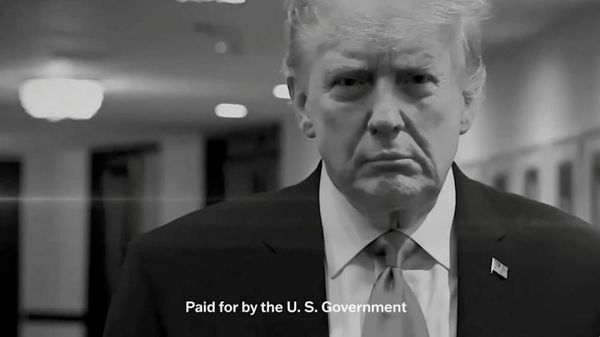
“You’re affirming the tremendous bonds between Ireland and the United States that go back to the very foundation of this republic,” he told Trump. “And the Irish helped to build America. We’re very proud of that connection.”
The Irish leader also pushed back on Trump’s criticism of European countries’ immigration policies and urged him to look for a way to end the Iran bombardment.
He told the U.S. president, who has pushed European leaders to mirror him by adopting more hard-line immigration policies, that “sometimes Europe gets characterized wrongly in terms of it being overrun.” And when a reporter asked Trump about a possible problem with “small snails” at his Trump International Golf Links in Doonbeg, Ireland, Martin shook his head and said, “What kind of question was that?”
Martin at one point broke into Trump’s Q&A exchange with reporters to give a lengthy assessment of the situation in Iran, including a polite suggestion that his host chart a path to the war’s end.
The Irish leader said he and European officials want a “peaceful resolution of this conflict.”
“We’ve been peacekeepers all our lives, and we’re the longest-serving nation in terms of [providing] peacekeeping forces in the world, as it turns out. But we think, ultimately, all conflicts come to an end — and I think we have to try and work towards that end,” Martin said in a diplomatic and measured tone. “I’m sure European leaders and the U.S. administration will engage, and hopefully we can get [to] an ending zone.”
Trump told his guest, referring to European countries, that “I agree with everything you said — but we helped with Ukraine, yes, and they don’t help with Iran, and they all acknowledge that Iran can’t have a nuclear weapon.”
The leaders addressed reporters in the Oval Office moments after Trump on his social media account lashed out at NATO members and other countries for rejecting his requests for help opening — and keeping open — the Strait of Hormuz.
Trump wrote on Truth Social that he was “not surprised by their action” because he “always considered NATO, where we spend Hundreds of Billions of Dollars per year protecting these same Countries, to be a one way street.”
“We will protect them, but they will do nothing for us, in particular, in a time of need,” Trump wrote, adding that the United States and Israel “no longer ‘need,’ or desire, the NATO Countries’ assistance — WE NEVER DID! Likewise, Japan, Australia, or South Korea.” (Japan’s prime minister is due in Washington on Thursday for meetings with Trump and a dinner at the White House that evening.)
‘Never heard him so angry’
Senate Budget Chairman Lindsey Graham, a South Carolina Republican and perhaps the chamber’s biggest foreign policy hawk who has the president’s ear, said Trump was fuming Tuesday morning.
“Just spoke to @POTUS about our European allies’ unwillingness to provide assets to keep the Strait of Hormuz functioning, which benefits Europe far more than America. I have never heard him so angry in my life. I share that anger given what’s at stake,” Graham wrote on X. “The arrogance of our allies to suggest that Iran with a nuclear weapon is of little concern and that military action to stop the ayatollah from acquiring a nuclear bomb is our problem not theirs is beyond offensive.
“I consider myself very forward-leaning on supporting alliances,” he added, “however at a time of real testing like this, it makes me second guess the value of these alliances. I am certain I am not the only senator who feels this way.”
Ahead of his White House meeting with Trump, Martin had tried to thread a narrow diplomatic needle on Iran — underscoring the importance of the U.S.-Irish relations while also stopping short of endorsing his American counterpart’s military campaign. His visit came as other prominent world leaders have rebuffed or tried stalling Trump’s request that they send minesweeper vessels and other assets to the Persian Gulf to try reopening the Strait of Hormuz.
The trans-Atlantic drama came a day after House Minority Leader Hakeem Jeffries said the administration “failed to prepare for this reckless war of choice.”
“They failed to prepare for Iran’s actions in the Strait of Hormuz. They failed to prepare as it relates to the fact that thousands of Americans were stranded for days, if not weeks, in the Middle East … where there are now more than 12 countries that have been plunged into this conflict as a result of what began with Donald Trump’s reckless decision to spend billions of dollars to drop bombs in the Middle East,” the New York Democrat told reporters Monday.
“There’s no plan of action as it relates to the fact that all of these countries are now involved in terms of what could have been predicted as it relates to Iran’s response, particularly connected to the Gulf states,” he added. “This was a clear failure.”
Trump said Tuesday his war in Iran would continue but should wrap up “in the near future.”
“Look, if we if we left right now, it would take 10 years for them to rebuild,” he told reporters. “But we’re not ready to leave yet. But we will be leaving in the near future.”
The post Irish PM tells Trump ‘all conflicts come to an end,’ nudging him to end Iran war appeared first on Roll Call.