Get all your news in one place.
100's of premium titles.
One app.
Start reading
International Business Times UK
Politics
Ma. Kyla Morco

Iranian Couple Sought Asylum in the US — 21 Months Later, Husband Is Free While Wife Remains in ICE Detention

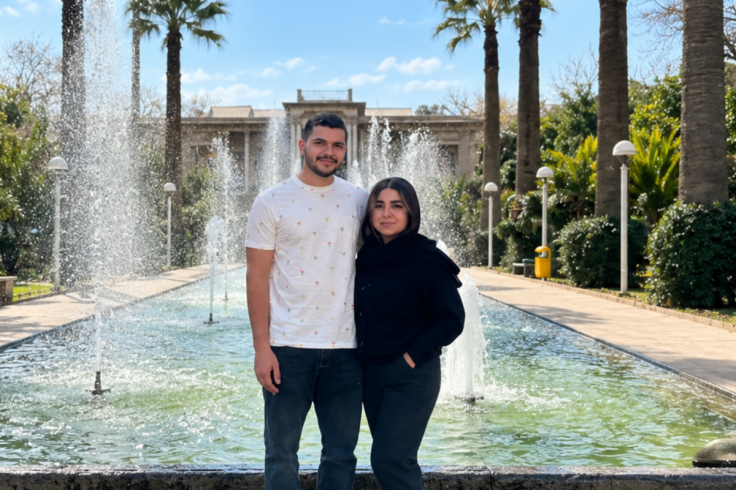
Mohammadjamal Azizi and his wife, Hannaneh Alikaram, in Shiraz, Iran, in 2024. (Credit: Courtesy of Mohammadjamal ‘Liam’ Azizi)

An Iranian woman has spent 21 months in US immigration detention while her husband has been free for more than a year after he was granted asylum, despite the couple arriving together and describing similar fears of religious persecution.

Hannaneh Alikaram and Mohammadjamal 'Liam' Azizi, Christian converts who said they were twice arrested in Iran, entered the United States on 26 December 2024. Their cases later produced sharply different outcomes: an immigration judge denied Alikaram's asylum application on 2 July 2025, while another judge granted Azizi asylum six days later.

The couple's separation now hinges partly on a separate immigration process. Azizi has sought derivative asylum benefits for his wife as the spouse of a person granted asylum, while her lawyer is challenging her continued detention.

The Couple's Flight From Iran

Azizi and Alikaram married in 2018 and lived in Isfahan, where he worked as a software engineer and she ran a greenhouse business. They stated in court documents that they began exploring Christianity through friends before attending underground home churches. They were baptised into the Anglican Church in January 2024.

According to their accounts, members of Iran's Basij militia raided a home church on 5 March 2024 and arrested them. Alikaram said she was beaten and required hospital treatment.

The couple said they were arrested again in June 2024 over allegations involving the practice and promotion of Christianity. They subsequently obtained visas for Brazil and left Iran on 3 November. They travelled north through Latin America before entering the US on 26 December. After crossing near San Diego, they were taken into Border Patrol custody and separated.

Two Judges Reached Different Decisions

Alikaram appeared before Immigration Judge Jennifer A. May on 2 July 2025. May denied her asylum application, citing what the decision described as inconsistencies in Alikaram's testimony and finding insufficient independent evidence that she would probably face torture or persecution if returned to Iran, according to The Intercept.

Alikaram and Azizi attributed some discrepancies to nervousness and translation problems. One reference to the Basij was transcribed as 'a siege' during the hearing.

Six days later, Azizi appeared before Immigration Judge Nimmo Bhagat in Texas and was granted asylum. 'I thought if my wife couldn't get asylum that I'd have no chance,' Azizi told The Intercept. 'But they gave me asylum.'

The Executive Office for Immigration Review, which oversees the US immigration courts and the Board of Immigration Appeals, declined to comment to The Intercept. The Board of Immigration Appeals reviews certain immigration judge decisions.

Derivative Asylum Offers Another Legal Route

Azizi's asylum grant opened another potential route for Alikaram. US Citizenship and Immigration Services allows qualifying spouses of principal asylees to seek accompanying or following-to-join benefits through the derivative asylum process, subject to eligibility requirements.

The couple filed for derivative asylum in December after the Board of Immigration Appeals rejected Alikaram's appeal. USCIS acknowledged receipt of the petition and scheduled a biometrics appointment in Jackson, Mississippi, but ICE did not produce Alikaram for the appointment.

Her attorney, Emily Trostle, filed a habeas corpus petition in April seeking her release from detention and later sought to expedite the case. A habeas petition is a legal challenge to detention, rather than a judicial finding that the detention is unlawful. The Board of Immigration Appeals is the highest administrative body for interpreting and applying US immigration law, and its decisions can be subject to judicial review.

Twenty-One Months Apart

While Alikaram remains detained, Azizi has been living in Los Angeles and working to cover legal expenses and pursue his wife's release. The Intercept reported that Alikaram has described poor nutrition, failing eyesight, and severe anxiety and depression while in detention. These accounts have not been independently verified. ICE did not respond to the publication's request for comment.

Azizi described the separation in a statement filed with the court. 'Being separated from Hananneh is unbearable,' he wrote. 'Every night I go to sleep wondering if she is safe in detention.'

For the couple, Azizi's asylum grant has therefore not ended their immigration ordeal. Instead, it has created a potential legal pathway for Alikaram while she remains in detention awaiting the outcome of separate proceedings.

Sign up to read this article
Read news from 100's of titles, curated specifically for you.
Already a member? Sign in here
Related Stories
Top stories on inkl right now
One subscription that gives you access to news from hundreds of sites
Already a member? Sign in here
Our Picks
Fourteen days free
Download the app
One app. One membership.
100+ trusted global sources.