
Get all your news in one place.
100's of premium titles.
One app.
Start reading
Tom’s Hardware
Tom’s Hardware
Technology
Luke James

Iran's forced nationwide internet blackout becomes second-longest on record as it passes 1,000 hours offline — possessing Starlink terminals punishable by death, country using 'military-grade jamming' against service

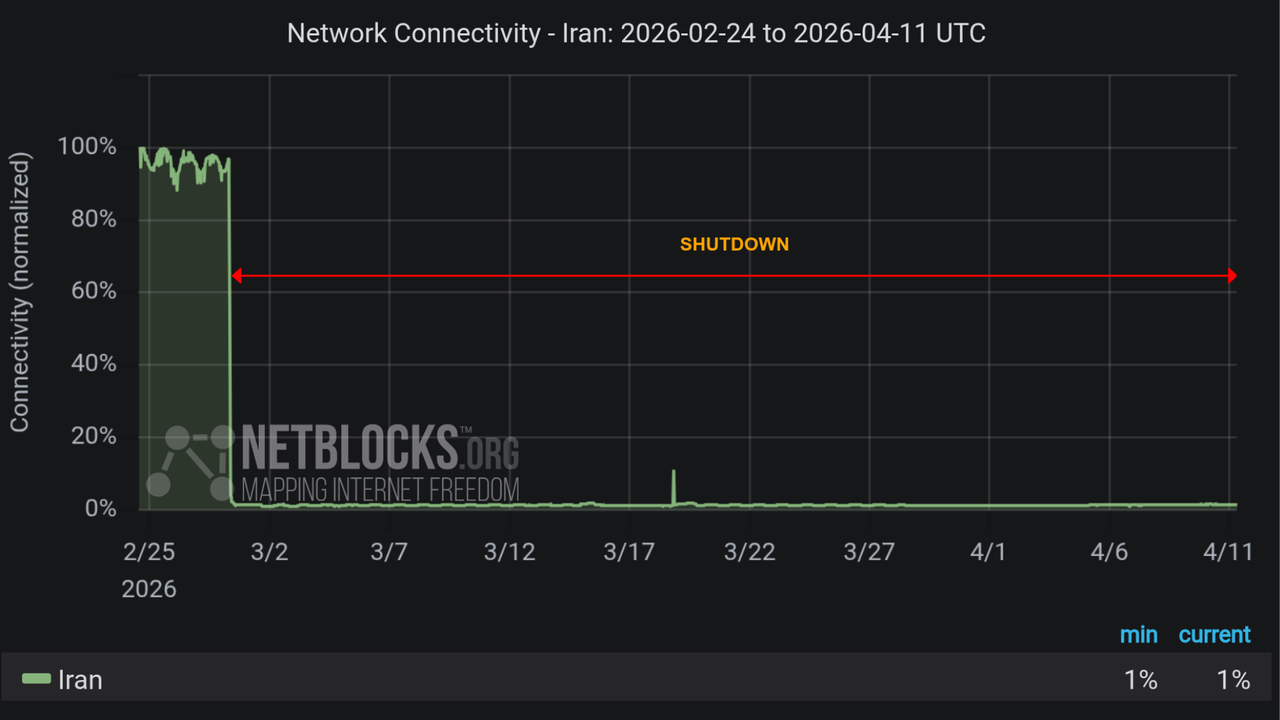
Iran internet blackout figures.

Iran's nationwide Internet blackout has crossed the 1,000-hour mark and is now one of the longest nation-scale shutdowns ever measured, according to connectivity monitor NetBlocks. The site has tracked the disruption since it was intensified on February 28 alongside joint U.S. and Israeli military strikes on the country. Starlink isn't the solution, either, as Iran is actively seeking those who possess Starlink terminals, and if caught individuals are punishable by execution.

Starlink inside the country is reportedly being blocked by “military-grade jamming,” per one researcher who spoke to IranWire back in January. The possession or operation of a Starlink terminal in Iran now carries potential penalties of execution under legislation passed this year, according to the Business and Human Rights Centre. Iran has also made threats to attack infrastructure owned by hyperscalers, including OpenAI, Nvidia, Apple, Microsoft, and Google.

NetBlocks marked the grim connectivity milestone on its official accounts on April 11, highlighting that the outage had exceeded 43 days and was still ongoing, with traffic remaining at around 1% of its pre-blackout volumes. According to them, the Iran shutdown has exceeded every comparable incident that it has cataloged. However, the Libya internet shutdown during the Arab Spring went on for six months (likely before NetBlocks started doing its thing).

Cloudflare Radar recorded a near-instant 98% collapse in Iranian HTTP traffic at around 07:00 UTC on February 28, across bytes transferred, HTTP bytes, and request counts simultaneously, with Tehran, Fars, Isfahan, Razavi Khorasan, and Alborz all going dark at the same moment.

Small volumes of web and DNS traffic have continued to move over specific IPv4 routes throughout the blackout, which Cloudflare attributed to a whitelisting system that keeps a limited set of approved users and domestic services online. State-affiliated media in Iran have said access is being routed through the National Information Network, the country's long-running domestic intranet project, with only pre-approved sites reachable.

This near-total Internet blackout follows on from earlier restrictions imposed on January 8 during widespread protests against the Iranian regime. Although the blackout had been relaxed by January 28, restrictions remained in place, and Internet traffic levels had been reduced by around 50% as of February 16. Iranian Minister of Communications Sattar Hashemi has previously acknowledged that the earlier January blackout cost the economy around $35.7 million per day, with online sales falling by as much as 80% during the cutoff.

Human Rights Watch has called the current shutdown a violation of fundamental rights and warned that it was obstructing access to emergency information during active military strikes, and Amnesty International marked the 1,000-hour threshold on April 10 with a public call for Iranian authorities to restore access.

Sign up to read this article
Read news from 100's of titles, curated specifically for you.
Already a member? Sign in here
Related Stories
Top stories on inkl right now
One subscription that gives you access to news from hundreds of sites
Already a member? Sign in here
Our Picks
Fourteen days free
Download the app
One app. One membership.
100+ trusted global sources.