
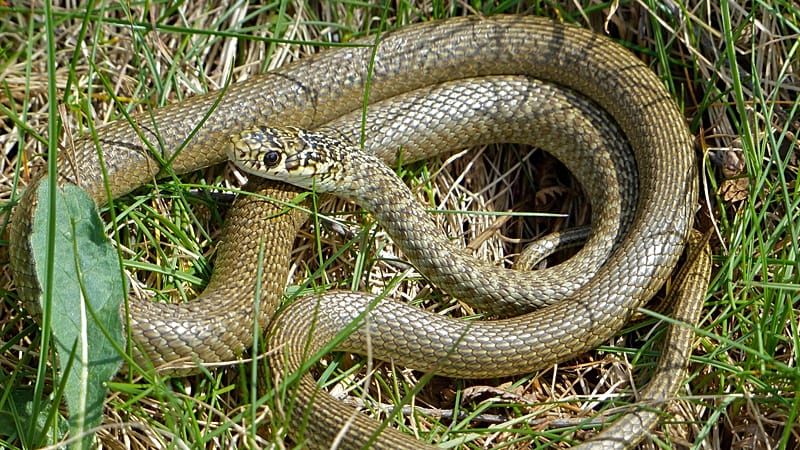
In German, the snake genus Coluber is known as “Zornnatter” because when these animals are held, they defend themselves vigorously and aggressively by biting. The green and yellow Zornnatter (Hierophis virdiflavus) can grow to 1.5 or even 2 metres in length.
Reptile expert Hubert Laufer has often been bitten by such a snake, as he has been tracking down Zornnattern in Germany for years. More than 300 specimens of the green and yellow Zornnatter have ended up in his cloth capture bag. “When you catch a Zornnatter, it tries to bite the person catching it. But if the snakes can flee, they do. If you leave them alone, they won’t do anything,” the expert tells Euronews.

“Imagine reaching into a blackberry bush and ending up with lots of tiny scratches on your skin. That is roughly what a bite from a Zornnatter feels like,” he explained in a report for public broadcaster SWR. So the snakes are not really dangerous for humans.
Many animal welfare advocates see the presence of Zornnattern as a sign of an intact natural environment. The reptiles are mostly black with a fine yellow-green pattern – their well-camouflaged scales make them almost invisible in grass and vegetation.
Artenschutz Franken, an organisation dedicated to preserving biodiversity in Germany, reports with photos (source in German) that Zornnattern are often run over by cars on roads, and is calling for these snakes to be protected.
Why are green and yellow Zornnattern a problem in Germany?
Landscape ecologist Laufer, who catches green and yellow Zornnattern at a rubbish tip in Zweibrücken – about 40 kilometres from Saarbrücken – is also an amphibian conservationist. “There are almost no lizards left on the landfill site. If there is absolutely nothing else, they eat mice or young rats. But lizards are their favourite food,” says Hubert Laufer.
And he explains: “Zornnattern are invasive and have negative effects on native fauna in Germany. That is why we want to capture them as quickly as possible.”
Coluber viridiflavus are originally found in southern France and Italy. In Germany, these snakes are an invasive species that threaten native animals and thus endanger biodiversity – much like the toxic pufferfish in the Mediterranean are driving out other fish species.
At the Zweibrücken landfill site, the Zornnattern particularly like to shelter under roofing felt, because it heats up quickly underneath and these animals from southern Europe love higher temperatures.
Expert Laufer assumes that the snakes arrived at the dump in 2017 with waste that was disposed of there. “There must have been a pregnant female among them. They have since reproduced.” By now there appear to be several hundred green and yellow Zornnattern on the landfill site and in the surrounding area.
Call for sightings: please report Zornnattern with a photo
The Zweibrücken environmental and service operator UBZ, which is responsible for the Mörsbach landfill, is calling on everyone who believes they have seen a Zornnatter in the region to report it, just as the snake catcher does.
Ideally, reptile conservationist Laufer tells Euronews, people should send him a mobile phone photo of the snake. There have already been around 25 reports this year. “But not all of them were Zornnattern. Other native species were reported too. We would rather also receive grass snake sightings than miss a report of a Zornnatter.”
Snakes caught by Hubert Laufer are passed on to people who can house the animals in a way appropriate to the species and ensure they do not eat lizards and other reptiles.
In recognition of his commitment, BUND Baden-Württemberg presented Hubert Laufer with the Gerhard Thielcke Nature Conservation Award in 2025.
If you believe you have seen a Zornnatter in Germany, UBZ Zweibrücken and amphibian conservationist Hubert Laufer are asking you to get in touch. The UBZ has an online reporting portal (source in German). The expert would preferably like to be informed with a photo, by email at laufer@bfl-laufer.de, by phone on 0175 9983307 or via WhatsApp.
This text was translated with the help of artificial intelligence. Report a problem : [feedback-articles-en@euronews.com].