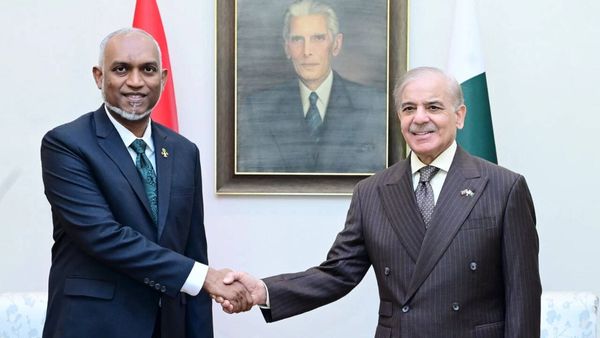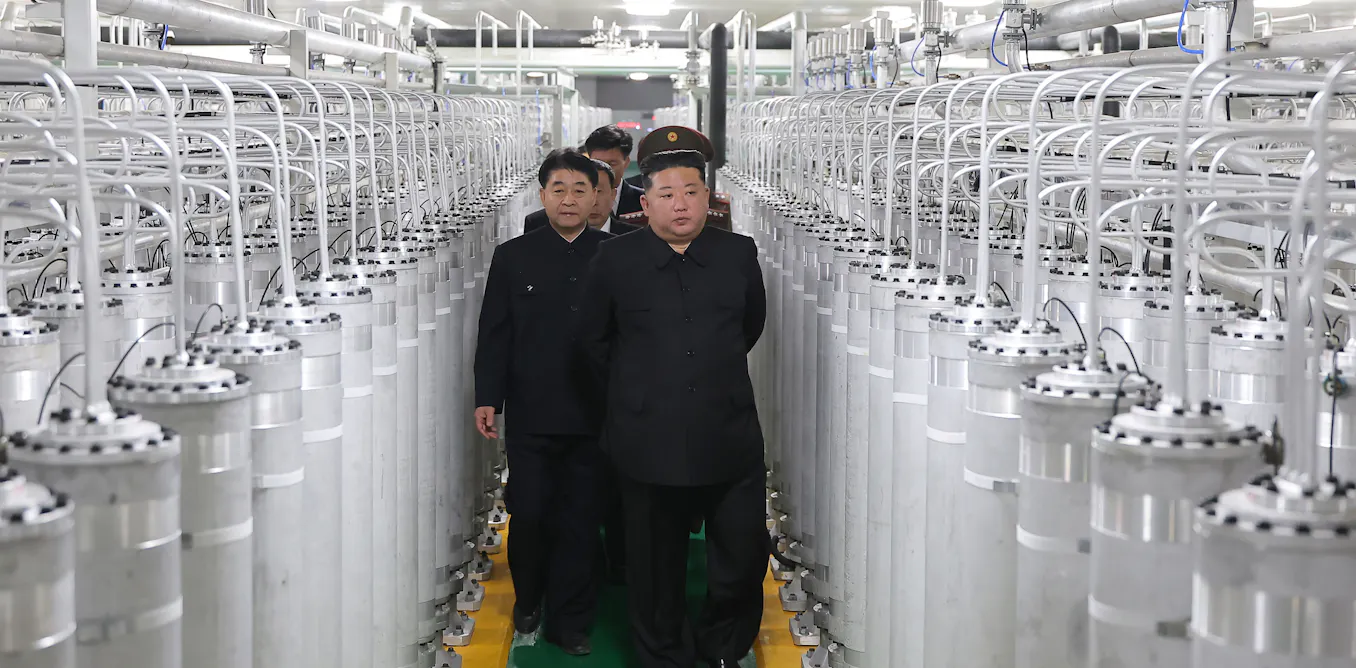
The dust has now settled on the ostentatious summit between Chinese President Xi Jinping and North Korean leader Kim Jong Un in Pyongyang earlier this month. But perhaps the biggest takeaway was what was left unsaid.
Chinese readouts from the summit conspicuously excluded any mention of denuclearisation in North Korea (meaning North Korea giving up its nuclear weapons). This signals a shift away from a decades-long policy goal of Beijing.

It’s the latest in a long list of setbacks for international efforts to denuclearise North Korea, and my soon-to-be-published research shows experts are widely concerned about the depth of the challenge.
In early 2026 I ran a survey and focus groups involving over 70 international experts in nuclear weapons. I asked them to forecast the probability of six hypothetical nuclear scenarios occurring by 2035:
- that China achieves a nuclear second-strike capability against the United States
- that North Korea achieves the same
- that Japan acquires nuclear weapons
- that South Korea acquires nuclear weapons
- that North Korea gives up its nuclear weapons
- that the United States or China uses a nuclear weapon.
North Korean denuclearisation came in last, with experts assessing only a 3% probability by 2035.
After over 30 years, it seems the international mission to denuclearise North Korea has failed.
Why? And what does this mean for the region?
How did we get here?
North Korea began pursuing nuclear weapons in earnest in the 1990s. This was driven by insecurity from the collapse of its superpower patron (the Soviet Union). Another factor was the still-unresolved status of the Korean War, which ended without a peace treaty.
International efforts to denuclearise North Korea initially focused on diplomatic negotiations. However, efforts broke down due to North Korean cheating on interim agreements and major North Korean provocations. This included it withdrawing from the nuclear non-proliferation treaty and a series of nuclear and missile tests.
International denuclearisation efforts then shifted from carrots to sticks, primarily economic sanctions. The aim was to compel North Korea to renounce its nuclear weapons.
By the 2000s, even North Korea’s erstwhile supporters — Russia and China — got in on the act. They supported an oppressive regime of United Nations sanctions against North Korea’s nuclear weapons and missile programs.
These efforts ultimately failed. Pyongyang now possesses a diversified missile arsenal theoretically capable of reaching the continental United States as well as an estimated 60 nuclear warheads with a scalable production capability.
What went wrong?
The full coercive potential of economic sanctions was never realised.
By the late 2010s, Russia and China had withdrawn support for sanctions, using their veto in the Security Council to block new sanctions resolutions.
They also provided economic lifelines to North Korea through lax sanctions enforcement in the border region.
Russia and China also used their positions on the UN sanctions monitoring committee to obstruct investigations into sanctions violations involving Chinese and Russian entities.
Russia even resorted to state-sponsored sanctions violations to procure North Korean arms and soldiers to bolster its position in Ukraine.
When UN sanctions lost their teeth, the US relied on autonomous sanctions to maintain economic pressure against North Korea. US autonomous sanctions cut off US market and financial system access for foreign entities that traded with North Korea or provided it financial services. But these measures, too, were neutered.
The US avoided politically and economically challenging sanctions against Chinese targets. And it scaled back new sanctions designations to facilitate the first Trump administration’s ill-fated diplomatic outreach to Kim Jong Un.
These gaps were ruthlessly exploited by a sophisticated network of North Korean sanctions evaders. They were able to draw upon their merchant fleet, diplomatic corps, overseas workers, and state-sponsored hackers. This was how they moved sanctioned cash, crypto, and commodities despite sanctions.
The result was a compromised international economic sanctions regime. North Korea was never pushed to the brink of economic ruin. It was never forced to consider seriously whether the possibility of foreign military intervention (without nuclear weapons to deter it) seemed preferable to the certainty of economic collapse.
What’s next?
Based on past performance, economic sanctions will never be strong enough to denuclearise North Korea.
Unconditional engagement is also not viable. The Kim regime has staked too much of its legitimacy on the nuclear enterprise.
And the international interventions that toppled Libyan and Iranian leaders (two states that decided against nuclear weaponisation) likely only reinforced perceptions in Pyongyang that nuclear deterrents are crucial.
Now, the only realistic path runs through radical political reform. That means regime change and/or reunification with the south.
One expert told me:
The only scenario I can imagine in which there are no North Korean nuclear weapons is a world in which there is no North Korea.
International stakeholders have few good options for driving this; such demand must come from within.
Rather than directly denuclearising North Korea, our focus should now be on buying time while the regime’s vulnerabilities (on succession, elite cohesion, and ideology) fester. This could generate internal demand for radical political reform.
Regional states should continue to support economic sanctions to slow North Korean nuclear weapons and missile development.
This would involve multilateral enforcement activities stopping North Korea from engaging in ship-to-ship transfers of sanctioned goods and remote IT work.
Regional states should publicly maintain a policy of denuclearisation. It is important to deny Pyongyang the propaganda coup of being able to say the international community tolerates its nuclear weapons.
And regional states should pursue counterforce options. In particular, ballistic missile defence would help reduce exposure to North Korean nuclear threats.
This article was originally published on The Conversation. Read the original article.