
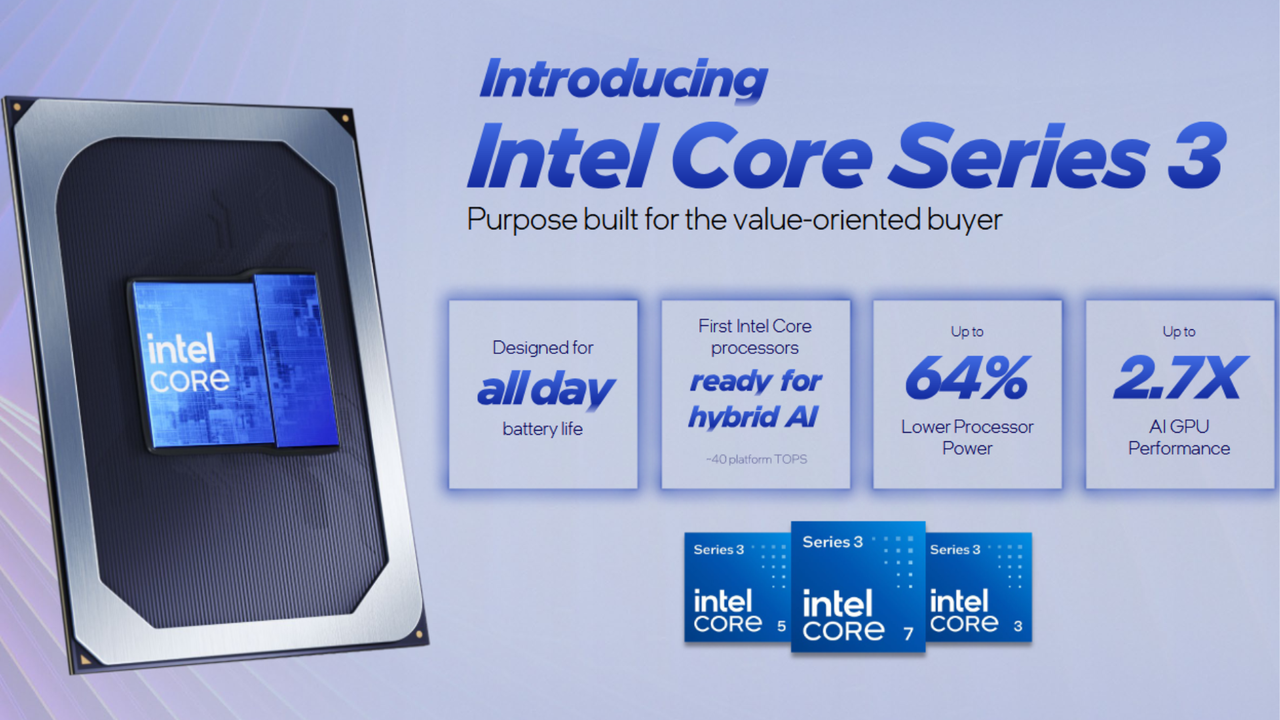
Intel has today launched its Core Series 3 mobile processors, confirming the official branding for the silicon tracked under the Wildcat Lake codename since late 2024.
The lineup covers six consumer SKUs plus an edge-only variant, all fabbed on Intel 18A, with more than 70 laptop designs scheduled from Acer, Asus, Dell, HP, Lenovo, MSI, Samsung, and others through the rest of 2026. Intel is positioning this family as the value-segment counterpart to Panther Lake, which shipped as Core Ultra Series 3 following its debut at CES in January.

Processor |
Cores/Threads |
P-core Turbo |
NPU TOPS |
GPU (Xe-cores / freq / TOPS) |
Core 7 360 |
6 |
4.8 GHz |
17 |
2 / 2.6 GHz / 21 |
Core 7 350 |
6 |
4.8 GHz |
17 |
2 / 2.6 GHz / 21 |
Core 5 330 |
6 |
4.6 GHz |
16 |
2 / 2.5 GHz / 20 |
Core 5 320 |
6 |
4.6 GHz |
16 |
2 / 2.5 GHz / 20 |
Core 5 315 |
6 |
4.4 GHz |
15 |
2 / 2.3 GHz / 18 |
Core 5 305 (edge only) |
6 |
4.3 GHz |
N/A |
1 / 2.3 GHz / 9 |
Core 3 304 |
5 |
4.3 GHz |
15 |
1 / 2.3 GHz / 9 |
The silicon uses a two-tile package with a compute die and an external platform controller tile. The compute die carries up to two Cougar Cove P-cores, four Darkmont low-power E-cores, an NPU 5 block, and an Xe3 integrated GPU with up to two Xe-cores, while the platform controller tile delivers six PCIe 4.0 lanes, up to two Thunderbolt 4 ports, Intel Wi-Fi 7 (R2), and Bluetooth Core 6.0.
Memory tops out at LPDDR5x-7467 or DDR5-6400 in a single-channel configuration, with a 4MB memory-side cache. That sits well short of Panther Lake's 4P+8E+4LPE top configuration with 12 Xe3 cores and dual-channel memory.
Intel describes the family as "hybrid AI-ready" with up to 40 platform TOPS. The NPU alone hits 17 TOPS on the Core 7 360 and 350, below the 40 TOPS Microsoft requires on the NPU for Copilot+ PC certification. Intel's performance figures compare the Core 7 360 to its previous-generation Core 7 150U on Raptor Lake Refresh, claiming up to 64% lower processor power during 4K YouTube streaming, up to 2.1 times faster productivity, and up to 2.7 times GPU AI performance.

For battery life, Intel claims the Core 7 350 inside a reference platform can achieve up to 9.6 hours of battery life in a Zoom call with AI effects, up to 12.5 hours in office apps as measured by Procyon, and up to 18.5 hours of video playback via Netflix streaming.

All seven parts share a 6MB L3 cache, single-channel memory support, and 15W/35W base/turbo power envelopes. The Core 3 304 ships with one P-core fused off, matching the pre-release sample that appeared last month. The Edge-only Core 5 305 eliminates the NPU entirely and reduces the GPU to a single Xe3 core.
Among the first shipping designs are the Ace Aspire Go 14/15/16, HP Omnibook 5 14-inch, and the MSI Modern 14S/16S. Asus Vivobook 14/15/17 systems are expected to follow at some point this quarter, with ExpertBook B3/B5/P3 models in the second half of the year. Lenovo (ThinkBook, ThinkPad E, IdeaPad Slim 3i/5i, IdeaCentre AIO 3i), Dell, Samsung's Galaxy Book 6, and Positivo are “coming soon,” per Intel.
Josh Newman, general manager and vice president of Consumer PC at Intel's Client Computing Group, said the family targets students, small businesses, and edge deployments on a typical five-year upgrade cycle, with Intel citing up to 47% higher single-thread performance versus a 2020-era Core i7-1185G7.