Formula 1 is constantly evolving and the Technical and Sporting Regulations that govern it are regularly changed to improve safety and keep the teams’ insatiable appetite for development in check.
The latest modifications for the 2022 season have been described as the biggest in ‘four decades’ with a radical new set of rules focused mainly on improving the show – despite last season being one of the most dramatic on record!
Winning in F1 is all about executing a highly tuned plan. The same applies to poker. See where your game plan can get you. Click here to start your game plan.
18+, New UK players only, min £10 deposit, Full T&Cs Apply, begambleaware.org, Play Responsibly
Why do F1 rules change?
The aim of any competitive sport is to win and to do that in F1 you need a car that goes faster that any other on the track. Teams spend hundreds of millions of pounds trying to do that – and the regulations keep changing to stop them.
In some cases, teams will find a ‘loophole’ – like Brawn GP famously did with the double diffuser that won them the World Championship in 2009 – and if this is deemed unfair or costly to replicate, it is often kicked out with a rule change.
Why not let the teams just go faster and faster? Well, the faster the cornering speeds get, and the faster top-speeds rise on the straights, the more dangerous an accident will become if anything goes wrong.
Changes can be made to circuit safety – like removing the old ridged sand traps that used to flip cars over and introducing safer barriers – but they can only go so far because of the limitations of the existing venues.
As a result, it is the cars and the engines that need to be limited every so often through regulation changes – effectively clipping the designers’ wings until they can learn how to fly again.

What were the first ever F1 rules?
When F1 was born in 1950, the official regulations, printed in a pullout in the original race programme, ran to just three pages and covered entry fees (£5 per car), technical regulations and prize money (£500 to the winner).
The technical specifications, point 5, stated that only ‘four wheeled racing cars conforming to International Formula 1 established by the CSI’ were permitted and went on to state just THREE specific rules:
- The cars had to be powered by a 1.5-litre supercharged engine or a 4.5-litre naturally aspirated one
- There had to be ‘some form of protection’ between the engine and driver’s seat to prevent ‘the passage of flame’
- Each car had to have ‘two reflector mirrors’ to give an ‘uninterrupted view of overtaking cars’.
And that was it.
The sporting rules, meanwhile, allowed just one pit stop for ‘replenishment’ and only three people could work on the car. There was no weight limit on the cars, and crash helmets were not even compulsory.
How have regulation changes altered the F1 format over the years?
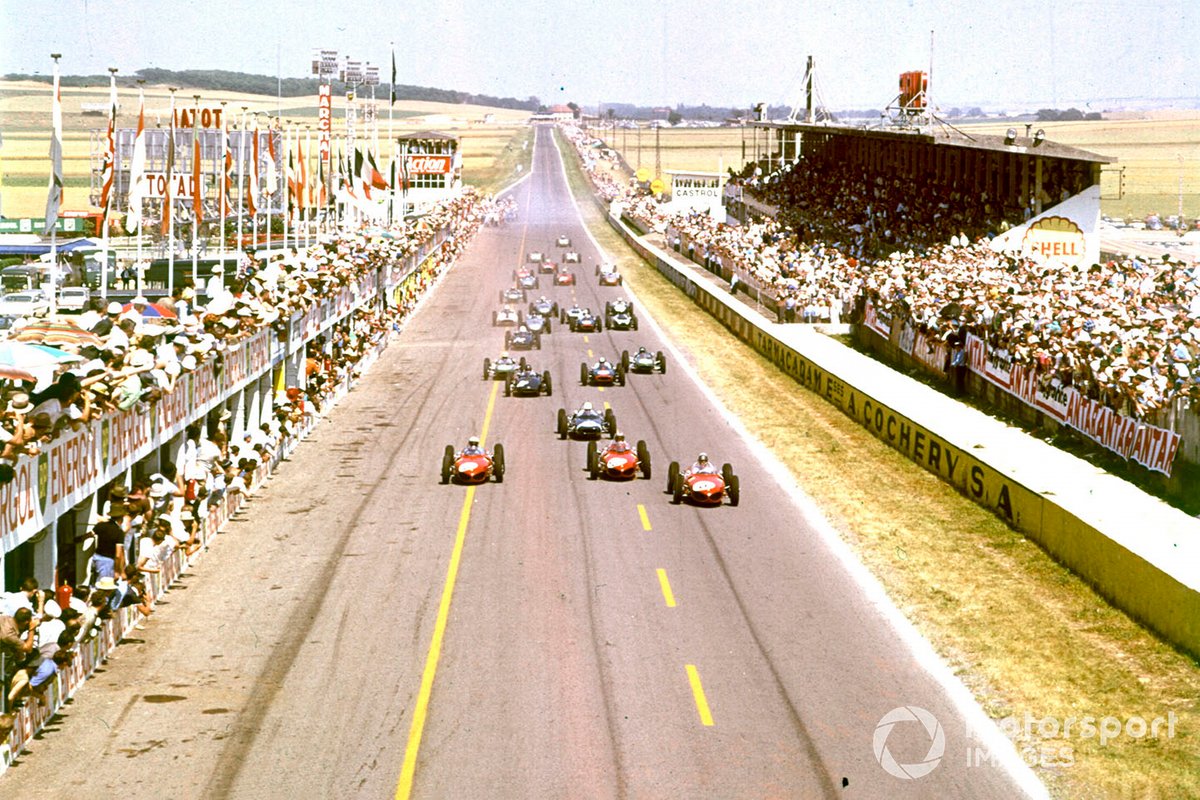
Not much for the first 20 years, but in the 1970s tracks became shorter, the familiar two-by-two starting grids (there used to be more cars per row) were introduced and races were limited to a maximum of 200 miles.
It was not until the 1980s, when all the different events were brought under the FOM banner run by Bernie Ecclestone, that the format became standardised and, by 1984, drivers had to have a ‘Super License’ to compete.
Qualifying
For almost 50 years, from 1950 to 1996, F1 qualifying always followed the same format: two sessions, one on Friday, one on Saturday, with the grid order decided on the fastest times across both sessions.
That changed in 1996, when qualifying was limited to Saturdays only and drivers were given 12 laps and one hour to set their best times. The format lasted for seven years, but was changed because teams spent too much time in the garages.
In 2003, in came one-lap qualifying, where drivers had a single lap, on their own, to set a time. This involved two sessions, the first run in championship order to set the starting position for the second, which would then decide the grid.
This format stayed for three years, with a few tweaks including aggregating the two session times, before the return to full-car qualifying and the introduction of the modern-day knockout format with its three mini-sessions.
In 2021, the rules changed again with the arrival of sprint qualifying for certain events. This sees traditional qualifying moved to Friday to decide the grid for Saturday’s 100km sprint, the finishing positions of which decide the race grid.
Points
The points system originally rewarded the top five with 8-6-4-3-2 points but this was extended to six in 1961, with the winner upped to nine points. That stood for 30 years, until the top prize rose to 10 points in 1991.
In 2003, the rewards were tightened at the top and extended to eight finishers in a 10-8-6-5-4-3-2-1 format then, in 2010, a radical change saw the current format introduced, with the top 10 scoring 25-18-15-12-10-8-6-4-2-1.
In 2019, a point was also added for the fastest lap in the race (if set by a top-10 finisher) and the introduction of ‘sprint qualifying’ in 2021 added an extra opportunity to score points, with the top three finishers earning 3-2-1.
How have the regulations on car design evolved since F1 began?
Regulations have been altered or introduced for many different reasons through the 70+ year history of F1, and this is a run-down of what changes were made when and why.
Safety first
The first major regulation changes in F1 came in the 1960s, with safety improvements including roll bars, quick evacuation cockpits, fire protection and extinguishers, helmets and overalls and the banning of straw bales as barriers.
In the 1970s, advances in aerodynamics, including ground effect cars, took speeds up another level and circuit safety came under scrutiny. Catch fencing was introduced (although a decade later it was deemed dangerous and banned).
Two key safety criteria that still exist today (albeit much evolved) were brought in that decade, with cars having to store fuel in ‘safety bladder’ cells and the drivers having to be able to extract themselves from the car in five seconds.
The 1980s saw ground effect banned and crash testing introduced, first in 1985 at the front of the car and three years later for the entire ‘survival cell’, which also had to be designed with the driver's feet behind the front wheel axle.
Despite these efforts, advances in engine technology had led cars to become faster still, with turbochargers creating huge power outputs. That led to kerbs and ultimately a ban on turbo engines by the end of the decade.

The Imola revolution
In the early 1990s, speed gains came by way of technology advances, such as active suspension and automatic gearboxes, creating a gulf between top teams and the rest of the grid. Much of this was banned for the 1994 season.
The tragic deaths of Roland Ratzenberger and Ayrton Senna at Imola that year – the first at a race weekend for more than a decade – lead to a major new drive in safety that has continued to this day.
Immediate changes focused on limiting aerodynamics to slow the cars down, lowering the rear wing, raising the front wing and adding the ‘plank’ beneath the car to raise the ride height and reduce the aerodynamic effect of the floor.
At the same time, safety improvements saw the addition of a headrest around the driver and additional crumple-zone crash structures, brought in over a period of years, to increase protection from high-speed impacts in all directions.
Tracks also had new regulations too, with a pit lane speed limit introduced and almost 30 corners identified as high risk and altered or eliminated. Many sand traps were also replaced by tarmac run-off to prevent cars lifting or rolling.
By the end of the decade, engine power had been reduced, cars narrowed and tyres given grooves to reduce the mechanical grip and therefore slow down the overall cornering speeds.
In the 2000s, the speed-sapping rule changes kept on coming, limiting rear diffusers and reducing engine power in the mid-2000s and eliminating ‘add-on’ aero devices and restricting wing performance in the late-2000s.
The FIA’s mission for safety improvements continued too, with the HANS (Head And Neck Safety) device introduced in 2003 and then most recently the Halo (named because it looks like an angel’s halo) in 2018.
Costs and sustainability
In the last 20 years, much of the regulatory focus has been on reducing costs, key to which has been the introduction of one-race then multi-race lifetimes for parts such as engines and gearboxes along with limitations on tyre usage.
As teams struggled for budgets during the late 2000s, one rule change even increased the size of the engine cover and rear wing end plates, just to give teams more advertising space!
The 2010s has also been about sustainability and improving entertainment, as F1 suffered an exodus of manufacturers and struggled to stay relevant to fans with increased distractions from global digitisation and social media.
The introduction of the KERS braking regeneration system in 2010 ticked both boxes, providing F1 with its first taste of electric power and using that power to give an acceleration boost that added uncertainty and strategy into racing.
A year later, the Drag Reduction System (DRS) added another ‘boost’ opportunity for drivers, balancing the effects of following in turbulent air by allowing cars within a second of the one in front to move a rear wing section and dump drag.
Around the same time, teams were getting bigger and becoming increasingly clever in finding loopholes. As a result, regulations were changed to eliminate advances like double and blown diffusers, F-ducts, ‘shark fin’ fed rear wings, flexi front wings, reactive ride, complex engine mapping and even helium air guns.
In 2014, the latest engine regulations were introduced, stipulating a 1.6-litre V6 turbo with integrated electric power from ERS-K (a far more effective version of KERS) and ERS-H and ever-increasing limits on the number of units per year.
Along with this, the latter part of the decade saw cars narrowed (back to what they were in 1998), tyre widths increased by around 20 per cent and wings simplified, in an effort to improve overtaking.

So what’s next for the 2020s and beyond?
This decade began with the introduction of a budget cap to cut costs further, along with the promise of a brand new set of regulations for a brand new generation of overtaking-friendly, sustainable F1 machines.
A radical new car
The 2022 cars – which were originally slated for 2021 before coronavirus hit – are designed with a focus on reducing the complex vortices that currently trail the cars and prevent others from following through corners, limiting overtaking.
According to research, the 2021 cars lost 35 per cent of their downforce within three car lengths of the car in front and almost 50 per cent in a single car length. The new rules claim to drop that to just four and 18 per cent respectively.
The main approach was to shift the aerodynamic focus from wings to the floor, and the new cars make use of full length underfloor tunnels that exploit ground effect to give the most efficient downforce and least disruptive wake.
During development, there were even trials to explore the effect of entirely eliminating front wings, but instead a completely new front wing shape that provides more consistent downforce was developed.
The rear wing is also designed to reduce the effect of dirty air, while covers are now required on the wheels to reduce the harmful unstable vortices created by flowing air through them.
The tyres have also changed dramatically – with low-profile 18-inch wheels designed to limit overheating and reduce the ‘bulging’ effect the current tyres have on airflow around the car, which causes instability.
Safety and sustainability have not stood still either, with 10 per cent of fuel now an ‘E10’ ethanol and a chassis that is longer, stronger, heavier (now 790kg) and required to pass even more stringent impact tests.
More sustainable engines
New engine regulations are slated for 2026 but not yet formed, although they are expected to have increased electrical output from a simplified hybrid power unit and to be run on 100 per cent sustainable fuels.
The electric element of F1 has already doubled from the original 60kW 80bhp KERS system to the current 120kW MGU-K format. The future plans currently estimate that will almost triple that to 350kW, equivalent to 470bhp.